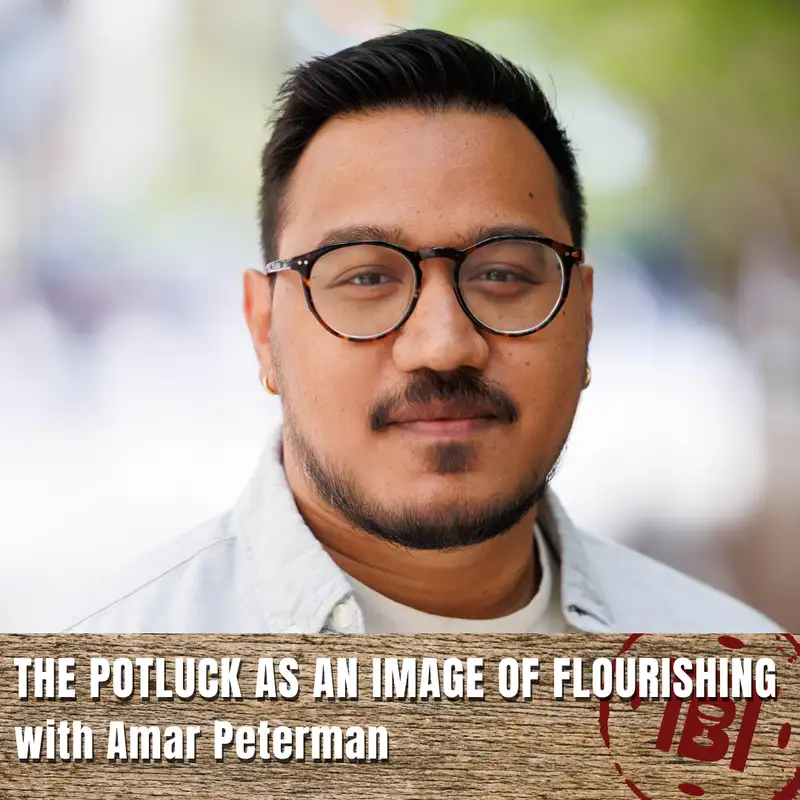
The Potluck as an Image of Flourishing with Amar Peterman
Episode 61 (Amar Peterman)
===
Andrew Camp: [00:00:00] Hello and welcome to another episode of The Biggest Table.
I am your host, Andrew Camp. In this podcast, we explore the table, food, eating, and hospitality as an arena for experiencing God's love and our love for one another.
And today I'm joined by Amar Peterman.
Amar is a constructive theologian working at the intersection of faith and public life. He is the founder of Scholarship for Religion and Society, LLC, and the former Assistant Director of Civic Networks at Interfaith America. He holds an M.Div. from Princeton Theological Seminary and is currently a PhD student at the University of Chicago's Divinity School. He is the author of the forthcoming book, Becoming Neighbors: the Common Good Made Local, published by Eerdmans.
His writing and research has been featured in Sojourner's Christianity Today, the Christian Century, the Fetzer Institute, the Berkeley Forum, and the Anxious Bench. He also publishes regularly on his substack, this Common Life.
So thanks for joining me today, Amara. I'm really excited to talk about to your, your forthcoming book.
Amar Peterman: Yeah, thanks for having me. Really [00:01:00] excited to be here.
Andrew Camp: Uh, so to begin with, I'm just curious, you know, for our listeners, when you say you're a constructive theologian, what does that mean and how is that differentiated between other types of theology we see, um, being published today?
Amar Peterman: Yeah, absolutely. I balance between going, saying I'm a public theologian and a constructive theologian, but the bend in, in both ways is trying to say that I want to say something generative and in its true sense, constructive about the Christian faith. Um, there are brilliant theologians and theologies that tinker with big ideas about God, um, that wrestle with other Christians about them and what they mean that go back to the original texts and engage with that. Um, I'm fascinated by those things, but what ultimately drives my work is engaging how Christian faith shows up on the ground.
And I want to help develop constructive theologies that help Christians do [00:02:00] that well. Um, and in my opinion, the way of doing that while looks like building a more loving generative, hospitable, um, faith that engages others, both within and beyond the Christian tradition.
Andrew Camp: Right. 'cause your book begins with this question of, can you imagine a world where we become neighbors to one another?
Right off the bat, many people will look at that sentence and say, no. Or like, even if we can't imagine or think we should imagine, we don't even know where to begin given the state of the world we live in. And so, like what gives you hope and an imagination to say that, Hey, this might be possible.
'cause you wrote a whole book on this idea and you, you know, you're constructing a paradigm for us to think through. And so what, what motivates you to think that this actually is possible?
Amar Peterman: Yeah, I mean, I think I, I bookend the book with this beginning of, can you Imagine? And then close the book with this vision of a [00:03:00] resurrected imagination.
And I think that's what gives me hope, uh, is that we see as Christians our common life in light of the resurrection of Christ, um, that the greatest impossibility of someone coming back, um, from death, uh. Can renew our souls and bring salvation to the world, uh, that that is possible. And if that's possible, then what is impossible.
And so to see with a resurrected imagination is to see the life that exists beyond death. And I think we see a lot of death in our current moment, uh, socially, politically, literally. People, um, are dying across the world. They're dying in, in the United States due to injustices and evils that are being perpetuated.
Uh. A resurrected imagination that gives us hope, sees a life beyond that present death. Um, I also think hope is a deeply embedded way of [00:04:00] living. It's certainly something that we hold onto, um, but our possession of it looks less like an object and more of a way of engaging the world. And so to engage the world hopefully, is something, is a discipline to be cultivated.
Um, and I think that has changed how I pursue the common good as well, and can see others as neighbors in this hopeful way that this is a, in one sense, a reality that we inhabit. The people who live across the street from me are positionally, uh, my neighbors. That's also something that we live into in the way that we engage and love one another.
Uh, the way that we pay attention to one another and a core piece of the book is to say that if we want to cultivate a common good, we have to actually know the people who live across from us, who engage in our neighborhoods, um, and to find something shared between us that can be good. And if we can't do that, then why are we presuming that there are these universal or national common goods?
Um, if we can't even find a good between [00:05:00] ourselves and our neighbor. And so the core call of the book is to walk across the street, knock on your neighbor's door, uh, and try to build a meaningful relationship with them. And that looks, we can get more into it. That looks very different depending on who your neighbors are.
And there's no single prescription of how that's done. Um, but I think the hopeful disposition is that we can see one another as neighbors, and that we can become neighbors to one another.
Andrew Camp: That's the, the idea, the hope and the love. Your guiding metaphor for your book is a potluck table, which, you know, resonated deeply with me.
Um, but I've never not heard people use the potluck table as, as a metaphor. And so what, what drew you to the potluck table and what's, what is it about a potluck that might guide how we think about being neighborly.
Amar Peterman: Yeah. Two things drew me to the potluck as an illustration. Um, the first is that I grew up in northeast Wisconsin and, [00:06:00] uh, we had potlucks and we had buoy, yas buoy as a, so a type of, uh, throw a bunch of things together, soup.
Okay. Um, and that I grew up going to plenty of those at neighbor's houses and church events, and everyone would just bring a dish to pass. And as a congregation, as a neighborhood, as a community, uh, you'd eat the most unlikely things next to one another. Mm-hmm. And that's because we, the neighborhoods that we lived in and the people that showed up, um, brought something that was meaningful to them.
And so you taste things differently when. If they're eaten alongside things they normally wouldn't be. Uh, the second is that, um, in my work at Interfaith America and in my own, um, education and scholarship, I've engaged both with, um, Eboo Patel and Danielle Allen. Um, and the two of them also use this illustration really heavily.
And so I've been deeply influenced by them. [00:07:00] Uh, they're both taking it in slightly different ways. Uh, Eboo especially is thinking of Interfaith America as a model of a plural, a pluralistic nation where people bring, um, the best of their different faith traditions and perspectives to, to the potluck. Um, and both of us set.
The illustration of a potluck against kind of the prototypical imagination of America as a melting pot. Um, and America as a melting pot has never made sense to me. I remember, I remember in my civics and social studies classes growing up, um, what is it? The, the Schoolhouse Rock, um, song, the, the Great American Melting Pot.
And you'd see this animation of all these specifically European immigrants jump into a melting pot. Uh, like that doesn't. That do, I don't think that would taste very good. Um, if we were all to throw our dishes into some homogenous, into a [00:08:00] pot to make some homogenous muck, uh, I think the beauty of a potluck is that we eat it.
We eat each dish on its own, but alongside one another. And in the illustration that I'm trying to present, there is this vision of asking people what they brought and why they brought it. Um, I think, and you can speak to this, I'm sure much more than I can that food, uh. The act of cooking and creating is deeply personal.
Yeah. Um, and often what we choose to bring to something like a potluck is tied to a story about ourselves and the people and the places that we come from. And so I think the potluck also is a metaphor in that this is exactly what we bring to the table. We don't bring our ideas and throw them all together and pretend it's the same or that we're all eating the same thing.
Um, instead we learn to enjoy and appreciate and even develop an acquired taste for things that are unfamiliar to us. And in the presence of new things, of [00:09:00] new dishes that don't often go alongside one another, we taste our own things anew.
Andrew Camp: Hmm. I love that. Uh, 'cause you mentioned too that in, in the potluck it positions the meal in a community owned space where all who gather are both host and guests, both givers and receivers.
You. So like the potluck is this, this leveling ground where everybody brings, um. What they can. And even if you can't bring something, you're welcome, um, to freely enjoy. And you have to trust that, you know, people will bring what is needed for, to round out a meal. And not everybody will bring dessert, or not everybody will bring a side dish, right.
But that there'll be enough to, you know, trust that there'll be enough at the table. And so, um, I love the potluck and I love that you also mentioned, hey, we're not asking you to sacrifice or give up your beliefs, but we're asking that those beliefs, wherever you come from, cultivate this shared imagination like you mentioned.
Yeah.
Amar Peterman: Yeah. I think too that, that point of. The potluck in a shared space [00:10:00] is significant to, especially to Christians who, uh, for many reasons might be the ones hosting. Yeah. Uh, churches might have the largest space compared to smaller religious communities. Um, Christians might have the networks to mobilize people in a specific way.
They may have their building in a place that, you know, has the biggest parking lot to, to, you know, to host everyone. Uh, but to have the potluck in a space that's owned by a community means that no one gets to take possession of it. Um, no one gets to say, this is mine. You're all my guests, which is often what Christians, even in the context of America, presume other people, other traditions to be mm-hmm.
Uh, is guests at their table. Um, and they don't often treat their guests in the most hospitable and kind ways. And so to consider what it would mean to gather across lines of difference means considering. Where's a place that has bus routes that can get to it? Mm-hmm. How are people going to show [00:11:00] up? As you mentioned, what happens if people can't afford to make a meal?
Are they still invited? How do we, you know, you can extend this illustration a million ways. How do you accommodate for dietary restrictions or religious restrictions, like something being kosher or halal? Um, yeah. These are all things that we think about when we're cultivating a potluck in a deeply hospitable way.
Andrew Camp: Well, yeah. 'cause there's, the questions are endless. And even one of the podcasts I did last year, food theology, they were asking these questions of how do we do a potluck in which it is radically inclusive? 'cause you know, often we just think, well, I'm just gonna cook what I like and worry about, you know, which is great.
Like, again, like you said, we bring our stories with our food. You know what? My grandma's recipe is deeply personal to me and your, you know, family history, your family recipes are deeply personal. And so we wanna bring those and honor those, but also think through what it means. Um, to share the space where people feel welcome.
You know, whether that is different dietary restrictions, you know, disability restrictions, like there's a host of [00:12:00] problems we need to think are not problems. A host of questions we need to think through, you know? 'cause you said that the common good is created, um, at a shared table where each person brings the best of their community, um, including beliefs, religious beliefs, traditions, food.
Um, and yet as I read that, I also thought of our current vice president who mentioned back in October that it is totally reasonable and acceptable for American citizens to look to their next door neighbors and say, I want to live next to people who I have something in common with. And yet you're pushing us mm-hmm.
To say no. Like we are at our best when we have this shared vision across culture, across religions. And so, like what, which, which is different than I think many Christians have framed the conversation. And so why? Why do you find hope in, you know, having this interfaith dialogue versus just hunkering down with other believers?
Amar Peterman: Yeah, I mean, I think it, [00:13:00] it ultimately is rooted in a deeply expansive vision of goodness that the good that God offers the world is not locked behind the doors of the Christian Church. Um, I think our God is too great and too unselfish to reserve goodness to a single group or to a single tradition. I think when we see across, across traditions across our country is that God's good work is showing up in many different ways.
Um, and it is a disadvantage. It is a. In my opinion, it is a worse way to live, to not see God showing up in communities that we would not expect, or that we think are beyond the fray of what could be included in goodness, um, or what could be good or who could be good. And so in my own experience, I mean, I see this in my work at Interfaith America, uh, as an organizer in Milwaukee, [00:14:00] as a PhD student at a divinity school that has people across many different traditions who I'm studying with, that there are wonderful, good, beautiful, true things that people are saying about the world and.
These are ways that they're showing up in the world. And if we, you know, put on our blinders and say it's, this is only Christianity, we only engage with Christians, we only show up to the table with other Christians, then, uh, we'll miss all of that. And in doing so, we'll miss God who is present at this table, um, where many people gather across lines of difference.
And I think that's part of this vision of the common good. That a common good that is only good for one group of people is not a common good. It's, uh, in its worst form. It's its tyranny. Um, and its Christian nationalism and its authoritarianism. Uh, a common good that is cultivated within the community is one that does not [00:15:00] try to seek a common good as if it exists, you know, beyond the stars.
And we need to build some sort of ideological spaceship to, uh. You know, send ourselves up and go grab it and bring it back and say, this is the common good. Instead it's built in communities. Uh, and that makes, that makes cultivating the common good, a deeply local project.
Andrew Camp: Right? 'cause again, to bring it back to the potluck thing, we trust that what we have at the table will nourish people.
Like, you know, that what everybody brings will have a nourishing effect for all people versus, you know, it's only my dish or it's only certain this, that, you know, can nourish people. But rather at a potluck, we see the, the breadth, the depth of, of the community's gifts versus just seeing what my table has, uh, to bring.
Yeah,
Amar Peterman: yeah, absolutely.
Andrew Camp: And, and you also bring then this idea, 'cause you were mentioning like, you know, we as Christians sometimes [00:16:00] want to use the table for something utilitarian, you know. But you differentiate, like, um, what is it, the means and the ends, you know, that, you know, we have to use the means for the right ends and not confuse them.
So can you ex, you know, explain this? 'cause I think it's a very subtle but important difference as we seek to cultivate the common good in our neighborhoods.
Amar Peterman: Yeah. Are you thinking of, uh, Augustine's use and enjoyment?
Andrew Camp: Yes. Yes. Sorry.
Amar Peterman: Yes.
Andrew Camp: Yeah,
Amar Peterman: yeah, yeah. No, absolutely. It is the, it is a similar framework as means and ends that Augustine says that, uh, God has given us things to use and things to enjoy.
Um, Augustine admittedly flip flops on this at times. He says, you know, the only, the only object worthy of our ultimate enjoyment is the Father, son, and Holy Spirit. Uh, and then other times he's, he includes our neighbors in that. Um, and I, I tend to take that. Reading [00:17:00] precisely because if we begin to see our neighbors as something that can only be used towards a greater love of God, then we're not treating our neighbors with the full dignity and humanity, um, that they deserve.
Uh, and then I think God, um, has bestowed upon all humans. And so to enjoy our neighbors is to see them as an end in themselves, uh, to see loving them as an ultimate good, not a greater good, leading to something beyond them. Um, of course as Christians we say, uh, we love our neighbors because God commands us to.
And so in loving our neighbors, we are also loving God. Um, but I think the mental shift to say, I love my neighbors, not because I'm obligated, I'm dragging my feet to love them because God tells me to, but instead saying, I love my neighbors because they are worthy of love, because God says that I should ultimately enjoy them in God.
Um, and so. That is a key way that we, that we show up to the table. [00:18:00] Um, Augustine uses this illustration of these exiles who are sojo back to their homeland. And on the way they become so enthralled by the devices that are carrying them home, uh, the ships, the carriages, this and that, that they forget.
Their ultimate end is to arrive back home to the place that, um. That they belong to. Uh, and I think that Christians do this with the table, that we become so enthralled with the table itself, that we forget the people who are at it. Um, that the ultimate thing that we are called to enjoy is our neighbors in God.
Uh, not the table itself. The table is the use. It doesn't mean we don't love the table. It doesn't mean we dismiss it, uh, but we see its place. And this goes back to you mentioned, uh, you know, our vice president. I had, I had written a piece in Sojourner Magazine about this, uh, the February, I believe after, um, he made the statement in the [00:19:00] fall and, uh, essentially say that he, he, the Trump administration, Christian Nationalists mistake, control as something that we should enjoy, rather as something that.
Rather than something, uh, we should use towards a greater enjoy enjoyment of God and neighbor. And so when we treat control, uh, which, which applies to the table as well, of dictating who shows up, what's spoken about, uh, what, you know, what food is served, we can continue that illustration. Um, we miss the point.
I think God wants us to use the control that we have towards a greater love not to see control, power, um, domination, all of those things as ends or as things to enjoy in themselves.
Andrew Camp: I love that 'cause um, it even makes me think back to like the Lord's table. 'cause you know, we have this grounding metaphor that we [00:20:00] celebrate weekly.
Um, depending on your tradition, like that should motivate us. But even the Lord's table is a. It is a use for greater enjoyment, not a, something we are like. So it, it's very different and subtle, but I think it's important 'cause we can love the table, whether that's our, our own table in our house or the Lord's table.
And forget that even the Lord's table propels me towards greater neighbor love and that, you know, I can use the Lord's table for control like we see in one Corinthians. Um, but the table functions best when it allows me to see my neighbor as, as a person created in the image of God and to, to enjoy them versus, you know, hey, this table is just for me, um, personally.
Yeah,
Amar Peterman: yeah, absolutely.
Andrew Camp: You also write about desire because I think, you know, in your influence, you know, James KA Smith writes your introduction or your preface for you, you know, and his work [00:21:00] all about desire, you know, is important because. As we seek to cultivate this common good, we, I know the right information, but no amount of right information is actually going to propel me to, to cultivate the common good unless my desire and my heart is formed there.
And so like how do we, how do we make this shift and how do we help cultivate desire for people who may be slow or anxious. You know? 'cause again, I, I, I hope I'm making sense. 'cause I think yeah. You know, your book is great, but no amount of information is going to actually propel me to actually cultivate the common good.
Amar Peterman: Yeah. No, I think that's exactly right. Uh, and yeah, I love Jamie Smith's work. Um, incredibly honored that he was willing to write the foreword for the book. Um, he yeah. Is is cited often across many of his different books. Yeah. Um, that have been really influential in how I've thought about everything [00:22:00] from pragmatism to heiddeger, to desire to build design and architecture, um, and the creation, the intentional creation of things.
Um, and so his name and his work shows up all across the book and obviously is in the first opening pages. I think desire is key because as you mentioned, we can't drag people to the table kicking and screaming, and we can't. Lay out any number of facts to get them there. Um, and I think, I think of, uh, Jared Stacey has a book called Reality and Ruins coming out shortly after, I believe, shortly after mine does.
Um, and his book is about American Evangelicalism and conspiracy theory, and he talks a lot about truth as well, um, and facts. And that to get someone out of a, you know, world of conspiracy calls it a totality, um, a whole encompassing way of seeing the world. Uh, that can't be done by simply giving them [00:23:00] the facts of, well, I don't think this is true, and I think this is what actually happened.
Um, where he and I, I think really align is that what matters is the stories that we tell about ourselves and the world around us that makes sense of our place in the world, who our neighbors are, um, how the world functions, and especially God's role in the world. And I think story and desire are deeply intertwined.
Hmm. And so to show up at the table rightly, to bring people to the table who may otherwise not want to show up requires relationship. It requires knowing others. And that's why, you know, there's no single prescription of how to love or how to know your neighbors because, uh, one, for some it might be dangerous to know your neighbors.
Um, and this book is in no way trying to call people into spaces where they could be harmed or hurt. Um. At the same time, it is a courageous call to say, um, [00:24:00] how are, how can we know our neighbors in a way that even being in proximity to them, and perhaps more importantly, uh, having them in proximity to us can shape or challenge the story that they're telling about us, about the world, about, um, about their neighbors.
And so I use, um, I mean, going back to Jamie Smith, I use, uh, Heidegger's concept of Thrownness um, often in the book. I think is this really rich, beautiful concept that he uses, um, that heider uses in being and time that names the true contingency, uh, of our being. That we think that we exist outside or above time, that we are uninfluenced by the world, that we have this sort of, uh.
Relentless autonomy and Heidegger's concept of Thrownness and Jamie Smith's elaboration on it as a [00:25:00] Christian really emphasized our contingency, um, and our ephemerality, that we are deeply shaped, molded formed by the people around us, um, by the language that we use, by the cultures that we are a part of by the liturgies and rhythms that guide our day that, uh, and so to.
Come to the table rightly, is to recognize our thrownness, to recognize that whether we like our neighbors or not, we are deeply formed by them. Um, and additionally that our faith, I mean I talk a lot about the nature of faith in the book as well. Um, that faith is not something that's stagnant, but it's something that's always dynamic and ever moving and ever being formed by those people and places around us.
Um, this gets into a lot of like what my academic scholarship is trying to do as well. That certainly finds its way into the book, especially in the footnotes. Um, but I think what brings us to the table is a desire to truly [00:26:00] love our neighbors. And as you mentioned, that is not. Often done through facts of, well, this Bible verse says to love your neighbors.
Um, which is true, and it should motivate us, right? Yes. Brightly. Uh, and at the same time, what will truly get us to cultivate a desire to love our neighbors is seeing them not as digital avatars, not as hashtags, not as news headlines, but as human beings who, who we share a neighborhood with, who we share a nation with, who we are intertwined and wrapped up in, um, that our flourishing is deeply tied to theirs.
Andrew Camp: For sure. 'cause that's, again, another part of the beauty of the table is the stories. We get to hear that at the table. You know, our neighbor stops becoming a hashtag or a clickbait or a, you know, headline just to, you know, rage against, but they become a story and in fleshed reality. That we can't control that, you know, like you said, the thrownness, that we are affected by them and they are affected by us [00:27:00] for good and for bad.
And so at the table we see each other differently in, in ways that I think few other places allow us to chance. Um, to do, especially if you ask, approach it with the holy curiosity of like, you know, if it's a potluck, why, what motivated you to make this dish? Why is this dish important to you? Yeah. What's the story?
Uh, 'cause like you said, you know, recipes have stories, you know, and they may tell of great celebrations or they may tell of great pain and sorrow. And to, to hear those stories at the table, we begin to see each other for, for who God wants them to be versus who we may want them to be.
Amar Peterman: Yeah. Yeah. And mentally it's, it's not easy No.
In any way. Um, and yeah, I think it's the work that we're called to. I think, um, you know, going back to Jared's book, Jared talks about how. It is easy to dismiss folks who seem to be so deep in conspiracy theories and these totalities as just [00:28:00] being crazy. Uh, and he rightly says, and I think, um, you know, my wife is a psychotherapist and she s says this as well in her own way.
She's like, I know there is a crazy that exists to dismiss someone who you disagree with or who might be wrapped up in these stories, these alternative stories, uh, of how the world works as crazy dismisses their humanity. Um, it is a much harder task to come to the table saying these people who I vehemently disagree with believe that they're doing something good for their community.
Uh, I have a hard time wrapping my head around that. I can't always make sense of it. Um, but. For me, having conservative family living in Wisconsin where they're, you know, uh, is a swing. You never know who you're going to meet or what positions or you know what yeah. Path people take. Uh, there's something deeply human about having [00:29:00] to sit with my family at Thanksgiving or Christmas or open presents, share words of gratitude about one another, while knowing that we disagree so much on these things that are truly life and death, that are truly affecting people in a meaningful way.
Uh, to engage in that very human work of sitting across from one another, um, I think drastically changes our perception of how we do this work. Um, in some ways it presents the most, uh, kind of arresting challenges and at the same time it can provide the most meaningful and longstanding hope too.
Andrew Camp: For sure.
'cause I think the table brings nuance. Um, it can bring color, uh, to, to us. Yeah. Obviously flavor. Again, you know, as we think about the potluck, it's such a rich metaphor, right? Like there's different flavors, and as you take a bite of this, it's a different flavor than that. Whereas our world wants to reduce everything to black and white.
Um, you know, and I'm just thinking we're [00:30:00] recording this, you know, beginning of January, you know, news just came out of the Venezuela ordeal and us, the US interfering. Mm-hmm. And as I looked at my social media that day, which is probably never a good thing to do, you know, but I have some friends who are from Venezuelan, you know, brothers and sisters in Christ who were, who were rejoicing in the, um, Venice Mada being out of power just because of what he had done to the country.
Whereas, you know, on the liberal side, everybody's decrying it. Right? And so I think. As we produce and work towards this common good like nuance in a world that doesn't want nuance. Like we have to get comfortable with nuance. Like I had to wrestle with, okay, is what's good and what's bad about this situation.
And maybe it's not all bad and all good, but is there, what's the nuance in this situation? I think again, the table helps us hear that nuance. 'cause again, we hear stories versus just facts.
Amar Peterman: Yeah, yeah. [00:31:00] No, I think that's exactly right. Uh, that headlines position us in a specific way, newsfeeds position us in a certain way, and it truly can, it almost feels so seamless and natural to just, you know, and there's also, you know, the algorithmic incentive of like, well, I, I can say something about this.
Yeah. Uh, and. Often those are voices that get elevated because social media doesn't enjoy nuance. Um, there's often not space for it. And so to take something, you know, like what is happening between America and Venezuela, uh, and to instead have the patience to hear many sides will also holding firm to conviction and, uh, values and virtue and beliefs.
Uh, not in any way saying to like, sit in our hands and do nothing. Right. Um, well, at the same time, uh. Positioning ourselves to be prepared with [00:32:00] a broader context. Um, and as you mentioned, the relationships that bring these events to life, that they're not just a news headline, uh, it's not just something that we see blips of and then it'll be gone, you know, in a handful of weeks.
And, but instead being in relationship with folks mm-hmm. That can speak to what is happening, what it means from many in a often nuanced, far more nuanced ways than we like to make space for. Um, and that is all the work of cultivating. You have to have the knowledge prior to be able to do that. You have to have cultivated the relations to relationships to do that.
Um, which is why this work is, um, as I mentioned, is a way of being in the world. Um, not these singular moments that we pick up when it's convenient, um, to do so.
Andrew Camp: Now, when you mentioned, um, you know, in your. Chapter on the practices of neighbor love. You start with compassion and that like, we can't decry injustice from afar, but that, you know, the [00:33:00] Parable of the Good Samaritan, which most Christians know and can tell the whole story about, you know mm-hmm.
Asks us to get our hands dirty, you know, with the people versus, you know, it's easy to decry just injustice from afar. Um, it's much harder task to, okay, what does it mean to work for the common good in my neighborhood? What does it mean to work for food security for all in my community? And what are the challenges Flagstaff faces versus Milwaukee are, you know, the, um, you know, and so, yeah, I think, you know, all those issues are important and that's where it gets tricky.
Like you said, you can't prescribe a one way for this, but there are virtues we can cultivate our habits or postures, whatever words you wanna use. And so what, where, what habits are postures, as you know, would you want. For followers of Jesus to cultivate as they think about producing the common good.
Amar Peterman: Yeah, I mentioned several in the book, and there's some, as you mentioned, that are, [00:34:00] uh, which you would expect, which are like, um, compassion and humility. Uh, and these are, you know, practices that are tried and true throughout the Christian tradition. Um, you know, I, with that chapter, wanted to engage also some new ways or some new, provide some new language for thinking about things that we have done for a long time.
Um, and it's also the challenge of, you know, as you mentioned, everyone has heard too many sermons on the Good Samaritan. Yeah. Um, and so I didn't want to, you know, spend my time rehashing all of those. Uh, although it's, it's a rich illustration and I provide, you know, kind of three brief, um, takeaways. One you mentioned is that, uh.
Christians are called to mend the injustices, even the ones to mend injustice, even the ones that we didn't perpetuate, um, that the Samaritan was not the one who robbed, uh, or beat the man on the side of the road and yet [00:35:00] saw it as, uh, a holy and sacred task to care for him. Um, and then I also mentioned in the book.
If you know anything about the parable is that the Jewish community and the Samaritans were enemies. Yeah. Uh, and so neighbor love is often enemy love. Mm-hmm. Um, and even considers what it would mean in this Jesus talking to a Jew, a Jewish audience, talking to a scholar of, uh, the Jewish law, um, to position the Samaritan as the protagonist, requires his audience to think, could my enemy be capable of love?
Um, this goes back to what we were talking about of the difficulty of imagining or trying to wrap our minds around those who disagree with us. Also believing that they're pursuing some sort of good for their community. Um, and they're not just crazy. They're not just insane. They're not, uh, wholly mean-spirited and [00:36:00] trying to do the most evil and heinous things.
Uh. Those people exist, but they are not, you know, I, I don't believe that they are everyone. Um, and so the call of, you know, this parable is to say, can we come to imagine that even our enemies might be capable of love? Um, and then the last is that love of neighbors, often love of stranger, um, which has many implications for our world today.
Um. What does it mean to welcome the stranger and the foreigner? Uh, how do we care for them? Um, at what expense do we do, we do. So, um, and so I to I touch on those things and then humility, as you mentioned, we get into Heider's, thrownness and a con, you know, contingency and our ephemerality, uh, Christ incarnation that mm-hmm.
The God who we might say is the ultimate thrower, the one who sets in motion, cause and effect, uh, enters into the ripples of that very action. Yeah. Um, and is put to death for [00:37:00] it. Um, and does so willingly for the sake of others. Um, so goodness might be given to us. Uh, but then I also engage some, uh, I suppose less traditional language.
Um, I talk about translation in that. Um, it is, uh, George Beck, uh, talks about Christianity as a language in, um. One of his books. In that often, uh, Christians are tasked with helping provide language to describe the world around us as being filled with God's glory, um, and God's active work. Uh, I also talk about resonance, which is, uh, Hartmut Rosa has a very lengthy book about, um, that's, that's really, really wonderful.
Yeah. Uh, but talks about what does it mean to be in tune, to resonate with the world and with our neighbors and sets, sets resonance against, uh, a concept of alienation where we seemingly speak out into [00:38:00] the world and nothing comes back. Mm-hmm. Um, it's sort a, sort of loneliness and antagonism to the world.
And so I say that resonance is a practice of neighbor love. As we join. Come into tune with our neighbors. Um, and that can be in shouts of joy or in pain and lament. It can be cries of protest, uh, and it can be declarations of peace. Um, and so I talk about resonance and then, um, I added in the practices of lament, which is also a, a somewhat typical one, but often isn't associated with neighbor love.
Um, and then the last is, uh, accompaniment, which is described by Paul Farmer, um, who I was reading, um, his, uh, biography by Jenny Block and just. That was from a friend of mine who had said, like, you, if you haven't heard of Paul Farmer, you should pick up a pick up this book. And so I did as I was, uh, towards [00:39:00] the end of writing and was like, I have to include something about Paul Farmer in this.
Okay. Um, and he brings up this practice of accompaniment, uh, as a medical professional. Um, he, uh, his, his biography is worth reading, okay. In, its in its full account, but essentially grows up, does a small trip to Haiti and sees, uh. A lot of the medical injustices taking place there, um, and says, we can, we should do something about this.
And the medical community is like, it's impossible. We can't do anything about this. It's too destitute, it's too much poverty. Hidden within that, maybe not so hidden within that is a view of the Haitian people as lesser as not worthy of our time and attention to care for. Um, and Paul Farmer ends up going to Harvard Medical School, but on the weekends is traveling to Haiti [00:40:00] with the medical equipment he got from the school to treat people in Haiti, uh, and ultimately builds a state-of-the-art hospital there to treat people and becomes a national figure.
He founds partner partners in health, which then expands this work into. Many other parts of the world. Um, but along the way, farmer meets Gustavo Gutierrez, the liberation theologian, and is captivated by his work, and they build a relationship with one, with one another. They end up writing a book together.
Uh, and Gutierrez question is, how do we show. God's deep and unwavering love for the marginalized, for the poor, for the oppressed, for the downtrodden, um, and develops this concept of a preferential option for the poor, that God sides with those in these positions. And we see that throughout scripture. Um, Paul Farmer then takes that and develops this practice of accompaniment, um, which is tied [00:41:00] to the word, uh, you know, the word companion.
Yeah. That his, he believed that his task as a healer, as a medical professional, as the founder of part or co-founder of Partners in Health, um, was not only to treat people's sickness, but to accompany them on their journey. Um, not in a short period of time of I'm here while you're being treated, and then you go on your way, but you are a person filled with, uh, dignity and respect, worthy of respect and love, and the deepest forms of care and.
He says, I will join you, you know, on your journey. I will become your companion. Um, and so we see, you know, in his life that he's not just staying at this hospital, but he's traveling across Haiti and visiting his patients. He's building relationships with them and their families. And this is a long way of saying like, this is an example of how we love and care for our neighbors.
Um, to accompany them is not to see them in a single moment or a single event, you know, and say, [00:42:00] we've done our job. It is instead to say, we build a life together as neighbors, as a community, um, as those who are called to love one another. And we become companions, um, on, uh, especially for Christians. I love the First Nations translation of the Kingdom of God is God's good road, uh, or creator's Good road.
And I think that tied with what Farmer is saying is that we become companions on God's good road, um, as we are seeking, um. God's will to be done on earth as it is in heaven. Uh, we don't do this in singular moments, but we do this as a way of being with and for one another.
Andrew Camp: I love that idea of accompaniment.
Just 'cause I think, like you said, it is this journey we are on with people that, um, it's easy to go and see people as a project quickly, you know, you know, we did our duty, you know, we can wash our hands. Hey, I did my good deed. Mm-hmm. But what does it mean to then, you know, as we [00:43:00] seek this common good, um, in our neighborhood, in our city, like it's, it's a long, hard, arduous path at times.
You know? 'cause we are working against systems of, of oppression or systems of injustice. Um, you know, we're dealing with bureaucracy, you know, the, the host of problems is, is numerous. But to, to commit and to say, Hey, I'm going to be on this journey, uh, for a while. Uh mm-hmm. Is, is a long Yeah. Like, it, it, it's weighty and I think we should feel that, that weight.
Amar Peterman: Yeah. Yeah.
Andrew Camp: Uh, and I'm curious too, 'cause this words have been floating around my head in, in this new year. I don't know why. Um, but the word joy has come up for me a few times. Um, and you don't specifically or maybe explicitly talk about joy in your book. Um, but I think it underlies, um, and I've just seen it come up in a few other books.
Like I was reading this dialogue, it's called A Taste for Change, but it's between Gail Gerard, who's a French priest, economist, and [00:44:00] then Carlos Carlos Petrini, who's the founder of the Slow Food Movement. Um, and it's their talk about food systems and communities. Really wonderful book. But Carlo, I just wanna read this quote 'cause this is where it got me thinking.
Carlo is talking about spirituality and he's agnostic and owns it, um, in the book, but he says, we cannot change the world with a heavy heart. It is as essential to face this moment with joy. Because initiating the transformation and seeing that new behaviors make us freer and more di decisive is a considerable element. This is why the question concerns not only believers or un non-believers, but everyone, the path we must follow is one of sharing and defending the gift given to us by our fathers.
Um, and so joy is this underlying theme throughout scripture, and we're told to be joyful, but so what does Joy, how does joy factor into this moment as we face this daunting task of, you know, pursuing the [00:45:00] common good?
Amar Peterman: Yeah, I mean, I think joy and hope become deeply intertwined, uh, as disciplines. Um, I think, you know, there's. Kind of the typical distinction between happiness as something that's temporal and joy, right? Is something that is more lasting. Um, I think there, I have not read up on, you know, the etymologies or the scholarship behind that.
Um, but taking joy as being the latter, I think is meaningful. Um, whether or not the etymology is, is, uh, relevant, right? Um, I think the idea of cultivating joy, uh, even a mist, despair, uh, is a deeply Christian practice. Uh, I think too that there, this ties back to a resurrected imagination, um, to see life beyond death.
Uh. Allows us to be joy, joyful people. Um, [00:46:00] 'cause as you mentioned, for all you know, the array of injustices and wrongdoings that we experience, that we see, that we are flooded with, uh, each and every day. To have a prevailing joy, I think is something that is incredibly rare, um, but also incredibly compelling.
And so if the people cultivating the common good are a joyful people, I think more people will want to know, uh, their desire may be cultivated to join others at the table as well. Um, and so. I think there, there's a balance to it. 'cause there's also, you know, I grew up in American Evangelicalism. Uh, joy is also something that I've seen, you know, feigned in many ways.
Yeah. That there's almost like this, you know, Christians there, there's a way to read this as like a happy go lucky. Like, nothing's ever gonna get us down. Like, there's always joy. Like resurrection comes at the end and they're [00:47:00] almo. You know, there are these platitudes where we don't reckon with the realities of our world, we just press on.
Mm-hmm. Uh, I remember it was a such a small encounter, but a memorable one. In Bible college, there was a student who came from a missionary family and was just like seemingly the most happy, you know, joy, spirit-filled person that you could imagine. And he's like, I never cry, I never lament because Christ is resurrected.
Uh, and even as like a young Bible college student, it's like something. Something doesn't feel right about that. Um, you know, if we want to use Heidegger's language, something doesn't feel authentic about that. Yeah. Um, this isn't how we are designed, uh, or created or meant to be. Mm-hmm. Um, which is why Lament is a practice of neighbor love.
Um, so I think true hard earned joy is deeply compelling when it involves reckoning with the [00:48:00] realities of death and destruction of our world. And yet that joy persists. Um, and I think for the Christian it ought to. Um, and I think for the Christian, we have grounds to hope to persist, enjoy, even amid all of the things happening in our world.
Andrew Camp: No, and like you said, it comes back to that resurrected imagination that like. You know, as you mentioned, death does not work against life. It works toward new life. Um, and you and I have both been influenced by Norman Wirzba. Mm-hmm. Um, you know, and his idea, like his writing on the soil is what helped me understand like, oh, like underground beneath what we just see as dirt or just inert matter is this living, breathing, teaming with life.
Um, you know, organism that as things are decaying, life is working in conjunction with death, um, to, to produce something new and beautiful. And you even last chapter, you talk about compost and the slow [00:49:00] work of, you know, that idea and gardening and that, you know, again, a good garden is one that is cultivated over a long time and not quick with pellets and mm-hmm.
Synthesized fertilizer. And so like. That always comes back to me as I, as I think about resurrected imagination, like thinking about the soil and what is teaming underneath the soil, um, and producing something, um, gives me, enlivens my imagination at times.
Amar Peterman: Yeah, no, absolutely. I laugh. I had a, um, a review of the book come out that said I, I overextend some of my illustrations and they, they used the example of compost as the reason for this.
And they quote like, uh, they put new life in quotes. And my friend Lauren, who I cite in the book, who's an accomplished ecologist and also a theologian who I met in bible college, um, sent me a picture of it. It was like. They know it, it actually is new life. Like this is [00:50:00] life that is happening. It's biological life.
It is not, you know, as you mentioned, it's not the chemical or artificial construction of pellets and Right. Uh, things like that. It is actual, you know, and as Wirzba talks about, like the activity microscopically, uh, happening beneath our feet, um, is profound and deep. Should be deeply moving. Um, as you recognize.
The weight and the breadth of God's good creation. Um, and through practices like composting, um, putting our hands in the dirt, tending to a garden, um, we get a small taste of what that looks like. Um, yeah. And get to, in a, I think a deeply, uh, satisfying way be, reap the harvest, the, the literal harvest of that work.
Mm-hmm. Um, as you put seeds in the ground and tend to a garden and then see new life arise, uh, and then for some [00:51:00] plants, you know, trim them back, uh, in the winter and see them grow again. Uh, I think is, yeah, these cycles of life and death. Uh, and new life is something that farmers and gardeners, uh. Are deeply attuned to and something that we should be as well.
Andrew Camp: Right. I, there's always a funny story that I think of when I think of composting. 'cause when we had started a garden, this was when we were living in Utah, we composted some Halloween pumpkins and then used the compost in our garden. And all of a sudden we see shoots coming out of the ground and we're like, what are these?
And pretty soon we have pumpkins growing and that we did not plant, or we did not mm-hmm. Expect or anticipate. But we had, you know, we never got, we didn't get big pumpkins. We had little small pumpkins that our girls loved, you know, and thought they were awesome. And we were like surprised by what emerged from our compost in unanticipated ways because we simply just decided to compost.
Um, but I think, you know, that is the beauty of compost is sometimes you are surprised, you know. [00:52:00] New life emerges where you weren't expecting it. Um, you know, it's not something we planted, it's not something we planned for or even like tried to cultivate these pumpkins just showed up. Um, you know, obviously not by accident fully, but like it was, yeah.
It's just a weird, one of those weird stories where we're like, oh yeah, remember when we composted pumpkins and we grew pumpkins by mistake?
Amar Peterman: Yeah. Yeah.
Andrew Camp: But I think it does illustrate that, you know, we are, you know, we, we do what we can, right? We, you know, as we cultivate the common good, we do what we can and we will still be surprised, you know, we can't control the results.
Um, you know, we, the thrownness of creation is still there. Um, but Jesus will surprise us, um, if, if we're faithful.
Amar Peterman: Yeah, yeah, yeah. Absolutely. I think. I think that's exactly right. Uh, that we're not tasked with controlling the result or creating some linear path to, um, a specific desired end. Mm-hmm. Um, and this is, you [00:53:00] know, I, I mean, I write the book as a Christian, and yet the, a focus of the common good isn't conversion.
Right. Um, and the purpose of the table isn't to have a microphone or a platform to, you know, tell others the gospel. It's to create, to build, um, spaces of mutual shared flourishing where we can show up in the fullness of ourselves and our own beliefs. Uh, and that's ties back to this, you know, you'll be surprised by what you find.
Mm-hmm. When you're willing to lay down, uh, you know, your apologetic tactics and just encounter others as people. Um, and then I believe that. I believe in the Christian Gospel, I believe, uh, in the proclamations of the Christian faith. And I believe that they're deeply compelling and that, and that there's something unique about them.
And that if I show up as best as I can in the fullness of my Christian tradition, uh, [00:54:00] people will find that compelling. Um, not find me compelling, but find the persistence of joy. The ability to lament, uh, the desire to know and love my neighbors, um, is something that piques a question of what might motivate, what might inspire me to live in such a way.
Uh, and so I think, yeah, I think the. The unexpected pumpkins that we will find at the, you know, at the table are numerous. Um, if we're willing to not meticulously try to predetermine or create a single result out of that experience, but instead let it, you know, do our slow work of composting. Mm-hmm. Um, and see what arises from it.
Andrew Camp: Yeah. Because as you mentioned about the incarnation too, that Jesus enters as an, with intimacy, not wanting to control the chaos, but rather to be thrown by it, you know, to taste. Mm-hmm. To smell, to feel, to hear creation, you know, this [00:55:00] creation that he created, you know, he wants to intimately be, um, affected by it in ways that are beautiful and that should propel us, or should compel us, uh, to live with a similar posture.
Amar Peterman: Yeah. Yeah.
Andrew Camp: And so as we wrap up, it's a question I ask all of my guests, what's the story you want the church to tell?
Amar Peterman: That's a great question.
I mean, in, I can't help but bring my, my evangelical roots out. Uh, yeah. They're prevalent. They're used in very different ways than I think my evangelical counterparts would like me to use them. Uh, but I think the story that I want the church to tell is one of deep radical and unwavering love for God and neighbor.
Um, a story that speaks of God [00:56:00] desiring a body, desiring to dwell with creation. Um, not to, as you, you know, quoted not to possess, not to control, uh, not to manipulate creation, but instead to be a part of it. And theologians speak of, you know, the. Christ incarnation does not merit anything in and for Christ himself.
Uh, Christ has everything that he needs, um, and yet chooses to come to dwell with his creation. Um, and why does he do that? Uh, why does God desire a body? Why does God experience the weight of and complexity and, uh, devastation and confusion of humanity? Uh, I say it's to give it all away that God comes to us so that goodness [00:57:00] might be ours as well.
Um, and that's, I think, the story that we tell of radical selflessness of, uh, dispossession of community, of mutual care. Um. And within all of that of liberation, um, and flourishing for all people. Um, so I think at the core of it, it's, I want the church to tell a story of deep and radical, um, neighbor love.
Andrew Camp: I love it. Um, yeah. And as you said, it's to give it away. Like as we build, it's not for profit. It's not for bigger kingdoms, bigger churches. It is for giving it away so that all may flourish. Yeah.
Amar Peterman: Yeah.
Andrew Camp: And, and some fun questions, um, about food then to wrap up. Yeah. What's one food you refuse to eat?
Amar Peterman: Oh, gee, I.
Refuse to eat, uh, tofu [00:58:00] mostly because I think there are better alter, I think there are better meats that I will like, yeah. That I will enjoy. And also Tofus never agreed with me and so I refuse to eat it in part because I don't want to bear the consequences. And also in part, uh, because I think there's, uh, I think there's better, better proteins to enjoy for sure.
Andrew Camp: That's fair. Um, what's one of the best things you've ever eaten?
Amar Peterman: Oh, the best things I've ever eaten. She'll probably never hear this, but a coworker of mine, um, who works in the finance department at Interfaith America, um, we do, as you'd imagine, a potluck every Thanksgiving. Um, and because we're a really diverse and multicultural staff, like it's living out a lot of kind of this illustration.
Yeah. Um, but her name's Nadia and she brings the most incredible biryani in this AMAs little crockpot. And [00:59:00] if you're not, the staff used to be, you know, 35, 40 people and we could all get a scoop. Now it's upwards of 80 some people, and if you're not first in line, that biryani is gone, uh, with within the first few people, I'm sure.
Um, but that is easily, I mean, yeah, it, I mean, it tells a story of her own immigration to the United States, uh, her, um, her Muslim faith. Um, and for me that. It's deeply grounding as well to have something familiar. Yeah. Um, as a biryani, uh, to eat, emit all these other foods. But, uh, I remember people hyping it up, uh, the first time I tried it and then going, it's, I mean, it's probably good, but it's like, it's a biryani that's a, you know, it's a work function.
Um, and was just blown away by how wonderful it was.
Andrew Camp: Oh, I love that. Um, yeah. A good biryani, that's one, it takes a ton of time to [01:00:00] do. Um, but the spices, the blending of spices that Yeah. Um, yeah. Wholeheartedly agree.
Amar Peterman: Yeah.
Andrew Camp: Um, and finally, there's a conversation among chefs about last meals, as in, if you knew you only had one more meal left to enjoy, what would it be?
So if Amar had one last meal, what might be around his table?
Amar Peterman: Hmm. Uh, there are. Little thing. There are a few things that bring me more comfort than a really warm and soft, uh, biryani not biryani, uh, butter chicken.
Andrew Camp: Okay.
Amar Peterman: Uh, it's like the, the cliche of, you know, like I live in Wisconsin, I'm sure the Indian restaurants I often, you know, frequent, are tired of making butter chicken for all of their, their primary clientele.
Yeah. Uh, I absolutely love like a good [01:01:00] traditional authentic butter chicken. And if I were near death and I had one, had one meal left, um, I think what would bring me absolutely the most comfort is just like a good, uh, like warms your whole body, uh, butter chicken.
Andrew Camp: That's awesome. Uh, it's funny you mentioned butter chicken.
'cause tonight I we're make, I'm making butter chicken. Joash Thomas, who endorsed your book Yes. Sent me his recipe for butter chicken. And so I was like, oh, you know, I have a fairly light day of work. And so I'm like, I'm gonna make Joash's butter chicken tonight. So
Amar Peterman: Amazing. Amazing.
Andrew Camp: Yeah. Yeah. So I'm excited to see, you know, how it goes.
Amar Peterman: Yeah.
Andrew Camp: Um, well Amar, I've really appreciated this time. Um, and if people are interested in learning about your work, where can they find you?
Amar Peterman: Yeah, I'm on all of the big social media. I'm most active on Instagram, uh, and trying to get on TikTok. I don't, I'm, I'm old enough that I don't quite know how it [01:02:00] works.
Mm-hmm. But I'm giving it my best shot. Okay. Uh, and then I also have a substack, um, called this Common Life, um, that I publish fairly regularly on.
Andrew Camp: Yep. And your book is coming out in March, what's the exact date?
Amar Peterman: March 12th.
Andrew Camp: March 12th. Yep. So pre-order the book, get it so that you know it's delivered wherever you get your books.
Um, it's a great book. I think it's a book the church needs to wrestle with this year, um, as we think through what, how we approach this common life in our neighborhoods.
If you've enjoyed this episode, please consider subscribing, leaving a review or sharing it with others. Thanks for joining us on this episode of the Biggest Table, where we explore what it means to be transformed by God's love around the table and through food.
Until next time, bye.