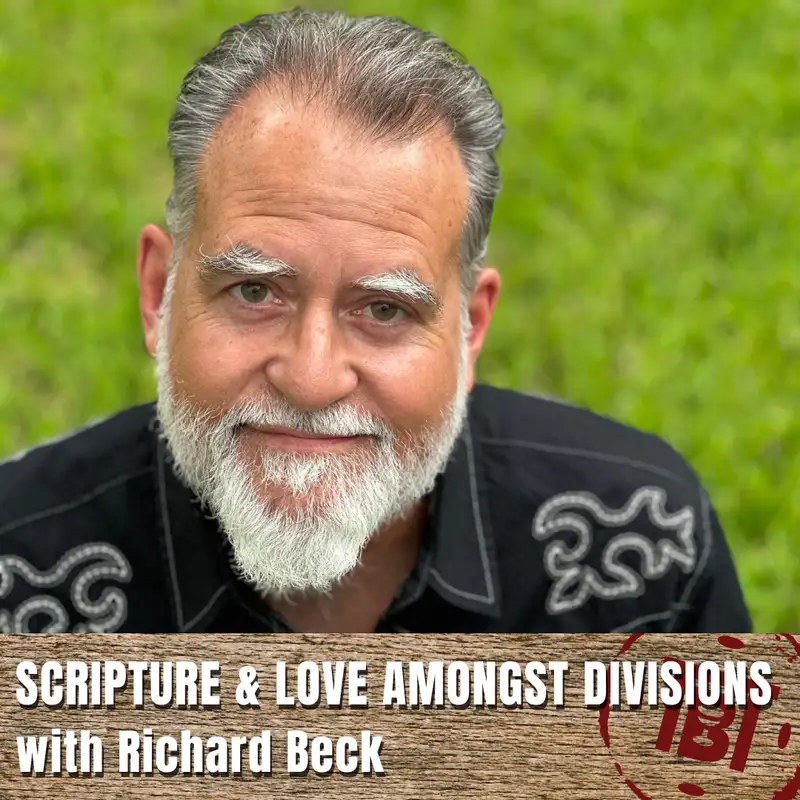
Scripture & Love among Divisions with Richard Beck
Episode 72 (Richard Beck)
===
[00:00:00]
Reading Scripture as Love
---
Andrew Camp: Hello, and welcome to another episode of The Biggest Table. I am your host, Andrew Camp. In this podcast, we explore the table, food, eating, and hospitality as an arena for experiencing God's love and our love for one another.
And today, I'm thrilled to welcome back Richard Beck.
Richard is a professor in the Department of Psychology at Abilene Christian University and is the senior fellow of the Sanders Center for Joy and Human Flourishing. He also teaches in the Doctor of Ministry programs at [00:01:00] Fuller Theological Seminary and Abilene Christian University. He is the author of a number of books, most recently The Book of Love and The Shape of Joy. He also serves as a prison chaplain at the maximum security French Robertson Unit and has written and spoken extensively about his experiences working among the incarcerated.
So thanks for joining me today, Richard. Always love connecting with you and talking with you about what you're studying and learning and growing, and so.
Richard Beck: Yeah, yeah. Thank you, Andrew. I'm excited to be back. Yeah, excited to talk about the book.
Andrew Camp: Yeah. So your most recent book is about how to read the Bible, and it is really framed, um, and formed a lot by your journey.
Um, and so what, what has been your journey in how you read and interpret this book that is so central to, to who we are?
Richard Beck: Yeah, yeah. Well, I, I think it, uh, part, part of the journey, um, I tell the first part of the book, um, with a sermon I preached when I was in college. And I grew up in the churches of Christ, and so [00:02:00] for listeners that aren't familiar with that tradition, historically, um, our tradition has been pretty, um, conservative, fundamentalist, um, sectarian in the way we read scripture.
And, and so that first sermon that I describe in the book in college, uh, was kind of I guess we would now, we didn't have a word for it back then, but would've been my first kind of public attempts to deconstruct a little bit, to kind of- Hmm ... think through what it might mean to read the Bible through the lens not of sectarianism or fundamentalism or biblical literalism, but through a hermeneutic of, of love, an interpretive strategy of putting love at the center of the way we read scripture.
And, um, so that's the first part of the journey. And that was many decades, but, but over the last, I'd say maybe 10, 15 years, spending time in more of the progressive or liberal spaces where reading the Bible as a book of love or through a hermeneutical lens of love is pretty obvious, that I've also [00:03:00] realized that there were some issues on that side of the, the divide, where I felt like progressives needed other strategies of reading the Bible, uh, as a book of love as well.
So the book is an... So that's a little bit my journey, kind of a- Yeah ... se- season of deconstruction, and then maybe a little bit of reconstruction, finding myself in between these very partisan and polarized ways of reading scripture, and trying to say something generatively and generously for both sides.
So it's an attempt to kind of I, I'm not... It's not a third way, it's just naming w- places where I think on both the left and the right w- there's a better way to read the scripture, um, as a book of love. So it's, it's probably a book that's not gonna please anybody because it's gonna, you know, w- for, you know, for every chapter you like, there's gonna be a chapter that you're not gonna like.
So I think I'm gonna be inundated with, like, four-star reviews on Amazon because everybody's gonna, like, pull a star for the p- parts of the book that, that don't [00:04:00] quite fit the echo chamber wherever they're, they're coming from. But I do think that's the novelty of the book- Right ... that the, that the book, um, won't sit easily on the bookshelf of a conservative or progressive reader of scripture, and I think that's an opportunity given how a, a lot of us read scripture with a degree of confirmation bias.
We kinda already know what we believe, what our politics are, and so we just wanna read a book that kind of says, "Yeah, you're right. You're exactly right." Um, where my book is like, "Yeah, you're right about many things, except for there's some other things I'd like to put on your radar screen as well."
Andrew Camp: I appreciate that, and it's funny.
I recently talked to Andy Root, you know, who writes from a s- similar angle of like, he's like, "I never get invited because progressives and evangelicals don't like me," you know? And so here we are again trying to figure out, okay, i- in an era of polarization, in an era- Mm-hmm ... when many of us are trying to make sense of this world and not a lot of what we were raised, we're questioning how we were [00:05:00] raised, whether that's in the evangelical world or the progressive world.
Like, how, what, what extremes do we need to be aware of as we think through, okay, how do we approach the Bible? 'Cause I think, you know, for me, growing up in the evangelical world, going to evangelical Christian schools, evangelical seminary, I f- I've always struggled with the book being a textbook almost- Mm-hmm
where it's like we gotta dig through and find these key truths, you know, find what the literal meaning is, you know, versus a, an experience with transcendence.
Richard Beck: Mm-hmm.
Andrew Camp: Yeah. You, you know? And so how, how, how do we, how do we not go to both extremes?
Richard Beck: Yeah, I mean, that, that's, uh, that's a big question, and obviously- Yeah
the, the book is, is trying to, trying to deal with some of those things. Um, because I, I do think that when people hear Um, the word love, they're, they're gonna worry a little bit about like, what do you mean by love? Right. And, and, and progressives are gonna [00:06:00] fear like, uh, not progressives, conservatives are gonna hear that word as a Trojan horse.
Um, that, that when progressives use the word love, they mean social justice, they mean wokeism, and so they're, they're anxious about how that word has been co-opted by the left. But on the left, they're kinda worried about how narrow, um, uh, how kind of ethno-nationalistic that word has become, that love means love of the same and the similar.
This is relevant to your podcast with questions about hospitality and welcome- Yeah ... to the table. That, that, that word has become very insular-
Andrew Camp: Mm-hmm ...
Richard Beck: um, and, and, and radically inhospitable. So, so you're trying to write in between those two spaces.
Particular vs Universal Love
---
Richard Beck: The other, the other thing I would say, and, and there, a chapter I, I, uh, in the book called Saved By Difference.
I do- Yeah ... I do talk a little bit about how love is a dance between the particular and the universal. Hmm. And, and by that I mean by [00:07:00] particular, you know, we, we've, you, you know, I was just visiting a little bit about we've just kind of, the country's just moved through the 250th anniversary of the 4th of July, and so this issue of like love of country-
Andrew Camp: Right
Richard Beck: can be, can be contested. And so there is a sense where we, we are naturally embedded in cultures and indebted to a, to a, a- a, a national story. And, and there is a, a right and proper way to feel, uh, patriotic- Mm-hmm ... in a grateful sense. So there is a sense of love of particular and love of place.
Andrew Camp: Yeah.
Richard Beck: Um, and, uh, but then there's...
But also, uh, if, if, if, if love of the particular becomes the dominant thing, that's when love becomes very tribal, very insular. Yeah. Uh, and I put my country and my, uh, comfort or place in the current status quo above the demands or the concerns of [00:08:00] others. And so, like, a is- a conversation about immigration might emerge here.
Andrew Camp: Mm-hmm.
Richard Beck: So I, I need to protect my country from those people. But, and so that's the call of the universal, right? The, the- Yeah ... the universal obligations, the universal duties that the, the, the people, um, uh, that aren't a part of my tribe, how I have a, uh, an obligation toward them as well. And that's where I do think where the liberals kind of lean.
They're like these universal obligations that we need toward each other, that, um, that our patriotism should not be used as an excuse to ignore those universal duties that we have towards the immigrant, to the stranger that is in our midst, that we have a, the, the virtue of hospitality is deeply embedded into the Christian, uh- Yeah
story. So, uh, but I do think sometimes liberals lean so far into the universal that it, it becomes almost kind of an elite cosmopolitanism.
Andrew Camp: Right.
Richard Beck: And, [00:09:00] and they don't, they don't get kind of the barbecue, Fourth of July flags, um, love of the neighborhood. Does that make sense? And so- Yeah ... there, there is a sense where liberals feel squeamish about the particular.
Andrew Camp: Right.
Richard Beck: Um, and, and I think in many ways that's where the conservatives kind of jump on them. Like, "You're ungrateful for this country. You cannot celebrate this country." Anyway, you can see the tensions- Yeah ... that I'm trying to describe- Yeah ... and how love is trying to say, "Listen, we gotta find our... We can't collapse it into one or the other."
No. Love is in between the particular. You're, you, you are called to love the people of your time and your place, mostly domestically. Right. Like, like your family and your, um, your obligations to your parents and to your children, and then your church, then to your city and your neighborhood. And yet all around that are universal concerns that we also- Right
have to give attention to. And so, uh, now is that, is that difficult? Of course it is. It's very difficult, and it takes a lot of wisdom to figure out how to, to [00:10:00] strike those balances. But I think in the current partisan context, we're not seeing a lot of wisdom. We're just seeing a lot of either/or. Like, these two things are pitted against each other, and you have to choose.
Right. And I think that's where the problems come, is you're forced to choose where you're actually supposed to do both.
Andrew Camp: Totally resonate with that because, you know, you also mention in a chapter about when you talk about the, um, Good Samaritan that, you know, the Good Samaritan parable reflects that, you know, within our circle of affection everyone is included, which is very universal, but then we are still called to a particular love.
And, you know, with every injustice that shows up in the world on my newsfeed or in my Facebook feed, you know, there, there's the feeling and temptation that I have to respond or say something to everything, and ev- you know, everything deserves a response And yet I'm, you know, m- I currently live in Flagstaff, where it's a very particular community, and so how do I, in the midst of [00:11:00] global destruction or global affairs, do I continue to love particularly?
Richard Beck: Mm-hmm.
Andrew Camp: You know? And, and I don't... It, it, it's a tension, and I don't know how to hold that tension, and I'm guessing many listeners feel the same tension of like- Yeah ... how do I, how do I love in the midst of being inundated with so much global news?
Richard Beck: Yeah. A- a- and I agree that social media exacerbates the problem because- Right
uh, my heart, if you're, if you're a compassionate person, your heart is constantly being drawn toward, like we've been recently, uh, traumatized by the earthquake and the deaths in Venezuela. Yeah. Right? So you're, so like suddenly I'm living in Texas, but I'm now concerned about tragedies intimately so, um, on the other side of the world.
Right. Um, but the trouble with that is, as we all know, is that the news cycle's gonna move on, and suddenly I'm gonna be worried about this other thing, and then, and our hearts, you know, we, we, we, we, we do the whole social media thing, get, being concerned about. There's the whole thoughts and prayers and virtue signaling, and then our [00:12:00] hearts- Yeah
move on. And I think that's the trap of the universal. I w- and, and maybe in this case we could describe it as the digital universal, kind of constantly- Right ... being digitally asked to respond to, um, the universal, that we forget the particular daily and concrete ways we need to attend to our local situation.
Like, to give you another example of this, think about hospitality, um, and welcoming people across differences, is, is that, um, like at the national level during Black Lives Matter, my local context here in West Texas, um, right, the big concern is, uh, a white-Black relation. And it, and it should be. But demographically in my town, I think the last census is that our city is, like, I think 8% African American.
But it's almost 25%, um, Hispanic-Latino.
Andrew Camp: Yeah.
Richard Beck: A- and it's, and so it's a good example of how our, the, the very online people at my church can become very concerned about [00:13:00] white-Black relations, and they should. Wanna be clear about that. Yeah. Um, and yet they will say nothing ever about white-Hispanic-Latino relations.
Yeah. And yet that, in our local context, is, is the pressing, uh, divide about hospitality and welcoming across ethnic differences. And so it's just an example of how y- your, your social media will pull you toward the universal to where you become lo- you can lose track of, like, um, your local context and the particular.
Andrew Camp: Right.
Secure Attachment and Grace
---
Andrew Camp: And so we live in this tension, but be- before we can even... It feels like at times, you know, and you, you rightly ground your book in, in sort of God is love, but you write that in ex- order to re- read the Bible as this sort of, as God is love, we have to start with a secure attachment to God, um, which is a whole topic of its own.
Um, you know, and too, much more [00:14:00] difficult to unpack here, but I think it's, you know, if we are to love the particular and love the universal, like we do have to ground it in this being who is love. And so how, uh, w- how do we begin to have a secure attachment- Yeah ... because many of us don't.
Richard Beck: Yeah, it, it is a, it's a catch-22 in a lot of ways.
A lot, I think a lot of these problems are like chicken and egg problems. Like you can't- Right ... read the Bible as a book... You can't read the Bible as a book of love until you have secure attachment, but you can't really kind of develop that secure attachment until you're hearing the scripture as a, uh, a hymn of love.
You know? Right. As a love song. And so you're kind of caught in between those two things. And so I really do think there's a little bit of bootstrapping back and forth here between these two things. Yeah. But, but just to name attachment theory just directly. So in the first part of the book, before I really get into kind of like starting with Genesis and reading the Bible all the way through Revelation, 'cause the heart of the book is, like, how do you go from Genesis to Revelation reading the Bible through the lens of love?
Before I do that, I [00:15:00] have three chapters on basically th- this question of, you know, hermeneutics, your interpretive lens. And so chapter one is just like, "Hey, listen, everybody has a hermeneutic. Everybody has a take. Everybody feels in their bones certain readings of scripture as being more or less plausible."
I use a metaphor from William James, the philosopher, that certain readings of scripture feel to us either hot and, and warm with possibility or dead and cold. Mm-hmm. And that, that... what, what the background assumptions, often your tradition, how you were raised to read scripture, are gonna affect the warmth or coldness of a g- of a, of a given reading.
So, so I say just, listen, everybody has a hermeneutic. But the minute you kind of admit that, the minute you're kind of like calling balls and strikes, to use a baseball metaphor, that raises a second question, which is like, I could get it wrong. What, what if I get this wrong? Right. Uh, if the Bible isn't transparently clear and I have to make some decisions, I can make the wrong decision.
So the second thing that kicks up therefore is this anxiety. [00:16:00] And so I use the, the, the research on, um, what's called attachment theory in psychology about how children have these affectional bonds with their caregivers. And obviously the healthiest attachment bond is having a secure attachment with your caregiver, that you find that caregiver, like, emotionally available and, and, uh, and reliable and warm, like, for you basically.
Yeah. And that gives you a confidence to kind of take on challenges, to explore your world, to, to grow into your maturity. Um, and yet some kids have an anxious attachment where they, th- their caregiver's perceived as either absent or emotionally unreliable or even abusive. And so that child is anxious about being separated or rejected or even hurt by their caregiver, and so they, they kind of walk on emotional, like, eggshells.
Andrew Camp: Yep.
Richard Beck: And some of us, and I would argue, uh, my church raised me this way, the Churches of Christ, as I was describing earlier, raised me to have an anxious attachment, that I was very [00:17:00] concerned about God rejecting me or being angry at me, and so I kind of walked on perpetual eggshells. And so the title of that chapter is called You Can't Read the Bible Scared.
Because if you are trying to delve into scripture and come to a new understanding to grow out of maybe naive or even childlike or simplistic readings of scripture, that there is behind the scenes this sense of this, this feeling of anxiety that literally you could go to hell for making the wrong interpretive move, then, then that anxiety just terminates any kind of open-hearted conversation or exploration.
And if anybody's been in kind of conservative evangelical spaces where hermeneutical questions are being wrestled with, like you realize that, that really what the real problem is isn't the interpretation, because these interpretations are different interpretations, or like plausible. Yeah. You know, like, like there, there's, there...
You, you can see the way people connect the dots [00:18:00] to reach plausible interpretations. Now, you might disagree with them, but they're reasonable.
Andrew Camp: Yeah.
Richard Beck: And yet it's, th- that conversation is not approached that way. Instead, you see a tide of anxiety, and you can literally see it in people's bodies- Mm-hmm ... where there's like a physical reaction to the anxiety that can also come out as like anger, um, and, and hostility.
And so unless you deal with that deeper attachment, um, you can't even get to a hermeneutical question because, uh, kind of, kind of the fear, the, those like a literally a fight or flight response has, has kicked in.
Andrew Camp: Mm-hmm.
Richard Beck: You know? That primitive amygdala response that, that is there to like signal that you are in the presence of like a predator-
Andrew Camp: Right
Richard Beck: you know, in the jungle. And so like, listen, how are you gonna read the Bible if, if you really feel like you're about to be attacked by like a lion? Like you really think you're gonna die in a situation. [00:19:00] Um, so you can't read the Bible scared. And so, so that brings me to the third chapter, which is r- God is Better, is the title of the chapter.
Yeah. Which is like you can't get to that security attachment until you have a fundamental confidence that God is for you unconditionally. Mm-hmm. And that even if you make a mistake, like even if you do go through a big Bible study and your denomination or you yourself kind of make a decision and it's, you know, you know, at the end of time, God says like, "Eh, you know, like I, I mean, I see what you're doing, but you know, that's not what I intended."
Right. But God's still like, "But that's okay." Like, like, "I'm s- you know, you did the best you could and, and you were faithful to your understanding as best you understood it." Like, like unless you have that kind of peace that God is gonna honor my choices if I make them with like integrity and a good conscience, that God's- Mm-hmm
gonna be okay with that. But, but you're gonna have to have work on your view of God underneath- Right ... all of that. So now how do you get, to your point, how do you [00:20:00] get to that? Um, and, and, and that's hard. I, I- Yeah ... I, I admit that. Um, I, I do think that, that a lot of us have gone through a season of deconstruction, have, have, um, wondered about those questions.
I mean, the one thing I would say, though, is sometimes it can become difficult to disentangle God from church-
Andrew Camp: Yeah ...
Richard Beck: and God from family.
Andrew Camp: Hmm.
Richard Beck: So a lot of people when they say like, "I think God is angry," or, "God is against me," and, and you kind of get to the origin story of a lot of that. They're, they're not really talking about God.
They're talking about, like, the church I was raised in-
Andrew Camp: Right ...
Richard Beck: or, um, the family I was raised in. And so the... And so that might be the beginning point. I gotta somehow disentangle- Mm-hmm ... my upbringing from God.
Andrew Camp: Yeah.
Richard Beck: You know, because God, if God is love, God has never hurt you. Now- Mm-hmm ... people in the name of God have hurt you, but God has never hurt you.
Andrew Camp: Right.
Richard Beck: And so a lot of our journey is the [00:21:00] disentangling of God from to my history of pain with a particular group of people.
Andrew Camp: I appreciate you naming all of that. And, you know, I, when you were talking about sort of the anxiety we all face, you know, uh, we're part of a small group and, um, there's a couple of us that were raised in the church, either pastor's kids, elder's kids, and we always talk about the rapture anxiety- Mm-hmm
that we felt at night of, like waking up and finding that our parents and our whole family had been raptured and that- Yeah ... you know, we were left behind, you know? And it's like, I, that, that's formed me and formed many people probably um- Yeah ... you know, in how we s- view God of like, "Hey, he's gonna forget about me."
Um-
Richard Beck: Yeah, as psychologists in attachment theory, it's called separation anxiety, you know? Yeah. W- we're just g- our lives just crackle with, um, or anxiety about abandonment, you know? Yeah. Those are, those are, those are the attachment themes that psychologists talk about, and they get imported into our spiritual lives.
Andrew Camp: A- [00:22:00] and yet, so much of the evangelical world was raised on these four spiritual laws of, you know, hey, God loves you and has a wonderful plan for your life, and yet here we are, many of us f- still feeling that God is an angry God, that- Mm-hmm ... this cross is a sign of divine wrath and judgment, and that, you know, God is, you know, a vicious God who kills people in the Old Testament.
You know, and so, like, you know, we're, we're dealing with all of this, and yet we wanna be true to what, who w- how w- I, at least, feel like, okay, the evangelical world gave me something beautiful- Mm-hmm ... I want to hold onto, and I, I want to think that it's not all bad. Um- Yeah. Yeah, right.
Richard Beck: Yeah. And I grew- I grew- like I said- Yeah
I grew up conservative, too, and I, I, I look back with a great deal of gratitude toward that up- upbringing.
Andrew Camp: And so how do we live in, like, but yet the world doesn't want us to live in these tensions. You know? Yeah. The world wants us to, to go to both extremes, and we've talked about it, but like as a [00:23:00] psychologist, like is tension good f- not, you know, physical anxiety tension, but like is this either/or- Or both and.
You know, like is there a psychological benefit to living with tension as we approach these hermeneutical questions?
Richard Beck: Mm-hmm. Yeah, I mean, eh, I, I think so. I, I, I do, I, I do think there's something ... And, and again, it g- I think it comes back to anxiety. I, I do think- Yeah ... given our anxieties, that we do like simple black and white narratives that, that, um, bring a degree of certainty.
So nuance and complexity and tensions and ambiguity and mystery, like s- like these things, if you have some anxiety, are, are gonna feel a little bit, you know, vague, and thus that triggers that anxiety. So, so I do- Mm ... think we're, we're kinda back to kind of a secure attachment. I do think [00:24:00] the securely attached can deal, can, can be patient with ambiguity, can tolerate mystery, can, can, can, um, don't have to be black and white and dualistic in their thinking.
They can hold, you know, it's not either/or, it can be both/and. Um, a- a- and, uh, it's, and, or even just practicing basically epistemic humility. Like I don't, like I don't know all the answers to everything. Right. Um, and I recognize as a state of humility that I probably have some beliefs that are wrong. Um, so, so just even admit that, it, to gri- Right
you know, ha- you have to be standing on a kind of a secure foundation. Because I do think when you see a lot of the certainty and the dogmatism and the apologetical in hospitality toward people who have different views on sort of, sort of things, that you are really seeing kind of people who are kind of catering towards kind of a sweet tooth, to use a weird [00:25:00] metaphor.
Like, I, I do think when we're anxious, we do like a security blanket, so there's always kind of a mental sweet tooth. They're like, "Hey, here it is. Here's the truth. Here's the simple answer, and I, I, I feel solid." And I think especially with the algorithms and the way social media is kinda gonna feed us those simplistic partisan answers, and I think that's why people get attracted to their echo chambers, because it's really comforting.
Andrew Camp: Yeah.
Richard Beck: You know? It's really comforting being in kind of a digital world where, like, everybody's just confirming that you are like, you are so right. The trouble with that, though, is, is that conviction, that it, um, tends to create kind of out-group hostility. Like- Yeah ... to be right, you gotta admit that those people, like, are wrong on both sides.
Mm-hmm. And so I, I do think some of us who kind of find ourselves in between kind of say, "Listen, like, like, I, I can't, like, [00:26:00] join in the, uh, throwing stones at the evangelicals because they're the people that taught me about Jesus, and there are some good theological things they gave me." 'Cause here's where I think evangelicalism is really good.
There's, they're just really good on the message of grace. Yeah. You know? That, that... And, and it's, what's interesting to me is, is how, like, when I, when I've s- journeyed away from evangelicalism to the progressive side is how, like Grace is, um, gets lost on the progressive side because it's, it's more performative moral social justice activism, which is why I moved over there, because I think, felt all of those things- Yeah
are, like, really critical to the gospel. It's like what Jesus did.
Andrew Camp: Yeah.
Richard Beck: And, and but when you move over there, you see a lot of people deconstructing, like, penal substitutionary atonement, that God died- Mm ... that Jesus died for our sins and, and, um, and, and God needed a sacrifice. And listen, I agree with all that.
Like, I, like, I, [00:27:00] like, I don't think the wrath of God being satisfied is a really good way to look at it. I said, "However, let's not throw the baby out with the bi- bathwater." Like, the, the fact that God, to use the language of the Psalms, does not treat us as our sins deserve, like, that's good news. Like-
Andrew Camp: Yeah
Richard Beck: progressives are deeply concerned about messages about shame. Mm-hmm. And the gospel comes in as, uh, with a message, um, that, that the worst thing you ever did, um, doesn't define who you are. And, and again, like I, like for me, one of the thing, one of the blessings of prison ministry is that I went out there as kind of a social justice warrior.
Yeah. But, but when I was out there, obviously the, the, the pressing pastoral concern of those prisoners are not prison reform.
Andrew Camp: Mm-mm.
Richard Beck: Um, I mean, their lives are definitely affected by the injustices of the, you know, um, prison systems in America and mass incarceration. Like, I'm not- Yeah ... saying that their lives are [00:28:00] not impinged upon that, but, like, they're m- what they're most concerned about is can they be forgiven for what they've done.
Andrew Camp: Hmm.
Richard Beck: And I was like, and I was like, "Well, does the progressive Christian gospel, can it say, 'Well, because Jesus died for your sins, you are forgive...'" Like, does it make sense? Like, like they need- Yeah ... this message- Right ... of grace. Yeah. So, so there's a way to kind of basically... So I'm trying to just try, I'm trying, agreeing with your point that, that, that it's not all bad, or neither- No
is it all good on either side. But typically the gospel is found in kind of in between these two values, and you're not, you don't, you're not committed to choosing a side as much as you're affirming the goodness on, on all sides, and also recognizing the kind of sicknesses on both sides. Because both, I mean, I think a lot of us would say the evangelicals have a lot of, are pretty sick.
They're not well. Yeah. But I would argue to the progressives, if you look at them, they're not doing great either, you know? They have their own pathologies they're dealing with. So, so, [00:29:00] so, and I think it's because they have typically jettisoned goods that the other are expressing.
Andrew Camp: So you're, you're continuing to name this side and you're drawing us to the middle and you're saying we need to read the book as love.
And yet love is a very nebulous term to us too. Yeah. Mm-hmm. And so like how... If you, can you succinctly define a biblical view of love that helps sort of draw us toward the middle? Or is it sort of we, we read and we, we slowly f- funnel our way-
Richard Beck: Yeah ...
Andrew Camp: ourselves? Like, like- Uh-huh ... 'cause, 'cause we could talk about love, and again, we're, we're talking about love, but we're, I feel like, again, like- Mm-hmm
if we're gonna read as the book as a book of love, which I think is compelling and right, if I don't define love, I, I don't know what I'm actually talking about.
Richard Beck: No, I agree. I agree. A good- It's a good- It's a great question. I, I think typically [00:30:00] though when people ask that question of a book like mine, what, what they, what they want is a, is a, is a political definition.
Like, they wanna say, "Okay, so w- so we read the Bible as a book of..." And, and, and so what does that mean for cultural war issue like X? Right. Like, um, sexual minorities. How should it treat, you know, the, to, should the church respond to the LGBTQ community? What do you mean by love in regards- Yeah ... to that community?
Or immigration, right?
Andrew Camp: Right.
Richard Beck: Uh, what, what do you mean by love in regard to how America should be hospitable with her borders? Um, and we could come up with other like examples- Yeah ... of that. And, and, and I think that's what people mean. Like w- when, when they ask for a definition, what they're wanting is- Tell me how the word love unpacks in a particular political outcome on these issues.
And I wanna, and so [00:31:00] this might be frustrating for, um, readers and listeners is that I don't put my thumb down, uh, on those issues. So- Yeah ... there's, there are books out there that do that, that, that, that will say depending on evangelical to progressive, if you wanna read the Bible in a way that can kind of f- confirms the way you're gonna vote, uh, in November, there are books out there that do that work for you.
This is not that book.
Andrew Camp: No.
Richard Beck: Um, and that might be a bit frustrating, but I also think it's, it also gives the book a chance to do something that can maybe kind of transcend some of the partisan divi- divide. So for me, I'm just gonna kinda unpack love in that very kind of Christological frame, um, of that kind of sacrificial giving for others.
Hmm. And I, um, like Christ, the shape of his life, um, and in fact I have a chapter called The Shape of Love in the [00:32:00] book. Uh, um, but I also point to the teachings of Jesus as, as kinda definitional of, of what-
Andrew Camp: Right ...
Richard Beck: he means by love, um, in a chapter called This Is The Way- Yeah ... where I kinda break down the teachings of the kingdom of God in...
So I think Jesus' teachings are definitional. I think the shape of his life to giving himself for others is definitional. But I, but I also wanna be clear that, that I do think a lot of this vision, the, the sacrificial aspect, the difficult, um, the kinda transgressive kindness is the way I describe it in my, my book Stranger God.
Andrew Camp: Mm-hmm.
Richard Beck: That's hard for all of us, is that there's the, the demand of love is always gonna kinda call us out of the echo chamber to love somebody who's very different. Yeah. So this is relevant for your conversation about hospi- hospitality, you know? Yeah. That a lot of people when they think about food and they think about hospitality, they t- they think of that kind of lovely table, you know, with good food and good friends and good conversation.
And like, listen, like amen, like there is a [00:33:00] grace-
Andrew Camp: Yeah ...
Richard Beck: around a table of like-minded companions. And yet Jesus says, "Well, what about the difficult person?" You know, and, and we don't need to get political.
Loving the Awkward Enemy
---
Richard Beck: Let's just talk about the awkward person in a friend group.
Andrew Camp: Yeah.
Richard Beck: You know? Do we extend the invitation to them?
Because it's gonna be some work, you know? Right. If they're, if they're there, if they're gonna... You know? And that's what I mean by the transgressive part, the hard part.
Andrew Camp: Hmm.
Richard Beck: And, and everybody can think of somebody who, who if they showed up at the table would go like, "Why are they here?" Or would roll their eyes, or just be kinda like, "Man, this is not gonna be the fun night that I thought I was gonna have because now I'm dealing with this person."
Um, so the messy, fraught family reunion is a great example of this. Yeah. You know? And, and if you spend any time in church, you're like, "My gosh," like, "What are, what's going on with all these people?" Like- Yeah ... and so, so to me, when I start talking about love, that's kinda [00:34:00] what I'm talking about. I'm not necessarily...
Listen, you, you could read my book and kinda maybe discern some political moves that you could make a- and I'm, but I'm gonna kinda leave that to the reader. Like- Yeah ... you already know what you think politically about those things, and I, and I will let you do that. But, but I will ask you to consider expanding the circle of your hospitality or the circle of your kindness or compassion to a place it might not wanna go.
Hmm. And then to kinda circle back to my point, you don't just see that in Jesus, 'cause sometimes we kinda pit Jesus against the Old Testament. So I think that one of the most important chapters of the book is- Yeah ... is a chapter called Mercy, Not Sacrifice, where I kinda use the story of Jonah-
Andrew Camp: Mm-hmm ...
Richard Beck: a- as, as a kind of, um, kind of a ra- God's kinda radical interrupting, um, our, our sense of like love is just for me and my people.
Right. Because when Jonah preaches to the Assyrians, who were like the abusers and oppressors of [00:35:00] his people, and God asks him this question at the end, and it's the only book in the Bible that ends with a question mark, "Should I not be concerned about these people?" And Jonah's answer, and the answer of the Israelites reading Jonah would be like, "Well, absolutely not."
Like, "You should... You know, that's, that's why Jonah runs." Right. Like, "Absolutely not."
Andrew Camp: Yeah. "
Richard Beck: You shouldn't be concerned about them. Like, you should smoke 'em." And that's why Jonah's out there waiting for God to, like, smoke 'em. And, and so this kinda question hangs over the Old Testament narrative- Hmm ... should I not be concerned about these people?
And then Jesus comes in the Sermon on the Mount and answers it definitively. Actually, the answer to the question is yes. Yeah. You should love your enemy. Parable of the Good Samaritan, right? Yes. Right. Everybody's your neighbor. Um, so all that to say is that question dawns early on in the Old Testament.
Right. Um, it's not just... It is, it comes most clearly into view with Jesus. So for me- Hmm ... that's the way I define love, in that kind of very Christological sense of loving somebody, that, the really difficult person. Hmm. [00:36:00] So, so n- so even if you kind of end my book with roughly the same political or hermeneutical decisions on a variety of issues, you will, I think, hopefully feel called to be a better version of who you are currently, no matter where you are on the political spectrum.
And, and, and I- Hmm ... and I think if we all did that, then we might create some more generative spaces across the political divides.
Charitable Listening Across Politics
---
Andrew Camp: I appreciate that word 'cause we're quickly approaching November, which is the midterms, which we're gonna be, what- whatever space you're in, you're going to be inundated with views and questions- Mm-hmm
and conversations, and whether that's in your own family or in your, a small group or just in a circle of friends, somebody's going to say something. And so you're asking us just to be a little more curious maybe- Yeah ... of like, "Hey, why did they come to that conclusion? And might we hold similar, want [00:37:00] similar things, but come to different conclusions about- No
how to attain that?"
Richard Beck: Well, I mean, here's the thing is I, I, I am not, 'cause, 'cause, you know, I've kind of, you know, and maybe rhetorically this is inevitable, kind of defining myself as kind of be- being between the left and the right, and somehow this is a, an inbe- the, the, the better middle ground or third way or moderation.
Like, I, I don't know if that's the best frame for it. Yeah. I, I guess all I'm trying to say is, like, you can hold your political opinions strongly-
Andrew Camp: Yeah ...
Richard Beck: um, but you don't have to hate people. Like- ... that seems pretty obvious. Right. Like, like it, it is okay to have a argument with people, and I don't mind people arguing with people.
Like, I have strong political opinions, but I have friends who disagree with me, and we like- Hmm ... like, you know, argue a lot about that. But, but if we could just, but you don't have to hate people to have a sharp, um, political disagreement with. Mm-hmm.
I, I had a f- so, so I'm a, as the center, you mentioned the center I'm a part of, the Center for Joint Human Flourishing- Yeah at my university at ACU. [00:38:00] And, uh, and so we gather students every month for, for lunch, and we kinda talk about topics. And one of my friends who's in the communication department did this exercise where he d- he had us take this survey where people had to deci- he, and he kinda tried to frame it really neutrally on a wide variety of issues like immigration, pro-life, pro-choice, you know, the, your classic- Yeah
issues, and just kinda which one, which side best represented your view. And so people took the, took the, the survey, and then he located places, you know, 'cause you could throw up the results instantaneously, and he located some questions where there was l- like pretty much a 50/50 split, split in the room.
And his task was for people to find somebody in the room where they were on the opposite sides of that issue and have a conversation with each other where you explain your viewpoint But then the task was once we were done with that, you had to, like, describe the viewpoint of your [00:39:00] partner- Hmm ... who, who again- Yeah
disagrees with you. And you're successful when after you're done describing their reasons, they, when they're listening to you, they kind of go like that, they got it. Like, like that is an accurate representation of how I believe.
Andrew Camp: Hmm.
Richard Beck: Um, and I, I thought, "My gosh, this is gonna be a disaster," right? Like- Right
trying to find somebody and have a conversation, but it was really delightful, and the students were amazing.
Andrew Camp: Hmm.
Richard Beck: And, and were able to describe the viewpoint of somebody who disagreed with them on all, all these issues to the, where the person felt heard.
Andrew Camp: Right.
Richard Beck: And, and that's my point. Like, I don't think those people are gonna agree by the end of that conversation.
No. I think they're still gonna have their viewpoints, but they learn how to listen, um, charitably. Um, so it, it doesn't have to... You don't have to be a jerk, you know, about your politics. You don't have to dehumanize people. Like, they have their reasons, and it's, it might be good to listen to them, um, i- if only to just prevent the [00:40:00] kind of easy dehumanization that happens when we just go like, "Oh, those people are hopeless."
Andrew Camp: And so then how does the Bible help us do that better? 'Cause it feels at times that everybody uses scripture for their own benefit to, you know, they have their go-to passages, and yet you're calling us, if, if we actually read the Bible well as a book of love, we might actually become more human and compassionate.
And s- Yeah ... like, it, is it po- Like, y- and you just shared an example where it might be possible, but, like, what gives you hope that this might actually work?
Richard Beck: Yeah, yeah, yeah. Well, I mean, you know, so, okay, so there's lots of things I can say. Yeah. But I mean, t- to, your podcast is one praxis, right? Table, hospitality, conversation.
Right. Like, sitting down, eating, talking over differences humanizes. And, and we kind of all know that. If we can eat and break bread- Right ... with people, some of that online hostility dissipates. A- and- [00:41:00] Yep ... so, so that's just, all I have to say is that's a praxis, um, that we can, uh, adopt. Uh, but, but as far as some other things, like how do we, right?
So, um, you know, obviously I, you know, some of the, some of the things I talk about in the book, I talk about the inherent dignity of every person. Mm-hmm. The imago Dei. Um, I, I... But back to the Jonah idea, um, Walt, the late Walter Brueggemann talked about the prophetic imagination, and I really do think this is actually really critical, is, is in the prophetic imagination, um, yes, it's easy to see the prophets as preaching against the oppressors.
But what it, what we miss is how the, the prophets were preaching against Israel. Like- Hmm ... the, the, the, the prophetic literature is about moral self-criticism, the way Israel had been emancipated from Pharaoh, and yet how they then began replicating [00:42:00] the exact same oppressive structures amongst themselves.
And s- and if you think about the Old Testament and how much of the Old Testament is devoted to the prophets- Hmm ... I mean, a huge slice of it, like a third of it, is moral self-criticism. Hmm. And to me, I think that is a capacity that's lost in these partisan debates, is that you, you typically see scripture used by progressives against evangelicals, right?
Yeah. So when evangelicals are saying, "Close the borders," we kind of grab those verses and kind of say, "But hey, you know, welcome the widow and the orphan and the refugee and the immigrant," you know?
Andrew Camp: Mm-hmm.
Richard Beck: Um, and then when progressives have their, you know, views, the, you know, the evangelicals will grab their texts and kind of say, "But the Bible says this about that as well."
And, and, and s- and so I'm not gonna say don't do that. I mean, I mean, people-
Andrew Camp: Yeah ...
Richard Beck: their mor- their moral views are formed by scripture. What I don't see on either side is this part, which is using scripture-
Andrew Camp: Hmm ...
Richard Beck: to morally self-criticize. Okay. To kind of like, like, [00:43:00] you know, critiquing your side and yourself.
That, that is a ... Yeah, that- Hmm ... rarely happens.
Andrew Camp: Right. Yeah.
Richard Beck: Um, and, and so how, how, so, so how can we think about Jesus not just as our kind of like, you know, um, co-pilot who just always looks at our, our politics and goes like, "Yeah, yeah, you're great. You're awesome." Yeah. Like, "I agree with you," you know? What about Jesus kind of saying, "Eh," you know?
So to me, that's one of the things I would say. B- so beyond practices- Hmm ... of hospitality, beyond recognize the dignity of every human person, um, I, I would say the prophetic imagination. H- Yeah ... to what degree are you spending time looking in the mirror, using scripture to look in the mirror, uh, and calling you to something higher?
'Cause that's, I mean, think about what Jonah, the Book of Jonah is to come back to it. Like, what is Jonah? It is written- By the Israelites for the Israelites to ask them this [00:44:00] very hard question, which is, "Hey, haven't you become a bit of a hater?"
Andrew Camp: Right. Like, yeah.
Richard Beck: Like, like, like, it's really, it's like- Yeah
aren't you like Jonah? Haven't you become... Because you're the chosen people- Right ... and you've ex- you've suffered, haven't you become a bit of a hater? Hmm. And maybe God might be concerned about the people you hate. And, and I, I don't, like... So we all need the Book of Jonah to kind of look in the mirror and kind of go like, "Hey, Richard Beck, haven't you become a bit of a hater?"
Andrew Camp: Right.
Richard Beck: And might not God- Hmm ... be concerned about those people you hate? Like- Hmm ... that's the way you read the Bible as a book of love. Hmm. Not, not, not as a cudgel-
Andrew Camp: Right ...
Richard Beck: but as a critique. Mm-hmm. A self-critique.
Andrew Camp: Wow. I really appreciate that word. I've never... Right. Yeah. H- 'cause so often we want the church to preach against the ills of others where, you know, versus, like you said, holding up the mirror of, like, okay, where, where do we need to be critiqued as a community?
Richard Beck: Yeah.
Andrew Camp: And where, where is God calling me, [00:45:00] Andrew Camp, in the year of 2026 to enter more fully into those spaces where I am least hesitant to go, or those places I'm least hesitant to love? And, um, I really appreciate that word, Richard.
Richard Beck: Thanks. Well, we all... I mean, I mean, it's easy to say. Yeah. But it's hard, it's, it's, we're, we all have our, we all have our moral, uh, blind spots.
Andrew Camp: We do. It's easy to say we need to reach out and touch the leper, but when that leper's in front of us, it's, it's much easier to shun.
Richard Beck: Yeah.
Andrew Camp: Um, that's what I appreciate about your work is it, it feels right, and yet it's, you're, you're obviously challenge... You always challenge me to think beyond what I currently see.
Um.
Richard Beck: Yeah. A- and one of the things I talk about in the book is kind of like, um, like the, the, the, this, the way of Jesus being kind of the narrow path.
Andrew Camp: Right.
Richard Beck: Um, i- [00:46:00] it's haunting that Jesus says, you know, "Narrow is the path that leads to life, and few find it." Like I f- I'm deeply troubled by the word few.
Andrew Camp: Yeah.
Richard Beck: Yeah. 'Cause, 'cause there's something about evangelicalism that likes crowds. Yeah. And it likes dominance, and it likes the word mega, right? Mm-hmm. It likes the word revival. It l- like, evangelicalism is kind of addicted to reaching some sort of population majority tipping point.
Andrew Camp: Yep.
Richard Beck: And then Jesus, but Jesus then grabs the word few.
Andrew Camp: Yeah.
Richard Beck: And, and so it just, it's just, I don't know, it's just a pebble in my shoe that basically kind of thinks, well, maybe this thing that, that we're calling Christianity i- isn't the thing we're seeing. It is this kind of- you know, hidden, uh, minority report that we're, that, that's- Right ... uh, in, in life because it is so [00:47:00] difficult.
You know, the majority report is the othering, right? Yeah. The, the throwing the stones at other people. Like, that's easy to do. Like, everybody-
Andrew Camp: Right ...
Richard Beck: you know, and the Bible just becomes one more stone to throw at another person, you know? Uh, and people are like, "Well, that's not Christianity." And you're like, "Yeah, you're probably right.
You know, that's not Christianity." But- Yeah ... but Jesus said the Christianity's only It's a narrow path and, and only a few find it. So maybe we should be looking for the, the few-
Andrew Camp: Right ...
Richard Beck: rather than the majority and going like, "Ah, the whole thing is a mess," you know? Um, anyway, so, so I, I think, yeah, the, the harder path is, is what makes it, um, so narrow.
Andrew Camp: Mm-hmm. And so you just ask us questions and you ask us to wrestle and to hold up the mirror, um, you know, and, and say, "Okay, where... How do we move further into love in a way that is actually life-giving for the, for the world?" [00:48:00] Um, and, and so what-
Hope and the Narrow Way
---
Andrew Camp: What gives you hope in these times then, and where are you finding hope?
Richard Beck: You know, I mean, so this is, this is one of the things where, you know, uh, where I would push back a little bit on progressives is, is that because progressives have kind of so unpacked their theology, uh, in like political social justice terms, and they kind of jettison a lot of the metaphysical beliefs of Christianity.
Right. Like, I don't know if I believe in God, I don't know if I believe in heaven or hell, but I love Jesus, um, you know. And so- Yeah ... and by loving Jesus, I mean like I love the ethical practices of hospitality, inclusion, and tolerance, and the golden rule, and, and so if that's what you mean by Christian, you know, like I'm all in.
But this other metaphysical stuff, I don't really know. But the trouble with that is, one of the troubles of that is, [00:49:00] is that you lose the capacity for eschatological hope. And you do see this temptation on the liberal progressive side of Christianity where they, they kinda just look at the world as a dumpster fire as it is, and then they despair.
Andrew Camp: Mm-hmm.
Richard Beck: Um, the, the... And they... And, and so the question about like where do you find hope, the, the answer is, well, not, not with us.
Andrew Camp: No.
Richard Beck: Uh, not with the outcome of this next election. Who knows how that'll go. And even if you win, like think about progressives during the Obama years. Even if you, like, so- Yeah ... hope, right?
Obama- Yeah ... that was his thing, hope. Well, he was followed by Donald Trump. Like, so like don't- It might, the political hope might last for a season. Now, uh, again, I'm not trying to de-emphasize political activism. I'm just saying what makes it sustainable during seasons where you feel like history has gone sideways?
Like Tolkien described- [00:50:00] Right ... history as the long defeat. Like, it- Hmm ... like Christians kind of don't think the kingdom is gonna come within history. It's g- the intervention has to come from the outside.
Andrew Camp: Yeah.
Richard Beck: So, so I would say, um, I, I, where ho- I get hope is I, I don't, I, I hope in God. Like, I- Hmm ... like that might be a little pious of me, but, like, I, I, that's the only thing I have hope in is that God, the, to borrow from Tolkien again, the eucatastrophe, the good catastrophe.
Like, like- Right ... I don't know we're gonna get the h- I don't know if I'm gonna entitled to or gonna see a happy ending in my life.
Andrew Camp: Hmm.
Richard Beck: But I have to operate, uh, and this is a big theme in my book, we have to operate with an ontology of hope-
Andrew Camp: Right ...
Richard Beck: um, to make the daily sacrifices, uh, worth it.
Andrew Camp: Mm-hmm.
Richard Beck: And, and, and, and I, and I, 'cause I think that's the only livable worldview.
The only really- Hmm ... livable worldview is that what I do today [00:51:00] matters in some cosmic existential way that I might not ever see.
Andrew Camp: Right.
Richard Beck: But I act in light of the hope that it does make a difference, and therefore- Hmm ... I can do the next right thing. Yeah. And when all the world seems a dumpster fire and I'm doom scrolling, I can step away from that and embrace, um, the, the idea that faith is a conviction of things that are not gonna be seen- Right
but that I'm living in light of an ultimate goal. And again, that, that demands kind of a supernatural, metaphysical, eschatological conviction that, that I think sometimes progressives lose and suffer from. The way I describe it in Honey Magic Eels is, uh, hope sickness.
Andrew Camp: Right.
Richard Beck: They suffer from hope sickness.
Andrew Camp: No, 'cause we all need this sort of re-enchantment of our world. Mm-hmm. And you've written about it, The Loss of Enchantment. Andy Root- Mm-hmm ... has written extensively- Yep, mm-hmm ... about this loss of enchantment in that, [00:52:00] you know, that we, we need a re-enchantment of our minds and imaginations, that what we do matters, that God is working something.
Richard Beck: Mm-hmm.
Andrew Camp: It might be a long defeat, but we also live with the tension of Martin Luther King's famous quote that, "The long arc of- Mm-hmm ... history bends towards justice," that what I do matters, and that we fight for justice that we may never see, and that God is, through the crucifixion, is doing something we can't comprehend.
Richard Beck: Yeah. I agree. I think, I think sacrificial love and hope go hand in hand.
Andrew Camp: Hmm.
Richard Beck: Um, they, they, they imply each other. Um, and if you lose hope, then sacrificial love becomes futile, absurd, pointless, and, and you're either gonna tip into despair, or you're just gonna kinda like just give up, you know? Yeah. And just kinda like, just, just focus on self-preservation.
Andrew Camp: Hmm.
Richard Beck: Um, and I s- I... You see that in activists, activistic spaces. Right. Where after [00:53:00] a season where they burn hot, the prophetic fervor burns hot, that they either end up getting into rage, so it's rage or- Mm-hmm ... despair, or they just kinda get old and go like, "You know what?" And they just start becoming, um, self-interested.
You know, let, let me just-
Andrew Camp: Yeah ...
Richard Beck: you know, give up on that. Um, so that's why hope I think is important- Yeah ... to sustain the prophetic witness through a lifespan.
Andrew Camp: Mm-hmm. And, and then that Jesus will meet us in those sorrows, that, you know- Yeah ... the, the cross points that Jesus is a- God is most alive in the desert, that-
Richard Beck: Mm-hmm
Andrew Camp: in our sorrows, you know, there, there's hope. Mm-hmm. Um, and, you know, and that we don't have to have it all figured out, that, that maybe, you know, the most profound moments might be found in sorrow. Um-
Richard Beck: Yeah ...
Andrew Camp: you know. And, and you close the, the book with, and I... With this quote from Manny, this prayer that Manny offers.
Um, you know, one of the prisoners you worked with. It [00:54:00] was like- Yeah, yeah ... Advent sermon, Advent series. Mm-hmm. And he, and he prayed, and you were shocked by it, but he, he, he prayed for his victim.
Richard Beck: Mm-hmm.
Andrew Camp: Um, which I thought was such a profound- movement. Yeah. And- Yes ... and so how, how does that then cl- wrap up what we've been speaking about?
Richard Beck: Well, it, it kind of goes back to what we've al- been wrestling about, like definitions, what do you mean by love? Yeah. And so, so for readers, um, at the, at the, at the very last epilogue of the book, I, we were in a, in a, a prayer out at the unit where I serve, and Manny, one of the inmates, prayed during Christmastime, um, for his victims.
And that's not, that's not a move you often see out at the prison a whole lot. No. Um, and I think there's some embarrassment there. There's some sadness and some shame in all of that. So for him to kind of verbally out loud bring his victims into view, uh, kind of to me Uh, is [00:55:00] emblematic of everything we've been talking about.
Like, there was somebody in his moral blind spot that he brought into view that was very hard to bring into view.
Andrew Camp: Mm-hmm.
Richard Beck: And we all have people like that. And so whatever love means, it means those places where your affections have become cold or hesitant or absent, that we would turn our hearts into that, toward those people, bring them into view.
And sometimes, yes, those are our political opponents. Bring them into view and will their good, right? Mm-hmm. Seek their good, um, to, to, to seek the Lord's blessing, to pray for those people who persecute us and our enemies. And, and we all can do that. I don't care where you are on the political spectrum, we can, we can do a little bit more of that, and I think that would help us on this journey toward love, um, than w- currently what we're lo- we're seeing a, a great deal of out there right now.
Andrew Camp: I appreciate it, Richard. Um, it's always a joy and a [00:56:00] privilege again to talk to you just 'cause you, you push me to ask questions, and you never answer the questions fully. But you leave us, you leave us wrestling, and I think that's- Yeah ... that's, that's what love does, is it leaves us wrestling with, with life- Yeah
and all of its complexities. Um-
Richard Beck: Yeah ...
Andrew Camp: y- and, and you call us to more. You call us- Yeah ... to something better and more beautiful. Um-
Richard Beck: Well, I mean, listen. E- at one level too, I don't think it's complex at all. Like, I think- No ... h- how do, how do I, how to, how today can I be a little bit more, a, a, a bit more kind, a bit more gentle, a bit more patient, a bit more merciful and loving today than I was yesterday?
And, and we all like, you know, if we take a moral inventory of our hearts, we all know we have some work to do. So just do that work. Like, just- Yeah ... do that work, um, and it'll all sort itself out in the end.
Andrew Camp: Yep. Yeah. I think if you live with others, if you're married, if you have kids, if you're around people, sooner or later you will realize how unloving you are, um, if not daily confronted with, you know- Yeah
I feel [00:57:00] like I'm daily confronted with my lack of love. Mm-hmm. Um, and so we, yeah. Uh, so I appreciate it, Richard. If people are curious and want to learn more about you, um, where, where could they find you?
Richard Beck: Uh, you can, like, find the book and my other books- Yep ... that we've mentioned, Stranger God and Hunting Magic Eels and so forth.
Those are everywhere you can buy books, Barnes & Noble, Amazon Bookshop. Um, but as far as my daily writing, I have an old blog. Uh, it's still there. Yep. But, uh, but I've shifted it over to Substack too. So if you, if you google Richard Beck experimental theology, I publish Monday through Friday at Substack as well if you wanna follow that.
Andrew Camp: Awesome. Yep. Do check it out. We'll make sure to have links. Um, and do pick up his books. His books always are a delight and have, your views of hospitality disgust have always c- I always come back to. So, um, thank you, um-
Richard Beck: Well, I appreciate it. Thank you. Lovely conversation, Andrew.
Andrew Camp: Yeah. If you've enjoyed this episode, please consider subscribing, leaving a review, or sharing it with others.
Thanks for joining us on this [00:58:00] episode of The Biggest Table, where we explore what it means to be transformed by God's love around the table and through food. Until next time, bye.