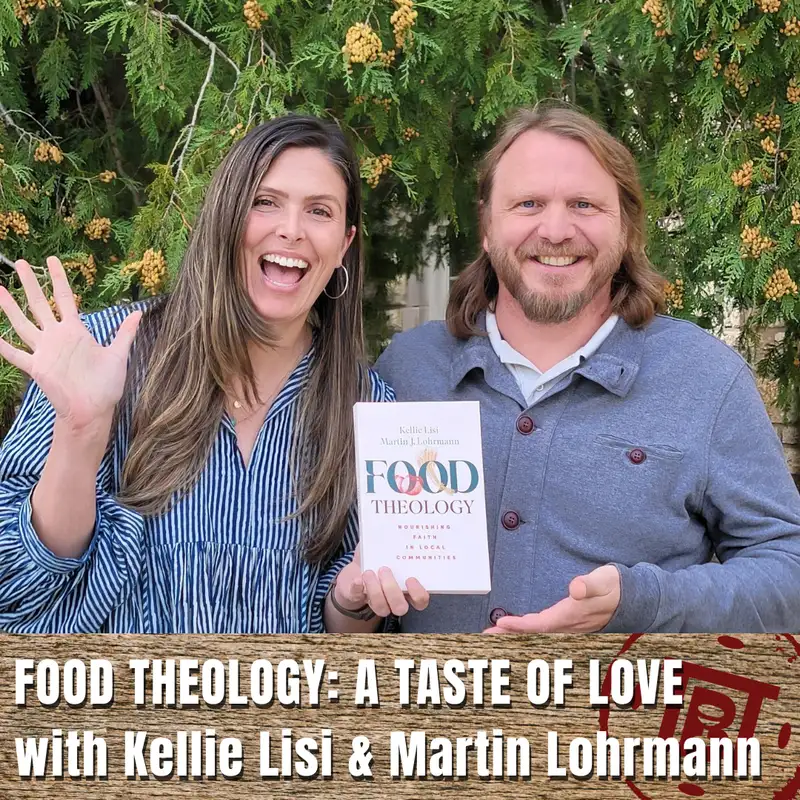
Food Theology: A Taste of Love with Kellie Lisi & Martin Lohrmann
Episode 57 (Kellie and Martin)
===
Andrew Camp: [00:00:00] Hello, and welcome to another episode of The Biggest Table. I'm your host, Andrew Camp.
In this podcast we explore the table food, eating, and hospitality has an arena for experiencing God's love and our love for one another.
And today I'm thrilled to be joined by Kellie Kellie and Martin Lohrmann.
Kellie is an ordained deacon in the Evangelical Lutheran Church in America and serves at Wartburg Theological Seminary as vice President for leadership formation. She has served as public school teacher and administrator, parish ministry leader and food educator. Kellie worked in the restaurant industry prior to and in the early years of teaching. Her most notable restaurant coworkers were Minnie Mouse Goofy and Chippendale at a character buffet restaurant in Disney World. At home in Iowa, Kellie's 9-year-old loves when she makes pizza, while her 12-year-old wishes she would make sushi bowls every day.
Martin is an associate professor of Lutheran Confessions and Heritage at Wartburg Theological Seminary, where he teaches classes in church history, the Lutheran Reformation, spiritual practices and Theology and Art. [00:01:00] In addition to many articles and essays, Dr. Lohrmann is the author of Stories from Global Lutheranism, A historical timeline and Book of Harmony, spirit and Service in the Lutheran Confessions, and the co-editor of First and Second Samuel. First and Second Kings First and Second Chronicles in the Reformation Commentary on scripture series. He enjoys going for walks, playing guitar, and cooking with whatever ingredients are on hand.
So thanks for joining me today. Uh, really looking forward to this conversation about your new book, food Theology.
Kellie Lisi: Thanks Andrew. Delighted to be here.
Martin Lohrmann: Yes. Glad to be here.
Andrew Camp: Yeah. So we'll start here, um, because right at the beginning of your book, um, you two write, "From the beginning of time we know that God loves us and God loves to feed us with good food."
And so I'm curious, how did you both come to this realization of love made physical through food?
Kellie Lisi: Um, I grew up in a home, uh, marked by my Italian grandparents, uh, who immigrated from Italy and created a home in Southern [00:02:00] California. Uh, we visited them multiple times a year and it was there at their table that, you know, I was always inundated with the cries to eat, eat, and course after course would come.
And it was just, it was absolute love made manifest in that space. I saw the way my grandpa, um, loved to have people and his number one, like love language and source of generosity was through food. Whether it was steaks on the grill or you know. Homemade pasta or sauce and mushrooms, you know, all, all, all the fixings.
Um, whereas my grandma, she, she would make what we called grandma's Italian cookies, uh, grandma's cookies, that's still the name of them for short in my house, which are just like plump little sugar cookies with almond frosting. Um, dry and not too sweet. Um. And they just became the absolute symbol of love for me, and that has always been a touchstone.
And as I [00:03:00] grew older, I was a teacher and really learned that when I brought food into my classroom, it brought our classroom community together. It made my students come alive. And so I kind slowly started incorporating cooking and eating. Noticing the way that conversation began to unfold. Um, and then there was kind of a journey into the theological understanding of food as I played with, uh, what I didn't realize at the time was the, the, the startings of dinner church, um, and just really connecting with people through food.
And it's been a journey from there through seminary and professional ministry. It's been a joy.
Andrew Camp: Yeah. Yeah. What about you, Martin?
Martin Lohrmann: Yeah, my earliest memories, uh, with, of church often include like, potlucks, coffee hours. And so for me that was always a facet of what made going to church interesting and fun, and spending time with friends, uh, the intergenerational side of this that [00:04:00] I, I met.
A lot of the adults in my life in those kinds of settings. And as I went into parish ministry myself, uh, as a pastor, I just noticed like food popping up all over the place in our community. But people wouldn't really talk about it like at a funeral luncheon, like, where did all these ham sandwiches come from?
Like, who's doing this? And of course, there's like a whole network of, of people. You know, showing love and compassion, you know, by preparing meals at times like that. And then I was a pastor at, at a couple other churches where food was more central and people did talk about it and I thought, oh, this is something to really build upon.
Um, 'cause the more, the more we're like naming what's important to us, the stronger we can make it and like, think intentionally about how food and faith go together.
Andrew Camp: I love that. And wanna come back to some of those points 'cause uh, I think they're important. But curious how the two of you then teamed up and the sort of [00:05:00] genesis of this book and how it all developed for the two of you?
Martin Lohrmann: Yeah, I'll start. Um, I had a sabbatical, uh, some years ago. It was during the pandemic actually, and I do a lot of work in church history, especially reformation history. And I wanted to do something that was more like on the pastoral community side of my interests and my own kind of calling vocation.
And, um, Kellie had actually just written a master's thesis on this topic. And I wanted to encourage her to keep doing stuff with this. Uh, and so I thought, I have a sabbatical. I'm interested in the topic. Kellie, uh, had just graduated and I thought maybe we can, you know, see what comes. And so we started making, uh, some proposals and floating it with, uh, there's a writing group here in Dubuque.
We floated it by them. Uh, we got several very polite rejection letters, but we decided to just keep going 'cause we both. Cared a lot about it and could see [00:06:00] kind of a gap in the field that there's like theory and theology of food and uh, kind of the yeah, theological reflection about God and food. And then there were some community books and howtos and we thought, let's, let's see if we can bridge that.
And, uh, eventually, you know, we did, uh, get a publisher to sign on and, uh, we're really happy with how it worked out.
Andrew Camp: Anything you wanna add, Kellie to this project?
Kellie Lisi: Yeah, I mean for me, food theology was my focus of my seminary journey. So my husband, uh, he was a youth director, um, in the early days of our marriage and kind of always contemplating seminary, and I really held him back for many years because just.
My kind of preconceptions around what it would mean for him to be a pastor and for me to be a pastor's wife. Um, and then I heard about actual dinner church, um, that was happening at various places [00:07:00] across the country. And when I heard that, it kind of opened this whole spirit of imagination for me. I had done as I was a teacher, um, I had also started a food blog and I was teaching at a cooking school.
And so I was just exploring food in so many different ways considering culinary school and kind of what's next. And then, and we were playing with, um, aspects of food and faith, like integrating. And my husband's, uh, his name's Jason. So in Jason's, uh, church and Congregational life. Um, and then I heard about Dinner church and God kind of cracked me open in that to say, look, food and faith go together.
Something new could be happening here. Um, and of course we know it's not new. It's ancient and it's holy and it's deeply embedded in so many communities and cultures. But that was kind of the thing that got us started. And so then when I just turned my own call to ministry, um, I entered it with the focus of.
Food theology. So kind of studied that and focused on that. Designed learning [00:08:00] experiences and immersion opportunities and service projects and reading and writing and all the things, um, focused in that area. Um, and then Martin was my advisor on my senior thesis project. Um, and getting that email from him saying, do, do you wanna do something with this together?
I was like, oh, yes, please. Absolutely.,
Andrew Camp: Appreciate that. Uh, and you, Martin, you alluded to this, but you guys distinguish your work, um, from, this sort of seminal works on food, theology, food and theology. Norman Wirzba's book, food and Faith, and then Angel Mendez Montoya's the Theology of Food.
Um, you know, obviously if you're in the food and theology world, like those two stand out as sort of seminal works. You wanna do something different? And you alluded to it, Martin, but can you e either one of you explain, you know, why, what your book adds to the conversation when it comes to sort of food theology?
Martin Lohrmann: Yeah, we wanted it to be as practical as possible, so to talk [00:09:00] about the Bible and, uh, church communities, um, broadly, and then say, and now, you know, try making communion bread together. Right? And when you do that, you know, think of all the things that happen in the midst of buying ingredients, planning, what it's like bringing the utensils and all that together.
Uh, who's doing cleanup? Like those things are also part of. The theology, the part of the God experience. And so to really lift up that practical communal side was, was part of our goal. Uh, so the other books, you know, do great things with God and food, and we wanted to let people know like, this is really just hands-on and you're probably already doing it, and how can we strengthen what you're already doing or what God might be calling you to do next?
Kellie Lisi: Yeah, it was, I'll add to that to say it was a very, the, the, the phrase food theology is very intentional. Right. You know, as you said, there's, there have has been a lot of [00:10:00] work and study and writing done on the theology of food and the theology of eating, and we very intentionally look at it from a perspective of food theology.
We're in, food is the conveyor, it's doing the work. And so through that understanding everybody is. Automatically a part of it, everybody is automatically experiencing it, participating in it, and sharing it. Um, just, just like we do with God's love for all people. Um, and so it's a very active, practical approach.
Martin Lohrmann: Yeah. And I, I'd say like food theology was just kind of what Kellie called it herself. And then we realized like, oh, there's a reason we're calling it that instead of theology of food, like the food is doing the theology, it comes up over and over again in the book. Mm-hmm. And so we didn't wanna overthink that, that when you are eating, when you are cooking, when you are cleaning up, that's, um, God's love in, in action.
So we wanted to foreground that as much as possible.
Andrew Camp: Right. And that. [00:11:00] Appreciate that because like you said, Martin, you know, many churches, if not most churches have some food component. You know, we just look at the Eucharist, like that is a meal, right? Like, you know, and then you can talk about potlucks or.
Coffee service, you know, donuts being served. Um, and yet few of us ever take the time to intentionally reflect on what is being communicated, whether it's in the organization, the planning, um, you know, all the logistics that go into a potluck or even serving the Eucharist. And so you invite your readers to actually contemplate that and you provide some great questions, I think, that really help people think through.
But why is it important then to think about these things? You know, we do the Eucharist almost by rote memory, but if we're not careful, we may be communicating something we're not intentionally wanting to communicate. So what, what benefit is there then in trying to think through what, what we're doing when we do food?
Kellie Lisi: Yeah, [00:12:00] it's, so the intention of this book is one that it's very invitational, um, because we want to invite people into their perspectives being shifted to pay attention because exactly like you said, Andrew, the, we eat constantly, we feed people constantly. If you're involved in a worshiping communion community, you are eating together, you're taking communion.
Um. But we don't, our attention isn't pulled to those acts. It's just like, oh yeah, this is just what we do. But there are things that are happening there, and so we wanna invite people to this attention shift, this perspective shift because when we pay attention to these things, we can see evidence of God's abundant action and lifesaving grace for all people Evident.
Over and over and over in our lives. It becomes just really, really clear and really tangible. And so that is a goal of the book. [00:13:00]
Martin Lohrmann: Yeah, we originally, like with the Eucharist chapter, there are a lot of stories of, of how it can go wrong, like how it can go, not wrong, I mean, but how it can be an inhospitable experience or it can be a situation where we're somehow disconnected from our bodies rather than more connected.
And, and so, well, we did start with like a lot of, oh, and then there was this time, uh, we cut most of those in the interest of a more positive, you know, narrative. Um, but sometimes it helps to remember like when you have felt excluded or when Eucharist hasn't been like an embodied moment. Um, and so those kinds of experiences helped us kind of drive the kinds of church communities and experiences uh, we'd, we'd like people to see or to remember and dwell in and then build upon.
Andrew Camp: I am curious, you know, as we think about this on a practical level, like, 'cause many of my listeners aren't leaders in a church, or maybe they're not in charge of, you know, [00:14:00] the Eucharist liturgy every week. And so like if, if somebody's listening, like what's a question they could ask themselves as they're hearing or getting ready to participate in the Eucharist, that might help guide them into a more fuller expression.
Martin Lohrmann: To think about it as a meal, you know, with God as the host, with, with Christ present and with surrounded by, uh, members of the kingdom, that that kind of spiritual inbreaking is really happening in the meal and just to like. Let that start to settle or like what does it mean to, to live into that a bit?
It really means something very amazing is happening and um, so just yeah, to let it be kind of all the profound things we say it is. And um, so that would be a starting place is like, this is communion with God. Whoa, this is communion with all these people, most of whom I don't really know. And somehow we're together and [00:15:00] somehow God is part of this.
Kellie Lisi: Yeah, to build on that very good answer. We say we believe, and we say that a lot of things happen in the meal at which we gather around the altar and we receive the body, the blood of Christ, and, and if we believe. What we say is happening that is radical. It is transformational. It is community changing, it's individual changing to claim these things for ourselves.
And so to, I would really invite people to think about, is what we're saying reflected in our communion practices? Or are there things that we are doing. For instance, are we expecting people to kneel and there are people with really limited mobility issues. Well then how does that [00:16:00] separate the practice and experience of the Eucharist from what we say and believe to be true about it?
Hmm.
And how can we minimize that gap so that it can be this embodied experience that we can live into? Um, because it's quite a promise that we're seeping.
Andrew Camp: I love that because the Eucharist is sort of not sort of, it is central, like Jesus told us to remember him by a meal. Uh, you know, and I think NT Wright has a great quote.
You know, when Jesus asked like, I forget the quote and I'd have to look it up, and so I don't wanna butcher it, but he, I think to summarize it, he sort of mentions that, you know, when Jesus asked us to remember him, it wasn't through sermons, it wasn't through a pithy saying, but it was through a meal. And so like what does that mean and how does that then ground food theology?
And so I'm curious, you guys are at a Lutheran seminary, which has a very. Robust, more robust theology probably of the Eucharist than, you know, I [00:17:00] grew up in the Evangelical free church. Um, and so I'm curious, you know, how the, your understanding of the Eucharist has spurred you towards thinking about food theology.
Martin Lohrmann: Uh, in traditional Lutheranism, there's this crazy phrase called mystical union, which has always been there as intellectual or as far from embodiment as Lutheran theology sometimes is Get. It gets, uh, it's always talked about mystical union is happening, and that just kind of blew my mind as a young person.
And then as we were sitting or starting to think about this book, I remember going for a walk in pandemic times thinking What's happening in Eucharist? And it crossed my mind that like in the Tindale translation, uh, from, you know, English in the 15 hundreds that, um, it's not, um. This is the covenant of my blood, you know, given for you in Dale.
It's the New Testament. So then I was like, oh, [00:18:00] this is the New Testament before there's even books, um, called the New Testament. The New Testament is this meal. And that, um, that then becomes like the start of the chapter on Eucharist. But, uh, again, Eucharist just kind of keeps blowing my mind. So, uh, yeah.
Andrew Camp: How does it keep blowing your mind? I'm just curious, like as somebody who's in the academic, like how, 'cause it's easy for it to become rote and so how to become it to become that mystical union experience.
Martin Lohrmann: Yeah. Uh, the, that God is present, that God is present with me, that God is present with us. That it's a plural for you, given for you.
Um. That when we talk about communion of saints, you know, we're talking about the people around us, we're also talking about the people who've gone before us that we're having this meal, which is a foretaste of the feast to come, as our liturgy says. And so we're participating in, uh, something eternal and, and [00:19:00] amazing.
So yeah, all those things. Plus it's bread, it's, you know. Somebody baked it or bought it or brought it, and the Altar Guild set it up so it's also very mundane at the same time. So all those things, um, yeah, they, they keep me, keep me coming back.
Andrew Camp: Yeah.
Martin Lohrmann: Keep calling back to me. Yeah,
Andrew Camp: no, for sure. Uh, 'cause you're right, the elements are very mundane, but there's a mystical transformation that happens like, you know, in the making of wine.
Like something happens that I think belies scientific, um, expression. You know, our chemicals, you know, and then bread, you know, the com, the combination just of flour, salt and water yields something beautiful. Um, whether in a short period of time and, or, you know, if you're making sourdough bread over two days, all of a sudden you have this rich bread.
That flavor belies the simplicity.
Martin Lohrmann: Yeah. And just quick, even though it's a small thing, you, it's like the parable of the woman who has just a [00:20:00] pinch of yeast and it leavens the whole thing. I mean, communion kind of is doing that in our lives.
Andrew Camp: Hmm. I love that.
Martin Lohrmann: Yeah. Kellie And where, how does it blow your mind?
Yeah.
Kellie Lisi: So I think that it's something that we have to work to pull ourselves out of the rote mundanity of it, um, because it is right. We go up and we, uh, uh, um, and something that helped me lean into that was the experience of receiving communion from my professors. While I was in seminary, so I came to seminary, um, in 2017.
My husband and I were both seminarians at the same time. We moved to Dubuque, Iowa with two young kids and lived on campus and attended residentially here, um, at Wartburg. And in this community. So we worship every day. Every day that classes are meeting, [00:21:00] um, or every day, that's an act considered an academic day.
We have chapel on campus and we have folks who are connected and engaged, um, at a distance. So they zoom in, they participate, they help lead. It's a very hybrid, um, experience. And then there are folks who are present on campus as well. And every Wednesday for us is the day that we celebrate the Eucharist as a community.
And every week there's kind of a different, um, faculty or staff leader, presider ordained people who are preaching and leading worship, um, along with students. And I remember very clearly the experience of receiving communion from one of my professors, Reverend Dr. Craig Nessen, um, who believed what he was saying.
Andrew Camp: Hmm.
Kellie Lisi: So completely that it changed me. Hmm. Because to, to encounter someone who it just [00:22:00] infused everything that he was doing and receiving bread from him was this really remarkable experience. And I experienced that on a regular basis. Now with everyone who, um, gives communion, it's people who believe so completely in, in what is happening.
And so when I received that bread, um. It just brings me back to the promises because sometimes, you know, if my belief is a little low or I'm down, or maybe I've got some big questions, which I often do. Um, communion is a chance to really lean on the community, on the body of Christ that is gathered, that is brought together to say, this doesn't depend on me.
Nothing that is happening here depends on me, right? It is all about God and what the triune God is doing in and through this meal, and by extension in and through this community who is called to [00:23:00] go out and live and serve. Um. And so bringing myself back to that every week, paying attention to what is being said.
You know, little things like, uh, physical reminders to myself, um, that we don't always do, you know, in the Lutheran tradition or some other Protestant traditions, but things that tie me to here's what I'm, here's what I'm participating, and this is God. God's reminder that God is with me. God is in me, God lives through me, and I am called to that and affirmed in that.
Um, when I, when I experience communion. And so I work to remember that every single week and people around me help tie me to those premises.
Andrew Camp: That sounds so rich and beautiful. Um, you know, seeing communion as this reminder that we are loved and upheld not only by God, but by the community. And, you know, if our faith is wavering, communion table can be that [00:24:00] sturdy place, that anchor, uh, for many of us, uh, what whatever season of faith we're in.
Kellie Lisi: Yep. Absolutely. And that's why we chose to start our book. I mean, the first chapter, chapter one is about holy communion, right? Because for. We think about food theology as starting at the table, right? That is where it begins, and it's kind of this doorway, this invitation, this opening that then we get to go through and think about, well, okay, so I do this at church, but this has meaning and implication and matters for all of my life and the way, and all of my meals and all of my eating.
But it starts there. Yeah. Um, for Christians. And so that framing is really important.
Andrew Camp: It is because at the table we receive and we realized we are not the primary actors in what we do and what we take into the world. But rather I can only welcome others as I have been welcomed. [00:25:00] And so that's where I think starting at the Eucharistic table helps us remember that as I invite others or as I am invited into others' lives, I'm not the the primary actor.
Kellie Lisi: God is,
Martin Lohrmann: sorry, it's chapter two actually, and I'm stickler for details. So chapter one's an introduction and then Chapter two. Chapter two, yeah. Is the beginning with you, Chris?
Andrew Camp: That's true.
Martin Lohrmann: Yes.
Andrew Camp: Sorry. All
Kellie Lisi: the Thank you, Martin. You're right. It's chapter two. Chapter one is Invitation to Food Theology.
Chapter two is Holy Communion.
Andrew Camp: So, so then as we take, you know, as we receive at the table in our local fellowships, whether that's. A traditional church, a dinner church, just a home fellowship, whatever it looks like for us. How does that then propel us and what, what do you hope people take from the Eucharistic tables into their other spaces?
I.
Martin Lohrmann: A sense of God feeding us then can inform like in the [00:26:00] rest of the book. Then we do go on to like community meals to food ministries like food pantries and soup kitchens to vocations with food, like growing food, serving food, preparing food, writing about food. Um, and, and so those are all kind of connected then to what's happening in the Eucharist.
The whole thing is, uh, is Holy Spirit. Lead and that we're participating in beautiful stuff. Um, that Eucharist sends us into other things that are also just spirit-filled and, uh, other oriented and really beautiful ways.
Andrew Camp: Um, you know, and the scripture starts with God creating a garden and planting us in a garden, giving us the bounty of creation. And so you guys touch on it. You know, I think it's one of those other seminal acts like Alexander Schmemann in his book on, you know, the sacraments. He talks, you know, [00:27:00] that he begins in the garden because, you know, he said God created us as hungry beings, you know, hungry for himself and hungry for um, food.
And so how does creation factor into how we think about food, you know, from vocation to gardens?
Martin Lohrmann: We use a lot of the biblical imagery of food and kind of growing. So yes to the garden. Um, Jesus says in John, you know, I am divine. You are the branches. Uh, so all that kind of imagery, uh, you know, it's not there by accident and yeah.
What else would you add to that, Kellie?
Kellie Lisi: I think Genesis two really reminds us that we are created and food all, all creation belongs together. Like it's, it's all a gift from God, right? It reminds us that food is a gift from God. It reminds us that God created. [00:28:00] And so that really helps us understand how we're called to live, not in dominion, but alongside how we're called to think about things and be aware of creation other than just ourselves, which is kind of our human tendency to go inward.
But we weren't created in that way.
Martin Lohrmann: Yeah. Oh, and we, we haven't even talked about how much Jesus does with food, right? No. Yes. So there's that too. You know, um, feeding people, sharing meals, all these things, it's just, um, so much is happening,
Andrew Camp: right? Uh, yeah. No, and I think for me, this food journey, um, started when I, it was a Eugene Peterson quote where he talks that Jesus is most, or that gospel writers are most fond of telling stories about Jesus around the table.
Um, you know, and when I read that quote that's, I had started thinking about what the table looked like and why the table and why do we linger. But it was that quote that sort of opened my eyes to the [00:29:00] robustness of which food is talked about, not only in the gospels, but throughout, um, scriptures.
Martin Lohrmann: Yeah. On the church history side, you know, what is it that makes Christianity different?
Uh, when it's new is, I think it's a, it's a new kind of table fellowship. Uh, right. Our liturgical scholars might say that there were other groups doing similar things, and then this group is talking about Jesus, sharing the life of Jesus, sharing his meals, and going from the meal then to care for the poor.
Uh, you see that in Justin Martyr, that the meal. And the collection for the poor and then going to serve are all kinda one action. So yeah, it's, it's really baked in. Uh, Kellie rolls her eyes at my food puns, but there it is.
Kellie Lisi: It's true. It, it is baked in Martin. Absolutely. And Andrew, I love that you name that. And it sounds like that has been such a catalyst for you in your own journey with food and faith. Right. Um, and for [00:30:00] me it's, it's so, it's so humanizing to think of Jesus eating like Jesus. Mm-hmm. On the beach, having breakfast with his friends.
Oh my gosh, right? Like that's, that's my Jesus. Yeah. Like, yeah. Invite me to the beach Bonfire for some fish. Um, I think we get to really see and understand Jesus the living word, always with us when we see him eating in these ways throughout the gospels. I, I experience it to be really meaningful.
Andrew Camp: I think it's interesting too, and I, I think we need to think through the implications that Jesus still eats and is recognized in Meals post-resurrection, that, you know, eating still is central, you know, to who he is and his ministry and his mission.
Martin Lohrmann: Yeah, absolutely. Right. He comes through the locked door, and then he asks for some fish,
Andrew Camp: right?
Martin Lohrmann: Yeah. Gimme something to eat.
Kellie Lisi: Yeah. Gimme something to eat. Or his disciples don't recognize him and then he breaks bread and [00:31:00] they're like, oh. Right. Like it's recognition through food. And I know I can think of so many times when food has brought me back to myself or helped me find recognition with another person.
So we see it happen with Jesus, and I think it's, that's true for all of us.
Andrew Camp: Hmm. You've mentioned it a few times, Kellie, and I'm curious, you know, that food is a way of remembering our embodiedness or helps or has brought you back to yourself and so. Can you expound a little on that? Just 'cause I think, you know, food has that quality, but many times I don't think we think about it that way.
Um, and so how has food helped you remember your embodiedness?
Kellie Lisi: Hmm. In so many ways. You know, there are times I can think to various points in my life where. Times when I feel disconnected, [00:32:00] when I am, you know, out of sorts. So often that is tied to times when I'm not feeding myself well or you know, we're getting by on. Fish sticks and cheese plates, and there's nothing wrong with fish sticks and cheese plates.
Nothing wrong with that at all. But you know, we're getting, we're just kind of getting by, like the creativity, the imagination, like the sitting down together, the being together isn't happening. And for me, that's often linked to the ways that I'm working and present or not in the kitchen. Hmm. And then there are times when I feel like my family, like we're in it together.
We're on the same page. We're, we're having fun together and we're connected, and usually we're cooking together and we're making the meals that we love and we're sitting and we're eating. Um, I think food is really, really powerful. Whe So I started a food blog in 2009 back [00:33:00] when, you know, back, back in the day of blogs and kind of the heyday.
Um, and that was like when I started thinking about it really critically, um, and paying attention to the way that I was eating and, um, the way that communities were coming together around food and people I knew were connecting around food. And I, I just really came to observe that when we. When my friends and I were eating together, we were in usually a pretty good place.
We were communicating things were good. When we weren't. It was rushed. We're passing, you know, it's just texts. We're not seeing each other. Things are a little bit more disjointed. And so just experiencing food is this incredibly grounding. Um, I think you, you, you used the phrase that like the table is so sturdy.
Like the table is sturdy and if we let it be magnetic to pull us to it, it can, um, have great power, influence, impact on our life, [00:34:00] how we feel and how we live.
Andrew Camp: What about you? For you, Martin, how has food helped you remembered your embodiedness?
Martin Lohrmann: Yeah, so there's the line in the Lord's Prayer about daily bread, uh, which if I remember right, could be translated, give us today our bread for today.
Andrew Camp: Hmm.
Martin Lohrmann: Um, that one day at a time, one meal at a time, you know, God is feeding us. It's that kind of ever present. And Kellie mentioned that before. How. Like we're food is just always there. Part of our, we need it and God created us to need to be fed. And that's okay. That's, um, so when I remember that when I take times, maybe pray at meals or just give thanks for what I have, it reminds me that every moment is like.
This moment of being nourished or, uh, in cases of people who live with food insecurity, uh, time that people ought to be nourished and that, um, [00:35:00] life is organized around God wanting to feed us and that we can be part of that. So, yeah, I mean, really profound. I, it's, and social systems and, you know, my own existential reality.
One meal at a time.
Andrew Camp: There is so much Yeah. Wrapped around food. Um, and you even address, you know, the hunger in today's culture. And I loved your section, you know, helping us understand Martin Luther, seeing what food and hunger need to be addressed as a political issue and that this is, you know, interwoven.
Um, and it's a bigger more comp and it's only gotten more complex, but it's a complex issue that can't be solved by one entity alone. And so how. Can you address that a little? Just 'cause it's been a, a journey for me to understand hunger and systems and, um, you know, I don't think of Martin Luther in that respect.
And so it was just helpful to see this side of him. Um, so.
Martin Lohrmann: On that point, um, in the small catechism, first of all, [00:36:00] Luther's small catechism. He is teaching the basis of the faith for families. He talks about daily bread, really also means everything we need for daily life. And so whatever contributes to what we need for daily life is a part of this.
Prayer that we're, uh, asking for. So that's the family we share it with, the jobs we have, you know, the, the people producing it and distributing the food. And especially then in Luther's large catechism, this is probably the radical bit, is he thinks all of politics exists so that people get daily bread.
And that's how we hold our leadership accountable. That's what we pray that they're doing. So really very holistic sense that this one prayer, um, is, you know, very personal. And here I am receiving what I need for daily life. And, uh, the whole community really exists for the welfare of, of the members, you know, of the people who live there.
And that's, I think, quite challenging for 21st century Americans. [00:37:00] Um, but I find it, um, encouraging and inviting then to be part of. People getting what they need for daily life.
Andrew Camp: I had a guest on Jeremy Everett who works at Baylor, um, in the Collaborative Center for Poverty and Hunger. Uh, and he had quoted, I think it was Roosevelt, that, you know, we are at our best in society when our legislation aims at the least of these and not, you know, the richest. Um, and so to hear Martin Luther talk about politics being making sure that we, everybody has what they need for daily life.
Uh, is a very radical, like you said, view for many white Americans, um, believers or not. And so I think that voice needs to be heard, uh, in today's culture. Yeah, agreed.
Martin Lohrmann: Yeah. Yeah. It's, it's too [00:38:00] bad. It's so radical. I could see. I know, right? This is very basic. Right? Right.
Andrew Camp: Here, it's, and, and the Old Testament is full of.
Of laws of making sure that everybody is fed and leaving portions, you know? And so I think baked into God's economy is this idea that no, a society flourishes. A community flourishes when, when everybody has what they need for daily life.
Kellie Lisi: Absolutely. Yep. And we see, we see that hit, that, that reality playing out right now.
Yeah. Don't we? We see so many people who do not have what they need and legislation, um, working against people, receiving their daily bread and having what they need. And it's a, it's a reality in which not everybody gets to prosper, gets to flourish, gets to live into God's desire. For abundance for all people.
Um, we know that we as a world produce enough food for everyone to have what they need. And so part of food [00:39:00] theology is recognizing that we see our world's brokenness play out in the food system because so many people do not have what they need. And that, um, that is not God's desire for God's people.
Andrew Camp: Right, because, and that's been the journey for me too, of realizing, you know, this, the table has always been this sturdy, joyful experience. And so how does that then help me stand in solidarity with people who don't have enough? And what is my role in, in fighting for justice, food equality, uh, and, you know, what's my church's community's role and how do we help others get the food they need and work with community organizations?
Um, 'cause yeah, the table, while it's this place of remembrance and sturdiness, for many people, it's not, whether that's food insecurity, uh, eating disorders, uh, there's a lot that's tied up with, with the table for good and for [00:40:00] bad that I think needs to be unpacked. And I love that you guys, you know, point us in those directions.
Kellie Lisi: Thank you. I mean, we definitely, we acknowledge this, this stuff is really hard and we all have like really limited perspectives that we come at it with. And so this is where, um, you know, we, in our discussion questions at the end of each chapter, we really try to invite readers to seek out what is food security and insecurity like in their community.
What kind of organizations are working towards food justice. Um, and how can they learn and get involved, right? And we are not, um, we are not saying that the, the wheels need to be completely recreated or that everybody who reads this book needs to be starting a food ministry. That's not the case. There are so many organizations and people working towards this, but us paying attention.
So again, shifting our attention to what is already happening and then figuring out how we can get plugged and how God is calling us to get involved. Um. [00:41:00] That is the way that we transform our communities,
Andrew Camp: you know? And you mentioned that food and faith are imperfect acts, you know that they're entwined.
And I had once a spiritual director, counselor tell me, you know, that, you know, cooking is a way to think even of sin sometimes of, you know, you miss the mark. You don't always get it perfect, but yet you get up and you try again. You know? And so the spiritual life is. It's like cooking where one day, you know, you burn your meatloaf or you, you undercook the Turkey or you, whatever happens, and yet you have to get up the next day and still cook and feed yourself or your family or other people in your life.
Uh, and so how, how do you guys see the interrelatedness working together for food and faith as imperfect acts?
Kellie Lisi: Well, I'll, I'll start on this one. So I love this question. This ties into an intentional choice that we made in the book. Um, so we do have recipes throughout the book, um, but [00:42:00] they show up in two different ways.
So in every chapter there's kind of the narrative of something to cook and something to make, and it's like, um, I think of them as recipe strategies. Because of exactly what you just said, like we don't have to show up in the kitchen and do things perfectly in order to be well-nourished. We don't have to show up in our communities and do everything perfectly in order for people to have what they need.
But we show up, we take a look at what we have. We give it a go. Um, and so every chapter has these recipe strategies that just kind of talk you through it. And it's like, Hey, try this and add this. And what if you combine these things? Um, we do have an appendix that has all the recipes with actual measurements and things like that.
Nothing is very fancy. Like this is not, um, like the, the, the culinary school chef there. But it's, it's, it's basic, it's simple, it's nourishing. Um. And the idea [00:43:00] there is that we just show up and we mm-hmm. We work with what we have. Um, that is really the way that I feel about faith and the way that I approach faith.
Like I do not have to get things just right. I am beloved. I am called and I show up and I do what I can with what I have, and I hope people will do the same in their kitchens and in their communities.
Martin Lohrmann: You know, that reminds me of the recipe for frittata that we have and all the recipes are Kellie's. So, um, but when, when Kellie suggested that frittata recipe, and it really is like, what do you have in your fridge?
Like what are the leftovers, what are the crumbs, what are the little bits of shredded cheese, veggies, uh, and all that. That's, that's around. That is, um, a can be very tasty. That's kinda my favorite way to cook, is what do I have and how will it be really tasty? And, but b, it's a great image for who we are as communities.
[00:44:00] Like maybe there's some odd bits and ends and flavors here, and that's exactly what we're gonna make something beautiful with. And, uh, what God's gonna make something beautiful out of. And I think that's of an encouraging thing for communities, that you don't have to be everything. You don't have to have the fanciest ingredients, you know, to whatever church churches are supposed to be doing.
You show up, bring the flavors and the people, the gifts you have, and it's, it's gonna be awesome. And so that's a big part of this book, really to encourage people and to, to see the blessings that they have and the blessings already around them.
Andrew Camp: It reminds me of, uh, the parable or the story of stone soup of a community.
You know, this guy just saying, Hey, I have a stone. What do you have? And so the community brings each, brings what they have, and the community is fed and nourished. Because everybody brought a little piece.
Martin Lohrmann: Mm-hmm. Exactly. The boy, the boy has, you know, a [00:45:00] couple loaves and fishes. Yeah. And next thing you know, the multitudes are fed.
Uh, yes, exactly. Yeah.
Andrew Camp: It's paying attention and asking a question of wonderment, like, Hey, what could be possible?
Kellie Lisi: Exactly, and in that app, I mean this is what we talk about in chapter two on holy communion. We are decentered. What I have is decentered and what God can do
Martin Lohrmann: with
Kellie Lisi: all God's creation is centered and that's what we're, we we're called to constantly work towards and that's what we try to keep lifting up throughout the book.
Andrew Camp: And this episode's gonna be released December 16th, so right in the midst of holiday season when many of us are going to be baking or entertaining or going places. And so like as people think of the Christmas advent season, like how, how can your work or ideas of food like help people rethink or reimagine or take a little step [00:46:00] so that food is something more than just.
All the baking that needs to get done or all the meals that need to be prepped before Christmas.
Kellie Lisi: You know, this season can be so stressful. Um, we're we're recording this in the week of Thanksgiving.
Andrew Camp: Yep.
Kellie Lisi: And, uh, I just did my big grocery shop yesterday to prep for Thanksgiving. We're hosting 10 people and you know, I was at the register checking out. I had my clipboard, my 12-year-old daughter was manning the clipboard and checking things off, and we were getting ready to go to our next place.
The total came up on the register and right, the total comes up and you're always like, oh, oh gosh. And it was this moment where joy and grief sat side by side. And in that moment I took a moment to just, to be in that and to recognize like, I'm so thankful. I'm so thankful to be surrounded by this abundance, to be able to prepare, to host people, [00:47:00] to welcome people to my table, and to gather around food.
And I feel deep grief knowing the state of many people's kitchens right now of challenges accessing food related benefits, and knowing that this. Is a really, really hard season for people. Mm-hmm. And so my daughter and I talked about that in the car. On the way to our next place, we said a prayer and then we grabbed some things at our next place to drop off to our food pantry.
Um, and so I think in this holiday season to welcome people to experience the full gamut of emotions that come with food and hospitality and abundance and scarcity to experience that, be present in that. Attention to it, and then take a step. Just what's, what's one thing I can do? This is so hard and I, I'm not, I, [00:48:00] I don't bear it all, but I do have agency and there are things that I can do.
Um, that's what I hope we all move into this season with.
Martin Lohrmann: I, I would just add, you know, at Christmas we remember Jesus is Emmanuel God with us. And that to, to be in the moment, to see the holiness of the moments we have and the people around us in the total humility that God has come to us, uh, in, in Jesus, born into manger, uh, as a vulnerable little child to a vulnerable family.
The, the God is there. And so that's what I would hope, you know, in the holiday season amid all the other highs and lows, uh, that come with advent and Christmas time.
Andrew Camp: I love the remembrance. Um, the simplicity. Um, you know, and Kellie, you mentioned it, that there's nothing wrong with fish steaks for meals. You know, [00:49:00] that sometimes life just demands that we, you know, we still gather, but we eat chicken nuggets and craft mac and cheese.
Um, you know, and that Jesus is, is still present in that, uh, and that we don't need to go all overboard when we're hosting people. We can, simplicity can be beautiful. Um, yeah. You know, um, and not to stress over, over the little things or, I always tell people like, if you're entertaining people, don't try a new recipe.
Like, try something, try, you know, do something tried and true so that you're not stressed and you can actually be present with the people. Uh, versus a new recipe that you, you have no clue what you're doing.
Kellie Lisi: Yeah. That's such good advice.
Martin Lohrmann: That's so good. I love that. By experience as a young adult, so
Kellie Lisi: Yes.
Martin Lohrmann: Yeah.
Kellie Lisi: No. Yeah. And,
Martin Lohrmann: uh,
Andrew Camp: and there's places for that and it's fun and that you can laugh, you know, and if something fails, you can order pizza. Right. Um, but just to still find joy or my family, we let our [00:50:00] girls watch a Christmas story yesterday for the first time. We watched it together as a family. You know, and, and the last scene when they're, you know, the Turkey burn or the tur, the dogs destroy the Turkey and so they have to go out.
Like there's still joy at that Chinese restaurant for this family of just being together. Um, yeah. You know, and it's, and they even say Ralphie mentions, it's a story we tell ourselves over and over again and laugh at. Mm-hmm. Um, yeah. So I think there is something beautiful in the mistakes as well.
Kellie Lisi: Absolutely. We're all just out here doing our very best and we're, but in Rea, we're just like the wilted kale in the produce store like me, but we show up and Right. Get sauteed with some onions and garlic and olive oil and we're gonna be okay. So we just gotta gotta show up with that perspective of this is good enough.
What we have is so good.
Andrew Camp: Mm-hmm. And so as we begin to wrap up, it's a question I ask all of my guests, [00:51:00] what's the story you want the church to tell?
Martin Lohrmann: God is with you in what you're already doing, you know, in the worship you're having, in the meals you're sharing, in the ways you're interacting with your communities.
And you know, food's a big. Happens to be some, uh, at the heart of a lot of those things. And so don't overthink it like God is working and you pay attention and you listen and um, that's, you know, God will be there with you and is there and has been and goes ahead and, um, yeah, that there's blessings to enjoy wherever you are.
And, um, and God will provide.
Kellie Lisi: A really grounding experience for me that I come back to very often was the first time that I visited St. Lydia's, uh, which is a dinner church in Brooklyn, New York. Um, and [00:52:00] on my first visit there, they sang a song that's really just a poem, um, adapted to sing with the Shrudy box. And the lines of that song are what we need is here.
Hmm. And they just sing that over and over and over. And that would be what I want the church to remember, similar to what Martin just said. What we need is here. God has already created it. God is doing it. God has created us, and our prayers will move us into action, into that co-creation. What we need is here and we can move forward in faith, in abundance, and not out of a scarcity, fear-based mindset that one of welcome and hospitality and acceptance,
Andrew Camp: what we have is already here.
I love that. Uh, it's great quote to remember in this holiday season, [00:53:00] um, in the hecticness, the busyness. To simply remember what, what I need or what my family needs or what we need, what we have, you know, is already here and present, um, especially in, in the midst of community. Um, so some fun questions to, to close about food.
Uh, what's one food you refuse to eat?
Martin Lohrmann: I almost everything. Um, it is just kind of a life choice. I like to try stuff. Um, I really don't enjoy li of beans.
Kellie Lisi: I am also a very adventurous eater, but I really draw the line at Undercooked brussel sprouts. I love brussel sprouts, and when I go somewhere and I get like a hard little ball, I'm just, I'm having none of that. Send it, slice it in half and burn it and bring it back to me. Please. I'm not messing [00:54:00] around with
Andrew Camp: right
Kellie Lisi: undercooked brussel sprouts.
Andrew Camp: Mm-hmm. That's, that's fair. Yes. Usually it's overcooked that people are like, uh, this, you know, like there's a fine line I think with brothel sprouts because undercooked, no raw is horrible, but then overcooked grandma's. You know, brussel sprouts that were stewed until they were just disgusting. Yeah, no, thank you
Kellie Lisi: people just olive oil and salt.
Yeah. Don't overthink this.
Andrew Camp: No. Or deep fry them because deep fried brussel sprouts are delicious too.
Kellie Lisi: Yeah, I, I will gladly take some deep fried brussel sprouts
Andrew Camp: on the other end of the spectrum. What's one of the best things you've ever eaten?
Martin Lohrmann: Oh, you know, I've taken a couple of student groups to Japan and I just love, um, how simple the ingredients are and just full of flavor and texture and, uh, that's all, that's just a treat. So the seafood, the noodles, um, yeah, it's a picture of me eating in Japan. That's [00:55:00] just the biggest smile I could possibly have.
Kellie Lisi: I, I have one of those photos of you on my camera roll from when our family went to Japan with you. I can vouch that Martin is at his happiest. Eating some raw fish in Japan.
Andrew Camp: Hmm. I can imagine.
Kellie Lisi: Um, for me it is so delightful when there's like the rare thing that I love and my children love. So there's like no fussing.
Like everybody is happy and you're like, what timeline are we in? This is amazing. The best way to usually accomplish that is pasta. So just homemade pasta, a great simple red sauce, maybe some meatballs. Um, and it might not be the best food in the world, but it's darn good and everyone's happy and together, and that just ups my enjoyment tenfold.
Andrew Camp: I, I can say an amen and amen to that one 'cause there is nothing worse than [00:56:00] crabby. Fussy kids. After preparing a dinner, after working all day, coming home, preparing dinner, and then they are pouty and grumpy and pretty soon I'm pouty and grumpy and.
Kellie Lisi: That's right. And then there's just no joy.
Andrew Camp: There's no joy, no.
Yes. So pasta for you guys. For us, we, we do raclette sometimes as a family, especially in the colder months. 'cause it is a winter dish. And so when our girls do raclette, they, they liven up and you know, it's melting the cheese on the broccoli or potatoes and they're all of a sudden like, oh, this is so good. Like, the bite was the perfect bite.
And you know, you, you, like you said, Kellie, there's nothing more enjoyable about food than when your kids. Sort of enliven and take bites that they didn't expect.
Martin Lohrmann: Yeah, agreed.
Andrew Camp: And finally, there's a conversation among chefs about last meals, as in, if you knew you only had one more meal left to enjoy, what would it be?
So for Martin, what would, what would your last meal be?
Martin Lohrmann: Oh, [00:57:00] I love crab. I like the work of like cracking the crab, crab legs. I mentioned seafood. Um, and I noticed in my family we talk about how much we're enjoying the food while we're eating it. It's, I think, a little weird when I have. It's kind of been other places or when me and a family member are with other people, they're like, why are you complimenting yourself?
Like, oh, I sure did a good job on this. And so I would want my last meal to just be talking about how much I would be verbally processing. Yeah, how wonderful it is. Whatever the flavors, textures, and, and company and you know, then I can go in peace.
Kellie Lisi: For my last meal, I would like to be plopped down on a busy street corner in Italy or Paris, and I would like a good cappuccino and an almond croissant.
Andrew Camp: Wow.
Kellie Lisi: And. I can say goodbye to a life well lived.
Andrew Camp: [00:58:00] Okay. Fair. That does sound delight. Yes. A proper croissant. There's, there's nothing quite like it.
Martin Lohrmann: So special.
Andrew Camp: Yeah. Well, Martin and Kellie, I really appreciate, uh, your time, appreciate your work, your book, and sort of bridging this gap of the theory and the practical.
And so if people are interested in learning. About your book, your work, where can they find you?
Martin Lohrmann: It's published by Fortress Press and it's available through Major booksellers. So your favorite place to get books, food theology, nourishing faith in local communities right here? Yeah. Uh, available at a.
Andrew Camp: Awesome. Well, I appreciate it, and if you've enjoyed this episode, please consider subscribing, leaving a review or sharing it with others. Thanks for joining us on this episode of the Biggest Table where we explore what it means to be transformed by God's love around the table and through food. Until next time, [00:59:00] bye.