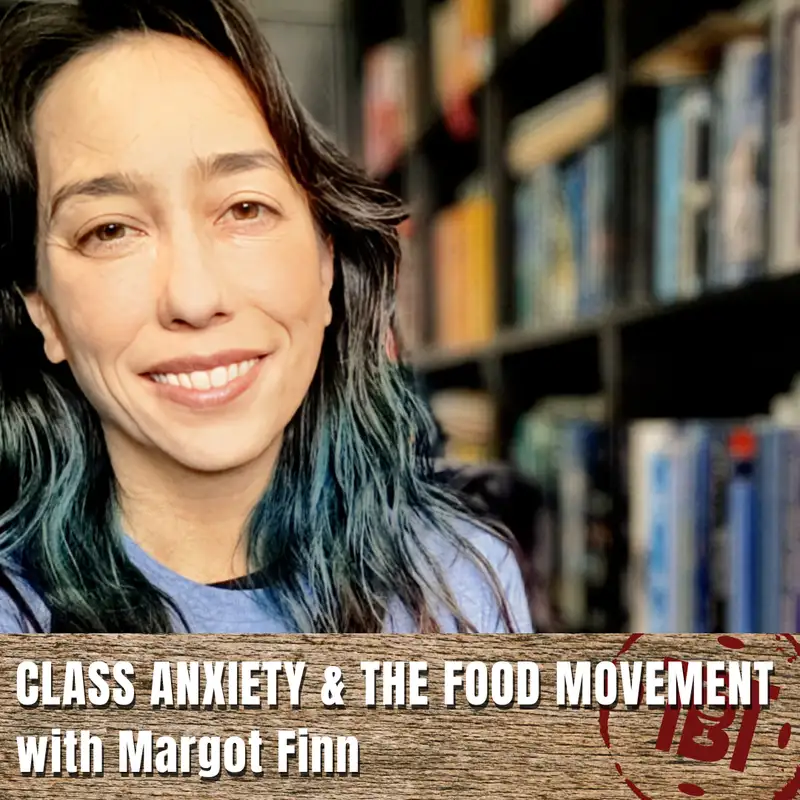
Class Anxiety & the Food Movement with Margot Finn
Episode 73 (Margot Finn)
===
[00:00:00]
Meet Margot Finn
---
Andrew Camp: Hello, and welcome to another episode of "The Biggest Table." I am your host, Andrew Camp, and in this podcast we explore the table, food, eating, and hospitality as an arena for experiencing God's love and our love for one another.
And today I'm joined by Margot Finn.
Margot holds an MA and PhD in American culture focusing on food studies, media studies, and 20th century US history. As a lecturer in applied liberal arts and affiliate of the Sustainable Food Systems Initiative at the University of Michigan, Margot seeks to help students integrate the many different academic disciplines they encounter in their liberal arts degrees and connect their academic work to their personal lives.
She encourages students to develop critical thinking skills and more informed perspectives on contemporary food debates, such as the ecological impact of organic versus conventional agriculture, local versus imported foods, the biology and culture of fatness, immigrant labor in the food system, and the history of elite food reform efforts.
So thanks for joining me today, Margot. Uh, really [00:01:00] looking forward to our conversation.
Margot Finn: Thanks so much for inviting me.
Andrew Camp: Yeah. So I came across your work through when I was interviewing Mark Johnson on American Bacon, and he referenced your book, Discriminating Taste, and it intrigued me and, um, and so I, like a good podcaster, I gotta follow the rabbit trails and see where things lead and who's, who's writing interesting things.
And so your book definitely piqued an interest and, um, is a great look at where we are in this modern food revolution. So, so I appreciate your work.
Margot Finn: Thank you. That's really kind.
Andrew Camp: So before we get into your work, Discriminating Taste, like what led you down this path towards food and food studies and sort of this interest in, in this modern food revolution?
Margot Finn: Sure. I mean, I, um, I came to grad school thinking I was gonna study the reception of US media in the Middle East. That was like my good, serious 20-something project- Yeah ... that I thought was gonna... And it was like a really post-9/11 project, [00:02:00] um, trying to figure out w- uh, you know, the, to a- to-- The more academic answer to that question some people were asking of like, "Why do they hate us?"
And like I, I didn't think it was such a mystery- Right. ... you know, but I didn't wanna... But there was a mystery in like, okay, um, what is hated about whatever it is we represent? What does America look like from the outside? Yeah. And also, you know, I, I'd heard about, um, these interesting scenes of like people tearing down posters of Britney Spears, which it's interesting that the posters of Britney Spears were there in the first place.
It's interesting that they get torn down as a-- And, and I was interested in all of that. Um, but I tried to learn Arabic, and I don't know if you've tried. It's hard.
Andrew Camp: I can-- Yes.
Margot Finn: Um, and I, and I was trying and trying, and also trying to master critical theory and doing the whole grad school thing, and realizing that if I persisted in this project to do ethnographic reception work on the reception of US media, it was gonna take me 10 years to [00:03:00] maybe be fluent in the language that people didn't even speak, the not vernacular, you know?
Right. Um, and I didn't wanna be in grad school forever. Um, so I was gonna leave and be a sommelier, 'cause the only worldly experience I had ever had outside of academia was food service. I was pretty good at it, um, and thought like, "Okay, I can, I can translate this into something with a little more status and a little bit of-- I can do some book learning around this, and I'll be a wine expert, and then that'll-- I can do food service, but it'll seem like a career."
Right. You know? Um, and my grad school advisor was a little bit like, "Well, okay, that sounds-- You would probably have fun as a sommelier in New York City for a few years, and then you're gonna get sick of working nights and weekends, and, and what then?" 'Cause he was, he good dad-ed me, basically. Right. And, and he was like, "Why don't you just write a dissertation first, sweetheart?"
And that sounded reasonable. I was like, "Okay, Dad."
Andrew Camp: Nobody's ever said that. I've never heard somebody say that the reasonable thing to [00:04:00] do is write a dissertation.
Margot Finn: It's, it's kind of that. And honestly, you know, I think we've gone back and forth, him and I, over the years about whether or not this was, like, good practical advice.
But it was probably... It was, I will say, loving advice for me because he s- he saw that I really wanted to live in libraries forever, and that there was a route there, and that if I could take a swing at it, I should. Right. Um, so, so then we, it was like, "Okay, so not U.S. media in the Middle East. What are we gonna do here?"
And he was like, "Well, you're interested in food. Go find out why we went from the cocktail hour to the wine and cheese reception, and see if there's something in that." And I was like- Right ... "You're not gonna let me do this, but okay. I'll... Let me go," and, you know, kind of like opened the door into, like, I went to a food studies conference and found my people.
Andrew Camp: Right.
Margot Finn: Uh, academically. They were so welcoming, and there were all these questions that it turned out it was valid to ask, and nobody- Mm ... made fun of me for asking. And I had been fascinated by food and interested in food a long [00:05:00] time. I just didn't know that there was a home for that in academia. Um-
Andrew Camp: Right
Margot Finn: but then I got lucky.
Andrew Camp: Then you got lucky.
Origins of Food Revolution
---
Andrew Camp: And, and so here we are, and so you've written this book, "Discriminating Taste," the subtitle being "How Class Anxiety Created the American Food Revolution." And so there's some modern ideas of what the food revolution encapsulates, and so before we, you know, get into your thesis, like what, what are the common understandings of how we got to this modern food revolution where kale is now seen as the ubiquitous vegetable for us all to eat?
Margot Finn: Oh, I love that way of putting that question. Um, yeah, and that, I mean, uh, to me it kinda seemed like common sense, I guess. When, when I, when I came at these questions of like, like, well how, how did I learn that I should be thin, and that that was what was important for people to be healthy? And how did I learn that organic vegetables were better for the environment, and a good virtuous [00:06:00] person eats free range eggs?
Like where, where did those ideas came from? 'Cause those seem like common sense, you know?
Andrew Camp: Yeah.
Margot Finn: So I think, um, I, I don't even know if there's... Like I, I, I give names to these different stories in my books, but I think for most of people, um, this is how, uh, ideologically hegemonic, to give it the big academic term, uh, ideas are.
They, they're the air we breathe. They feel like common sense. They-- We, we might have multiple different ideas about why they're good, but usually their goodness is kind of uninterrogated. These are just- Hmm ... it's just the air we breathe. This is the stuff I want, this is the stuff I don't want. And, and, um, media scholars, you know, the, lots of people look at these from different ways.
Media scholars often look at advertisements because those are where we can, I guess, um, pull back the curtain a little bit 'cause somebody is speaking to our desires. So when we see what an advertiser is speaking to, then we go, "Oh, well that's something that people want." And then we can start asking questions about, okay, so why do people want fresh food at this [00:07:00] particular moment?
When at other moments we can see that people saw fresh food as dangerous and scary and likely to carry pathogens. Right. Something people are coming to a different awareness of again.
Andrew Camp: Yeah. Um, and so your book talks that, you know, really the modern contemporary food revolution began, you know, in the late '70s, early '80s, with the divergence of great wealth.
So as we saw a spike in the super wealthy, we see a spike in this modern food revolution. And so- explain
Margot Finn: Where did that icon come from? You know,
Andrew Camp: like, yeah, where, you know.
Margot Finn: Sure. Well, I think the, um, the place where that idea came from really is not from this latest m- so I did start looking for that moment of like, okay, so how did I learn that food was this and that?
Yeah. And many of those ideas seemed to, um, become mainstream in the 1980s, but when I looked further back at co- like, so when did we learn really about weight loss? Well, there was a real big craze for weight loss dieting popularly in the 1920s. [00:08:00] Hmm. Um, so I couldn't just look back to, well, it wasn't the 1980s when we learned that thinness was good, but instead there were these earlier moments where weight loss dieting was popular, and then it was not so popular for a good amount of time.
And the more I looked into a lot of the things that I had come to understand as unquestionably, unproblematically good and good for all time, had become good around the time I was a child, become-- became ascendant in my adulthood. But they had this earlier moment in the 1920s where- Hmm ... many of those things were good, especially for the upper middle class women who were defining what was goodness in food at that time.
Huh. And that's, I think, where class started to seem a little bit like, oh, maybe this is part of the equation, when it was not everybody eating in these ways that seemed very familiar to me, wanting natural food that was pure, wanting weight loss dieting, wanting ethnic foods, and wanting to have Japanese teas that would be very authentic.
There were all of these ways that the upper middle [00:09:00] class was eating in the 1920s that felt very recognizable to me as the ways that I was trying to eat as a good, virtuous middle class striver in two-- you know, circa 2005, right?
Andrew Camp: Right.
Margot Finn: Michael Pollan rhymed with Upton Sinclair in this way that... And then, then it was kind of the mid-century that had to be explained.
And one thing that I knew coming from an American studies background was that the mid-century was very weird in a lot of ways, that there was a middle class consolidation of power and status that we had not seen before or since.
Andrew Camp: Right. And so, um, I came across this work from another guy about, like, America's special century from 1970-- 1870 to 1970, and that the GDP growth, you know, we saw in crazy amounts of GDP growth at, like, 3%, he said, that we-- we're not gonna see again 'cause it was special, right?
Like, and... But so does GDP growth, when we h- see higher GDP growth, does that [00:10:00] coincide with a less posturing of the middle class to get food? Or like, 'cause you write that, you know, really when the middle class is flourishing, there's less of a posturing for eating well. Whereas when GDP, you know, when, when there is this big dichotomy, um, you know, the middle class really wants to posture themselves as something better.
Um.
Margot Finn: Yeah. That's a great question. I think what I would say is it, it's two things. You need GDP growth, and y- you also need that growth to be shared. So we had high GDP growth, and that's interesting, that kind of 1870 to 1970 period you mentioned. Yeah. I would say you, um, but the, but that earlier moment in the 1920s, you also had great inequality.
So it's not just GDP growth, it's also how broadly it's being shared. And it w- and- Okay ... in, I think in that early, earlier period, 1880 to 1920 in particular, you also saw vast inequality. And so that's where you get people striving for symbolic forms of status, and I think that's what [00:11:00] we see again in the 1980s when the middle class starts to stagnate.
So what's special really is that period after the Great Depression, when the New Deal and all kinds of labor organization, lots of forces worked to make the middle class more powerful. And then in the '70s and '80s when that starts to sunset, then I think you see people starting to do the symbolic aspiration again.
So it is GDP linked, but it's even more closely linked to inequality.
Andrew Camp: Inequality, right. 'Cause then we have this post-World War II thing where, like, eating becomes this, like, we want the processed canned food, like processed food elevates in po- you know, and so we, you know, you write that in the Gilded Age we see a growth in- eating well, and then post-World War II things revert.
So we're not looking at a progress. You know, if, if this was purely progressional, we would continue to progress, and yet post-World War II we see a reversion back to something. Um-
Margot Finn: Well, it's, yeah, it's interesting. By our current values, it does look [00:12:00] like regression. I would say that they came to value different things.
So in- Yeah ... the vast kind of in the '30s to the '70s, instead, um, having ample food was really important, having food that was consistent, reliable- Yeah ... that could please everybody, things that everybody could have. So the idea of, um, plain things. Um- Right ... you've got surveys where people would say what they most wanted, uh, their ideal meal would be a plain roast chicken and a plain Manhattan.
This is luxury, but it's luxury that's, um, that's not as- aspiring to be different, right? Hmm. As opposed to, to something like filet mignon and fancy wine, right? Right. Like there, there are way, there... Even the ways that people were framing luxury in that period were wanting to be like everybody instead of wanting to be different.
So I, I don't think it's-- I think it's more that you see a change in what people see as good and desirable, and whether or not differentiation itself is good and desirable.
Andrew Camp: Hmm. Yeah.
Taste Class and Virtue
---
Andrew Camp: That's interesting 'cause taste is such a weird phenomenon in and of [00:13:00] itself, and I've been reading a book on flavor, and you point out some stu- like flavor, like good taste is a weird phenomenon that is not just, you know, it's not inherent.
It's learned. It's cultural. Um, and so like what you're aiming at describing is that my love of a premier cru Burgundy may have less to do with inherent goodness in the wine and may be a posturing of me wanting to look better than I might actually be.
Margot Finn: Well, and what's fascinating is it turns out that if you think that wine is more expensive, you will think it tastes better.
Right. We know this, right?
Andrew Camp: Yeah. Yeah.
Margot Finn: Um, and, and we know that even people who rate wines as a profession are no better than chance when it comes to identifying. So, so, um, so something else must be going on there because we also know that wine is available at vastly different price points and means different things to different people, and [00:14:00] means something different than Budweiser.
Andrew Camp: It does. And you even point out the study that just blew my mind of that they got, you know, this study from in France where they gathered university professors from the wine st- college, and they had them sniff a red and a white, and then, then they came back and they dyed the white wine red, and people described it as a red wine even though, like...
What, what, so what is going on with, with taste and flavor then?
Margot Finn: Oh, many things. Many things. I mean, the brain is weird and wacky, right? Right. Like, um, so I would say that context matters a whole lot, and that's not crazy. We're social creatures, and we often eat in social environments, and we take cues from other people to tell us whether or not what we're experiencing is good, bad, or, or other, right?
Andrew Camp: Right.
Margot Finn: So of course these things matter. And also our, our experience of taste is going to be influenced by those things. So almost everybody has had the experience of tasting something [00:15:00] that they don't like at first, and then over time they come to like it. Maybe they even come to really like it. Mm-hmm.
This is particularly true of things that are bitter or fermented foods, cheeses, pickles. Um, most people on their first encounter with things like sauerkraut and gefilte fish and tea even, uh, anything that's got smoky flavoring, all of these things are-- they're challenging and they require repeat stimulus, but- Right
you can acquire them, and then those tastes that get acquired have all kinds of associations, right? Sometimes the hardest-- Well, very often the hardest to acquire tastes get associated with, with maturity and masculinity and expertise. So you-- I mean, I, I hope you're already thinking about things like scotch and- Yeah
um, really hoppy IPAs and all of these things are, are blue cheese, right? Super funky, weird flavors that we don't expect children to like that take a, a lot of exposure to decide [00:16:00] is, um, good food instead of something that would poison me, right? Right. Yeah. Which bitter and funky smells often are in, in nature.
So this is like, it's like a mark of how we get acculturated into eating the vast array of things omnivores can eat.
Andrew Camp: So you just keep-- You know, I just thought I was a better person because I loved my scotch and I loved Époisses blue cheese, or Époisses cheese, and I like blue cheese. But, you know, as I study food more, these are learned behaviors, you know, and it's wrapped up in culture and posturing in, at times, and sort of these four idea...
You, you talk about the four ideals of the food revolution, of sophistication, thinness, purity, and cosmopolitan. Um, and so yeah, like what-- Okay, so where are-- You know, we've talked about a little flavor and we're-- I love just talking to people about food, and so we're just, you know. Uh, so like where are we in this food revolution and what are these ideals that, you know, [00:17:00] sort of guide but at the same time contradict each other?
Margot Finn: Yeah. That's a great-- So I came up with these four mostly as a way to just conceptually organize. Here, my kitty wants to join us. This is Mystery. Um, and she's sweet and shy, and once she realizes that she's on camera, she may disappear. And- Yeah ... oh, you didn't wanna be part of that, sweetie. Well, um, so the four pillars were, again, I think I was, um, as I was trying to figure out this morass of here's all these ideas about how to eat better, and then anytime I went to scratch under the surface of one, it turned out like not only was it not new, mostly they had this moment in the '20s, and then they mostly weren't actually better, right?
All the reasons that I had been told about why they were better fell apart on very cursory kind of examination. Um, which made me realize like, okay, actually, I wasn't convinced by evidence that these things were better anyway. So starting to look at, okay, where do these things come from? And, and so really to simplify it for myself, divide it into the things that I felt I was aspiring to.
The idea of sophistication or [00:18:00] gourmetness, this idea that I had to know about fancy foods, um, had to know about French foods. Right. The names of foods. Um, and not because they were... And not like, uh, not to learn about other people way, but because these were, these were what rich people were supposed to know about, right?
They, I, I could see that was status. That was the easiest one to see status. But then even with weight loss, as I learned more about where the ideal of thinness came from, who had been involved in weight loss dieting, um, who had resisted weight loss dieting, it, it was one way less evidence-based than I had been led to believe.
Right. Um, and also very much a n- again, a project of elite white women that was more about distinguishing themselves in terms of aesthetics and this imagined virtue than it was really about doing anything for anybody's health. Um, natural food was interesting in part because there was-- I felt very tied to that movement because of ecological reasons.
I was vegan for a while. I tried to eat local food, was very into Michael Pollan for a while. Right. [00:19:00] Um, and then to find out that most of the arguments that were being made in favor of these things were not real or valid, that they were not better, and also to realize that I had not started doing these things because of any good reason, right?
Somebody had given me a real flimsy story, and I had been like, "Oh, yes, I, I think that corn is definitely the death," you know? Yeah. Right. Um, um, so I guess I was interrogating my own beliefs and finding that there was not much there, but underneath each of them, I could see the desire for virtue, the desire for distinction.
I could see middle class practices. I could see the virtues that I had grown up with, which I don't wanna demonize. Um, I think the idea of trying to use information to make things better is a real good thing, and the idea that we could maybe deny ourselves some things right now so as to, to have better things in the future, these are, these are not bad in and of themselves.
But when they're stories that you believe in and refer to because they're habits for you and not because they're necessarily a real practice that's gonna improve anything in the world, well, then I think [00:20:00] we're putting our energy in the wrong place. So I guess that's where, that's where the four pillars came from.
Yeah. They were from me, truly. Right. They were what organized my own eating, and then as I interrogated each of them, it turned out they were not new, not better, and not doing the things that I wanted them to, but they were marking me very clearly in terms of my class.
Andrew Camp: Hmm. And that's where I think I've, I've struggled with, you know, is somebody who has lived and breathed in this food world and understanding food and the table and the power it has to shape us for good and the power it has to bring us together, but then also the ills of, you know, factory farming.
And so I'm, I'm caught in this place of like, okay, budgetarily, where do I-- where can I put my resources as a middle class, you know, guy trying to p- support a family? And then also the, you know, how do we feed everyone? You know, and so like if I wanna shop at farmers markets, I-- that's fine. It indicates a place of privilege for myself.[00:21:00]
Um, but not everyone has access to that. And so like w-where, like in this tug and pull of how do we take care of the earth ecologically, at the same time feeding everyone, it's this tug and pull of like, okay, what, what do I do? Um, you know, and that's, that's the tension I feel, and I've even talked to some friends about it, and we feel it of like, okay, like there's not a good answer to any one question, and yet it, it feels at times the white middle class, upper class wants to tell us, "No, if we just all get rid of factory farming, we'll be better and life will be better and we'll take care of the earth."
And it may be. Who knows? I don't know. But like, you know, here we are in this tension of how do I even eat?
Margot Finn: It's a, yeah, I... And if there's anything I would tell people, it's that they can calm down and realize that it's not on them and they can't personally fix anything, right? No, right. Yeah. And there's a little bit of, I think, I think there's a little bit of the, it's attractive to middle class drivers too, right?
That I can work hard [00:22:00] and, and fix it. Not in this case. Sometimes this needs to be about, you know, policies that are above us. The decisions that people make about what fossil fuels get used and how, and whether or not we're gonna have renewable energy, that's beyond us.
Andrew Camp: Right.
Margot Finn: Um, beyond me. Yeah. And no decision that I make about what to buy.
But it is useful to me to know that many pesticides that are used by organic certified farmers are not better for the environment. In fact, many of them are less effective and/or worse for downstream life. Hmm. But the way we do organic certification is a problem, that we've decided that organic just means not synthetic.
Andrew Camp: Right.
Margot Finn: And that's not better. No. That's just not synthetic, right?
Andrew Camp: Right. A- and it usually comes with a cost of an arm and a leg that, you know, s- some people can't afford.
Margot Finn: And it may not actually be organic anyway. Yeah. There was a great NerdWallet investigation into organic pineapple. I don't know if you know that one.
No. But there, I mean, the, um, the, the amount of, [00:23:00] uh, organic pineapples imported from Costa Rica far exceeds the amount of pineapples that organic, uh, pineapple growers in Costa Rica could produce. Oh. So there's fraud somewhere.
Andrew Camp: Yeah.
Margot Finn: But where is a really- Yeah ... good question. Are the pineapples organic or not?
Some of them are not, and they're being labeled organic. But then the deeper question maybe is could, does it matter, right? Are there more residues of pesticides that matter for consumers or anybody else on the pineapples? And there aren't, so there's really no way to tell. So we know that some of these pineapples are not organic, but we'll never be able to tell which ones.
Andrew Camp: Right.
Margot Finn: So, um, so when you think you're buying organic and that's better for anybody, I tend to think about the Costa Rican pineapples.
Andrew Camp: I, e- well, and I even remember even from Michael Pollan's book, "The Omnivore's Dilemma," he, he points out that, you know, trying to buy organic asparagus from Whole Foods that's been flown in from, you know, a faraway [00:24:00] country, is that any better than buying inorganic or unor- not organic asparagus, you know, from another place?
'Cause you're still dealing with the fossil fuels and all the craz-, you know.
Margot Finn: Well, the, and there's no way out. There's truly- No ... no way out of that, right? 'Cause even small farms have to y- And the delivery system to small farms actually means there's more total miles involved in local also. Right. So you're not saving the fossil fuels that you think that you're saving by buying the inefficient produce from the farmer down the road.
Andrew Camp: Ugh, gosh. It's like, 'cause, and so, so we feel trapped, and yet there's part of me, you know, we, we didn't talk about this beforehand. My day job is I'm a, I sell wine. I distribute wine, you know, for a small distributor, and most of our wines are small boutique- family-owned wineries that I, I want to believe.
Now after, you know, talking with you and reading your book, I may, you know, you have me questioning my whole life existence.
But like, you know, that [00:25:00] wanting to buy from them and drink their wines versus the mass-produced Josh Cellars or Meiomi, just to, to pick on them, right or wrong. Um, you know, like I feel better about myself and it feels like I'm doing something better and I want to believe that the wine is better, um, because they care about the craft.
Um, but again, based on flavor and studies of flavor, it may just be a story I, I want to tell myself. And so like is it, i- is there anything, like should I just throw my arms up and buy Meiomi and Josh and, you know? Or like is there still worth pursuing something good?
Margot Finn: Not if stories matter to you.
Andrew Camp: Hmm. Say more.
Margot Finn: I, I mean, so the idea, the idea that it's just a story, but everything's a story. Story, right. I don't, I don't, I don't think that it's just a story is actually, um, small.
Andrew Camp: No.
Margot Finn: Uh, it may in fact [00:26:00] be that you know the person who makes the wine and that they go about it in a particular way that you find admirable, whether or not it makes the taste better is, is worth it.
Right. Like that, that whole thing from start to finish might be really worth it. And it can be. And it doesn't actually have to taste better is I think-- Or, uh, it wouldn't have to taste better to somebody who doesn't care about that story.
Andrew Camp: Hmm.
Margot Finn: Maybe it's a little bit like the communion wafer, right? Like nobody else has to-- It doesn't have to mean anything to anybody else if it means something in your mouth.
Andrew Camp: Hmm. I love that. 'Cause the story does matter and like the, the art does matter, the craft w- still matters 'cause buying a, you know, we would say buying an art piece from a local artist is better than going to Hobby Lobby, you know? Uh-
Margot Finn: If it is for you, right? Right.
Andrew Camp: Yeah. That's [00:27:00] true.
Margot Finn: But if you're decorating an Airbnb, maybe you go to Hobby Lobby and don't invest so-- You know, like maybe- Yeah
you, you even have different contexts, right?
Andrew Camp: That's true. Yeah. And I was even talking with a friend long ago, or not long ago, but we were talking about wine and we were drinking a Meiomi, um, side by side with like a Willamette single vineyard pinot noir. Very different, but we both were like, "Okay, if Meiomi helps you start a journey to love something, is that inherently bad?"
No. If you stay there because that's, you know, maybe, you know. But can you grow to appreciate, you know, something nuanced, um, or different? Um, so...
Margot Finn: But do you even need to, right? Like it's-- I think I would draw it back even to like- Yeah ... if, if Thomas Kinkade is the way that you wanna decorate- Thumbs up, 'cause if you like it, then you like it.
Like- You know?
Andrew Camp: Okay. That's fair. Yeah, like if, yeah. So really it's coming down to like, okay, [00:28:00] what, what do I love, and can I embrace my journey and my story versus being informed by what the elites want to tell me is good?
Margot Finn: Yeah. Although we are so attuned to status, and I think it's okay for us to-- I mean- Yeah
we can check that in ourselves and decide- Right ... when we don't want to invest in that. But that we would have our tastes caught up inexorably in a whole system of judgment about where we fall is like we're primates. That's what we do. Yeah. You know?
Andrew Camp: No. Yeah, we do care about status. And, you know, as a wine seller, I, I do care about these finer wines, and I wanna sell, you know, the cheaper ones because that moves sales a little bit, but I also want to represent the finer brands, too.
And, um, I never consider it a bad day when I get to drink champagne or, you know, single vineyard Burgundy,
Margot Finn: right? See, so it's, I think there is some part of-- But [00:29:00] it, I think it's tough because we also feel a lot of both shame and guilt about status distinctions, making them- Yeah ... and experiencing them made about us.
There's a real sen- And it, and it's funny to me that it go- It's like there's no, there's no comfortable place to sit when it comes to class status, right? 'Cause- Right ... even to be in higher, then you're a snob or, uh, like elite is a slur. Like there's all the, you know- Yeah ... again, there's no-- You can be sneered down at, you can be sneered up at.
There's just no comfortable pl- We're deeply uncomfortable with it, even as we're very invested in where are we and how do we sit relative to other people. So it's, it's a, it, it's a very uncomfortable thing for us to both always be part of and like conscious of and, and aware of, and also have to, to try and tell people like, "You don't have to care about that."
You, you do. You're going to. You're right. But you can try and turn the dial down if it's not making you happy, you know?
Andrew Camp: Hmm. I-- Yeah, this conversation's gone a different place than I thought it would, and I love it just because I think [00:30:00] we are so caught up in, okay, what should we eat? How should we eat it?
Who should we eat it with? You know, and really you're inviting us to say, okay, like those matter, but at the end of the day, like you have to come to grips with your own story and be comfortable in your own skin and, and live that way, um, as best as we're able to.
Margot Finn: Knowing it's imperfect, you know?
Andrew Camp: Yeah. Yeah.
And so we're, we'll like what we like Hopefully we don't get stuck in what we like and we can not-- 'Cause there is the temptation just to hunker down and just never experience anything beyond, you know, whether that's-
Margot Finn: Well, there's that, but we're also very exploratory. I love this- Yeah
the, the idea of the biggest table. I think my, my goal or the thing that makes me uncomfortable about the way the food revolution was exclusionary, and I think still is to some degree, but, but not all and in all ways.
Andrew Camp: Yeah.
Margot Finn: I don't like the idea that somebody might be made to be uncomfortable by not knowing or not already buying into a particular kind of [00:31:00] aesthetic or ideology, especially when those aesthetic i- and ideologies are often based on lies, which they are.
Andrew Camp: Yes.
Margot Finn: Right? So that's-- And we all want to avoid that, I think. Right. You know, nobody wants to be judging people, especially based on false, uh, ideas about what's better and worse. And, and it, and then it, but it makes people so uncomfortable that they've been doing that, that it's like, I don't know. It's-- How do we get to a place where it can really just be like, it's okay if you wanna bring your KFC into this urban garden.
That's fine. It's not wrong or un- unwelcome in any, any more than it would be wrong for us to take this, you know, salad of locally harvested greens into a, a picnic table at a cafeteria, right? Like can- Right ... can we all mix and give people options and then be okay with whatever people choose, even when it's Jell-O and KFC and Kraft Dinner?
Andrew Camp: Mm-hmm. And, and yet with the food revolution, like you said, it is this space of judgment [00:32:00] or elitism. And so, like, has this food revolution brought anything good? Like where, where's, where-- Is there some goodness? Oh,
Margot Finn: well, I love the aesthetics. I don't know about you. Yeah. But I love a farmer's market and an urban garden, uh, just like many people do.
And I think more green spaces in cities is absolutely essential to people's wellbeing.
Urban Gardens Beyond Food
---
Margot Finn: Um, I would like to see it happen a little bit bigger infrastructurally. I think the problem with a lot of urban farms and gardens is that they get abandoned very quickly, and then-
Andrew Camp: Hmm ...
Margot Finn: and that's not good for e-- Right?
Like once you have... It takes a lot of labor and infrastructure to create, and then when they go fallow within a few years, which is the typical kind of life cycle of these things, that again, it doesn't benefit anybody. Um, I would like to see more tree planting in cities. In the neighborhoods that need urban gardens, probably an actual tree canopy would go a lot further towards making it possible for people to be outside among their neighbors.
So if there's something that I really love about urban gardens, it's that they [00:33:00] sometimes were at least temporary oases where you could get away from the city heat and be around your neighbors in a beautiful place, and maybe share some food that was grown there. The food, I think, is like 10th on the list of the things that those spaces might do for a community.
Andrew Camp: Hmm. No, that makes sense, 'cause, you know, again, what the-- if the goal is to bring people together and to help, you know, nourish people in, in a flourishing moment where it's-- we, we care about more than just what they eat, but about the flourishing of their whole life. You know, what's, what purpose does a garden serve, uh, you know, i- is an important question to ask of like, how does this help people flourish versus how does this help people eat better?
Uh.
Margot Finn: And I don't think urban gardens are really a very good answer to making people eat very differently. It doesn't seem like the research suggests that they are. Okay. Yeah. It doesn't seem like the practice suggests that they are. But can they be really nice gathering spaces, and is that important? I think so, but we might need to structure and maintain them differently if that's our goal.
Andrew Camp: Hmm. Interesting. Yeah.
Food Narratives and Field Shifts
---
Andrew Camp: And so then your book came out in [00:34:00] 2017. We're almost 10 years post-publication and lot has changed, you know, uh, y- you know, in 10 years. And so, like, what, what have you seen over the past 10 years, or what might you a- add conversationally, like, you know, where we are? Obviously, the class distinctions have only, you know, amplified.
We-- You know, Elon Musk being the first trillionaire, like, there's something wrong- Sure ... inherently wrong, I, you know, personally, you know, I think with a trillionaire. But, um, you know, here we are.
Margot Finn: Oh, that's so interesting. I do think-- So a, a number of things have sort of... Things have changed and then they haven't.
Um, I still get students who believe... It's funny, students' beliefs haven't changed, right? Like 10 years ago, I started out, I, I was like, "Okay, so organic isn't really better, local isn't really better, weight loss isn't really the key to health or better." And y- like, and students would just-- It was just like, "What?
Everything I've been told [00:35:00] is wrong." Okay, that's still the same. People are still coming into my classroom with exactly the same beliefs, but they're much easier to get under now. The- Right ... I, I teach an entire class on obesity, and it used to be we would spend the first eight weeks getting people to the point of being like, "Okay, so maybe fatness isn't the worst, but we still should probably fix it."
Right? Like, that's where I could get people, you know. And by the end- Right ... of the semester, I had-- It would-- a mix. Now it's like after week two, they're like, "Oh, yep, turns out it's all bullshit. Okay. Now, so how, how and now, now what?" Yeah. And, and it's, um... And so I've had to adjust to they-- Maybe I'm better at some things too.
I don't know. There's like many things that have changed, but one of the things that has changed is people are much more willing to believe that everything that they've been told is wrong.
Andrew Camp: Yeah.
Margot Finn: So that's interesting.
Andrew Camp: That is
Margot Finn: interesting. Um, and e- and especially on fatness. I think- Hmm ... I, I do think some part of it is fat activists and health at every size people have made a little bit of a dent, that there's been a little bit...
And like with Lizzo, there was [00:36:00] some kind of public awareness around questions about whether fatness was so bad. But I-- But somehow that one has fallen apart more. I think COVID did some of it. I think that changed how people feel about health in general and I-- and whether or not fatness is the worst.
Andrew Camp: Hmm.
Margot Finn: Uh, is my-- That's, uh, that's foggy though. I- Right ... I have a sense that COVID changed something around fatness in particular, um, but also that was declining as it was. Um, what else has changed? People care a lot less. There was like, there was a while where food was just everywhere, and I, I mean, that was the Michael Pollan moment, right?
Right. And like, and, and farmer's markets, and there was all of this. And then I was a real wet blanket, 'cause all it-- I, I mean, I just kept saying, "Well, not really. It's not really better." And like, yes, I, yeah, food, yeah, I, yes, food, but- Yeah ... no, not the way you're doing it. Um, there's-- it's much less loud and intense and, and people are now-- The people who are still doing that kind of thing are sort of lagging and hangers on, and there's so, there's just a different energy.
Um, and the [00:37:00] fact that there's questions about it is not so new. So I feel much less novel and, um, less shocking and less like a wet blanket all the time. Right. And more like I'm the person you go to when you're having-- when, when you're past your nihilism crisis and you wanna go play in, in the playground of the aftermath, I'm there, and I've been there for a little bit, and it's fun, and we, um, eat Pixy Stix and also kale.
Both.
Andrew Camp: Right.
Margot Finn: Yeah. You know? Um- Yes ... so those are some of the things that have changed.
Andrew Camp: So what are we seeing in food studies then? Like where, where is food studies moving towards? Oh, that's a great
Margot Finn: question.
Andrew Camp: You know, and, and what-- You know, I, I, I-- It's more for my curiosity's sake of like, okay, like where, what, what are people, you know, like you and Mark saying about like w- where is food headed?
Margot Finn: Oh gosh, I don't know where food is headed. And he- Yeah ... and he and I are both historians, so, or I'm not a histor- I was raised by historians. Um, so we we're reluctant to predict the future. [00:38:00] Um, I will say I'm very-- I have real fears about what I'm seeing with the Cyclospora outbreak, um, regarding our food safety system.
Mm. I thought that somewhere s- there were adults still in charge, and now I'm really feeling like maybe that's not the case. Um, so some concerns about our overall national food health and safety infrastructure. But that aside, um, food studies, I don't h- I don't even know if I have a good picture on the field at this moment.
My sense is that it's maturing to the point of differentiation, so people are, uh, um... and this I guess happens in a lot of fields. There's more balkanization and there is even institutionally, um, we're seeing a splitting apart of the people who do agriculture stuff, and the nutrition stu- people didn't ever really come to play as much anyway.
Um, but the ag people and then the history culture people are splitting somewhat, in part because the agriculture people are really US-based and US-centered. Something like 80 to 90% of their [00:39:00] organization is US.
Andrew Camp: Okay.
Margot Finn: And only 60% of the cultural studies side is US-based, with 40% of our membership elsewhere.
Andrew Camp: Okay.
Margot Finn: So w-we're sp- we have... historically, we've met together, uh, n- but not even forever, like 20 years we've been meeting together somewhere in the US. It no longer makes as much sense for North America to be the sole annual meeting place for particularly the cultural studies side, so that's gonna be more...
They're now, this next year they're doing six, I think, meetings around the world. One will be in New York, but a number of them will be somewhere in the Global South, which is good, but also a challenge in terms of thinking of how many of these are anybody gonna actually get to. And so I guess maybe that's a long way of saying Parts of the organization, especially the parts that are not as focused on agriculture, are becoming much more international in focus, which is great-
Andrew Camp: Yeah
Margot Finn: because historically the focus of food studies has been really kind of US and insular, and I'm part of the problem in that domain, and so is Mark. Um, [00:40:00] but it's becoming broader, and then that's making it much harder to track where people are and what people are doing, um, which is probably a good thing for the literature, but a bad thing for anybody knowing what's going on.
Andrew Camp: No, that makes sense. And, you know, I think, yeah. Again, you know, you may be part of the problem, but you tell the story of where you are, and you're situated, and you can't tell the whole-- You know, you can't tell the global story. It's true. You know, and so again, you are where you are, and much like you said with the table, like, you know, bring your KFC, bring your...
You know, and hopefully we, we learn from each other.
Margot Finn: Yeah. I'll bring the American cheese. Somebody else can bring, like, the salad.
Andrew Camp: Yeah, exactly. Yes, yes. We, we need, we need the French cheeses, we need the American cheeses. You know, we need it, we need it all. You know, the more cheese the better, in my opinion.
Margot Finn: I... Yeah, amen to that, and lactose intolerant people will get you too.
Andrew Camp: Yes, we'll get you too.
Sharing, Reciprocity, and Wrap-Up
---
Andrew Camp: Um, but you do help, you know, in the midst of where we [00:41:00] are in making sense and questioning these narratives, you do end your conclusion in the book with sort of some ideas of, okay, is there a path forward or what do-- how do we...
Given the tension we face and, you know, damned if we do, damned if we don't times, you know, the way I feel sometimes, like what can we do? And so, like, how can we move more in a healthy, maybe robust, I don't know the right word, but you know, in a more true sense in this food narrative?
Margot Finn: That is-- Uh, yeah, I think there must be.
But would you remind-- Do you- Yeah, so- You've read these more recently. What do I say we should do? 10, what, 10 years ago, what did I think?
Andrew Camp: You said we should be more critical of the food narrative, so question, you know, we should question it. Um, reform efforts must include input of the target population. So if we're going to, you know, in my instance, you know, the Navajo Nation is close by, and so if we wanna address food insecurity in the Navajo Nation, it [00:42:00] behooves us to actually talk to the Navajo Nation, um, before implementing programs.
And then aim to cultivate a greater awareness and tolerance about how class difference shapes taste. So again, I think the last two go hand in-
Margot Finn: I endorse all of those.
Andrew Camp: Yeah. No, they were really helpful, and I was like, "Oh," like, "this is, like, really..." You know, we've been critical of the food narratives, and so if we're aiming to look at fixing hunger and food scarcity and food deserts, which I think is a worthwhile goal that we can and should aim towards, we, we need to not do it from a white privileged perspective.
Um, you know, but then as a white middle-class male my whole life, like, I should be akin and clued in to how, you know, the foods I eat have shaped me more than, you know, I care to admit, and that what Latino neighbors or, uh, Indigenous friends eat, you know, can we be open to [00:43:00] their expressions?
Margot Finn: That's awesome.
That all sounds like exactly what I want for people to do. And the, I mean, the nothing about us without us, I get that from disability studies, and I think that that's, it's just crucial in so many realms, you know? Right. And it's true in education, right? Like, could we involve children in telling us what they need and then really listen to them and give it to them?
Could we involve the parishioners of any church in telling us what they need and just really listen? And there's just, you know, like if we just listen to people, they will tell us. And if people are telling us, "I don't really need more locally grown vegetables, what I need is money," oh my God, give it to them.
That's really what they need. And will they eat better? Yeah, they will, 'cause they'll have time to eat the way they wanna eat, and that will be better for them.
Andrew Camp: Yeah. Well, I interviewed somebody from, um... I did a hunger series, like, last year and got to interview somebody from Bread for the World, and, you know, she talked about the fact that during COVID, when people were given m- you know, money to buy [00:44:00] food, they act- like, we saw child hunger rates go down.
Like, what? So people spent the money as we thought they should, you know, and were responsible human beings to take care of their kids. And so, like, giving people the means to actually buy the food they need, they'll actually do it.
Margot Finn: We find there's timing and microfinance, right? The lesson has always been, "Oh my God, give money to women."
Andrew Camp: Yeah.
Margot Finn: They spend it on really good things for their families. They build businesses out of a single cow. They feed their children. All kinds of good things happen when you give money to people who need it.
Andrew Camp: Yep. And so as we think about the table, what's the story you would like the table to tell?
Margot Finn: Uh, well, I mean, I do think bigger is al- is, like, we can be more inclusive.
You know, um, Warren Belasco, who-- one of my mentors, um, has this beautiful metaphor that he starts off, uh, his book "Meals to Come" with, where, and I don't even know if this comes from him, but the [00:45:00] idea that if you're trying to feed a lot of people, you've got a few options. You can either bake a bigger pie, this is the Cornucopian o- uh, option- Yeah
right? The idea that we could always have more and more and more. Or, um, you can kill some of the people, that's the Malthusian option. Um, or the William Godwin option is to teach everybody better manners. You can share what pie there is to be baked among as many people as there are to share it with, and that's the hardest option, but that's the one that I'm always aiming for, is I don't think- Mm
we can b-bake infinitely bigger pies, although we should try and bigge-bake the biggest one we can. Right. Um, and I would prefer not to kill anybody. So I think we all need to try to learn the best manners that we can when it comes to sharing.
Andrew Camp: Equality. Maybe there's something, you know, that,
Margot Finn: uh- Or equity, better, right?
Equity, yeah. Yeah ... let's get everybody what they need. Yeah. Let's get everybody what they need. There's also, um, and I, this is from, if you [00:46:00] know Astra Taylor's work, uh, the, oh, the book title is so good. "Democracy May Not Exist, But We'll Miss It When It's Gone." Mm-hmm. Um, her, she, there's a, an example at the end of, um, the Dish With One Spoon treaty, and it comes from Northern California, where a number of the tribes, um, before they would meet to decide on the use of common spaces, so common grazing lands and other things- Mm
they would share a dish, and there was one long spoon, and everybody had to get fed, which means, and it's really hard to eat yourself with a long spoon. There's metaphors about heaven about this, right? Yeah, yeah. You have to feed other people. So before you all sit down to talk about sharing the land, you share food, and you do it in such a way that people have to feed each other.
And I think that there's something to, to the deep wisdom of these kinds of practices where we need to think about what does it take to feed each other, and if we think about caring for other people first, we'll get our needs met, and we'll all get our needs met, I hope.
Andrew Camp: I do, too, 'cause I think that when we [00:47:00] are obsessed in scarcity or obsessed with resource accumulation and grabbing and hoarding, um, we will forget others and treat others horri- we will go towards killing others, um, metaphorically or physically.
Whereas if we are, if we believe that there is an abundance and that we believe there's enough for everyone, we may actually find that we are all satiated.
Margot Finn: Do you also know, um, Robin Wall Kimmerer talks about the, the great saying, um, "I save my meat in the belly of my neighbor." Mm-hmm. And I really like that one too, right?
You can't save your meat, not really, but you can feed other people, and then they will feed you.
Andrew Camp: Yep. Yeah. Life, when life is that rec- reciprocity, uh, it's way more beautiful and more fun, and yet we've been shaped so profoundly by [00:48:00] late stage capitalism and resource hoarding and accumulation, extraction.
Like the stories we've been fed work against us in terms of trying to live in a re- reciprocity manner.
Margot Finn: They do. But then David Graeber also, um, "Live as if you are already free," right? It's true. Mm-hmm. Yeah. We can understand why we're trapped, and also you got one life.
Andrew Camp: So- Yeah, so you can... Yeah. Live a more beautiful life and share and not...
Yeah. It-- But it's hard 'cause then the tensions- It is ... we face pull us back.
Margot Finn: And we live in the world. We didn't- Yeah. You know, we live in a world not of our making.
Andrew Camp: It is. But we can aim to look, maybe leave it slightly better for my girls.
Margot Finn: Yeah.
Andrew Camp: You know? Um- For
Margot Finn: all of them.
Andrew Camp: All of them, yes. So some fun questions to wrap up about food.
Sure. Is there one food you refuse to eat or maybe won't choose willingly?
Margot Finn: I do not love banana. I had a really bad experience with banana flavored erythromycin at [00:49:00] four and threw up a lot of banana flavored medicine. And- Oof ... uh, but it's close, the, the fake banana flavor is close enough that real banana also I d- I'm not.
Okay. It's... Yeah. That's a forever one. Um, but I don't love okra or mountain yam or nopales. It's that sliminess that they all share. Okay. Yep. That I, I will eat those things, but I would not choose
Andrew Camp: them. Well, and yes. I, I've had to, I, I'm rethinking of how to ask that question 'cause people are like, "Well, there's nothing I'll refuse," you know?
But is there something I may not willingly- I
Margot Finn: bet they're, I bet they're just not willing to admit. I know. Maybe. There's something almost everybody refuses.
Andrew Camp: Yes, I know. Yes. Um, what's one of the best things you've ever eaten?
Margot Finn: Oh, there's so many. Oh my goodness. Um, today I had the most amazing watermelon. Oh, it was so good.
Huh. Um, two of them actually, 'cause there was this kind Black Diamond at the supermarket, and I was like, "Well, I have to find out if it's better." Yeah. And I had to pick, like, the best seeming seedless watermelon next to it that I could. Both of these watermelons were, like, out of the park. I ate, like, a quarter of [00:50:00] the watermelon myself, and I'm not sad, and I might go eat another quarter of it afterwards.
No. It was so good. So really... I mean, p- fruit at its peak. Yeah. A, a ripe mango, I would eat all day any day until I was sick.
Andrew Camp: For sure. Yes, fresh fruit at its peak. There is nothing...
Margot Finn: Peaches.
Andrew Camp: Yes.
Margot Finn: Oh my God, peaches.
Andrew Camp: Yes.
Margot Finn: Yeah.
Andrew Camp: Yep. No, I would... Yeah, there's... Yeah, fresh vegetables at their peak. Fresh fruit and vegetables at their peak are-
Margot Finn: Mm-hmm
yeah. Oh, peas out of the garden.
Andrew Camp: Mm-hmm, or tomatoes. Yeah. I think my mind changed on tomatoes when I got a fresh tomato from a You know, a stand.
Margot Finn: That's the one everybody-- And so that's the one everybody brings up 'cause that's the one where you can really tell. There are very few kinds of r- vegetables where I could tell in a blind taste test.
Yeah. Yeah, tomatoes, 'cause the commercial ones, to, to make them firm enough to travel, they really suffer. But, but most produce, man, our supermarket stuff, we are so spoiled.
Andrew Camp: We are. Yes. I think peaches, peaches are, are, are great from, you know... [00:51:00] 'Cause supermarket peaches always come so underripe that by the time they're ripe, you're-
Margot Finn: If you get- It's hard
if you let them ripen, though, they can still... Now that we got some amazing- Yeah ... ones from Trader Joe's earlier this summer, and then, and then it's been months since until we could get Michigan ones.
Andrew Camp: Sure. And then finally, there's a conversation among chefs about last meals, as in if you knew you only had one more meal left to enjoy, what would it be?
So if Margo had one last meal, what might be around your table?
Margot Finn: Um, I would have a loaf of my sourdough starter, uh, just a crusty loaf with butter and salt and an entire bottle of Châteauneuf-du-Pape.
Andrew Camp: Oh. Is that, that's your go-to?
Margot Finn: All for me.
Andrew Camp: All for you?
Margot Finn: Oh, God. It's not a go-to. That would-- No, that, that would be- No, no
my last meal. Yes, yes. Any wine, any wine is fine for daily drinking, um- No ... or, or weekendly drinking. Um, but- I know we all
Andrew Camp: have that, that bottle that speaks to celebratory life beauty- Yes ... more so than other bottles.
Margot Finn: When I finished my dissertation, at my second [00:52:00] wedding, yeah, if I-- When I'm gonna celebrate something, Châteauneuf-du-Pape is, is what, is how I, uh, is how I do luxury.
Andrew Camp: What, what stands out about, about the Châteauneuf-du-Pape for you?
Margot Finn: What is it? Um, I don't-- I think it's because that's the one I taste a story in. The-- I think, you know the description in "Sideways," that, like, like the moment when- Yeah ... Miles is doing his, like, the, uh, pontificating? Um, he's not wrong.
There are some times where, where wine is thrilling, and it, it's thrilling, I think, because you taste the age somehow. Mm-hmm. And there's something about Châteauneuf that, that, um, tastes like a story to me in a way that other wine tastes like fermented grape juice, but Châteauneuf-du-Pape sound, like, tastes to me like time.
Andrew Camp: Hmm. I love that. Yes. I've not had too many Châteauneuf-du-Papes. Um, like the one- I haven't
Margot Finn: either. I haven't done that. I-
Andrew Camp: I know ... there
Margot Finn: aren't that many times you should in life, I
Andrew Camp: think. I- there aren't, yes. Luckily, like again, [00:53:00] my privilege allows me to drink- But your, but your, in
Margot Finn: your career, in your
Andrew Camp: career- Yes, in, in my career
you taste many more. Yes. Yeah, I taste, I, I drink way above my pay grade and- ... you know, my wife and I are happy about that most days. Although there's, there are times where, like, we're just tired of wine. Like, do we have to drink more-
Margot Finn: I bet ...
Andrew Camp: Pinot? I'm like-
Margot Finn: I'm having a summer of non-alcoholic beer because all of a sudden they've really cracked it.
I mean- Okay ... the, the stuff that people are making now, I have never been a fan, but for various reasons it's made a lot of sense to drink a lot less this summer, and the non-alcoholic beer available now, I am not sad.
Andrew Camp: Hmm. Okay.
Margot Finn: It's much better than, than it has been for years and years. Like s- there's hazies out there, and they don't taste like a, like a real hazy beer, but they don't taste bad either.
Andrew Camp: Oh, good to know. Yeah. We don't drink- ... as much beer anymore. They, they tend to not sit well with me. Uh,
Margot Finn: fair.
Andrew Camp: I just don't feel great, you know? And I'll have one- Yeah ... if I go out with friends, but it's not something we, we reach for. Mm-hmm. So we're, we're wine and cocktail people. [00:54:00]
Margot Finn: Yeah, I am typically too, but anyhow, it's been my summer of non-alcoholic beer and it, and it's really not bad.
Andrew Camp: No, it's great. No, good to hear. The, uh, not, the de-alcoholized wine is still progressing. It's not-
Margot Finn: I haven't tried any that has been, that I have liked much.
Andrew Camp: Some of the sparkling can be okay 'cause the bubbles help, um-
Margot Finn: Oh, that makes sense ...
Andrew Camp: you know. And, and whites- Mm-hmm ... are obviously better than reds. Um-
Margot Finn: That makes a lot of sense.
Andrew Camp: So.
Margot Finn: Yeah. Whatever-- They've figured out something that, where they can add some of the weight back, I think. So, and they're, they're often more caloric, so you'll be drinking- Yeah ... a non-alcoholic beer that's still 85 calories. There's something, like they're doing something else.
Andrew Camp: Right.
Margot Finn: Anyhow. Yeah. It's... And it's better.
Andrew Camp: No, it is. Yeah. Well, Margot, I've really appreciated this. Appreciate your time, your expertise, your knowledge. Uh, if people are interested in your work and wanna find out more, where could they find you?
Margot Finn: Oh, God. That's a good question. You can email me. Um, I'm at smargot@umich or Gmail, and I do reply eventually to most things.
But I'm not, I [00:55:00] don't have a ton of other, like, things of... And I'm, the really, the only thing I'm actively working on in terms of writing and publishing is this book series that Mark and I are doing out of the University of Arkansas Press. Yeah. Um, which I don't know if any of your listeners would happen to have a manuscript they're shopping, but we are, um, but we are looking for it.
But for food studies people who are listening- Yeah ... if you have a food studies manuscript that you would like to see in a home with other food studies, uh, publications, so people are likely to find it, and with very loving editing from me and Mark, um, we are just starting off and looking for new titles.
So that's the main thing I'm, I'm working on right now.
Andrew Camp: Awesome. Well, I look forward to it. Uh, so if you've enjoyed this episode, please consider subscribing, leaving a review, or sharing it with others. Thanks for joining us on this episode of "The Biggest Table," where we explore what it means to be transformed by God's love around the table and through food.
Until next time, bye.