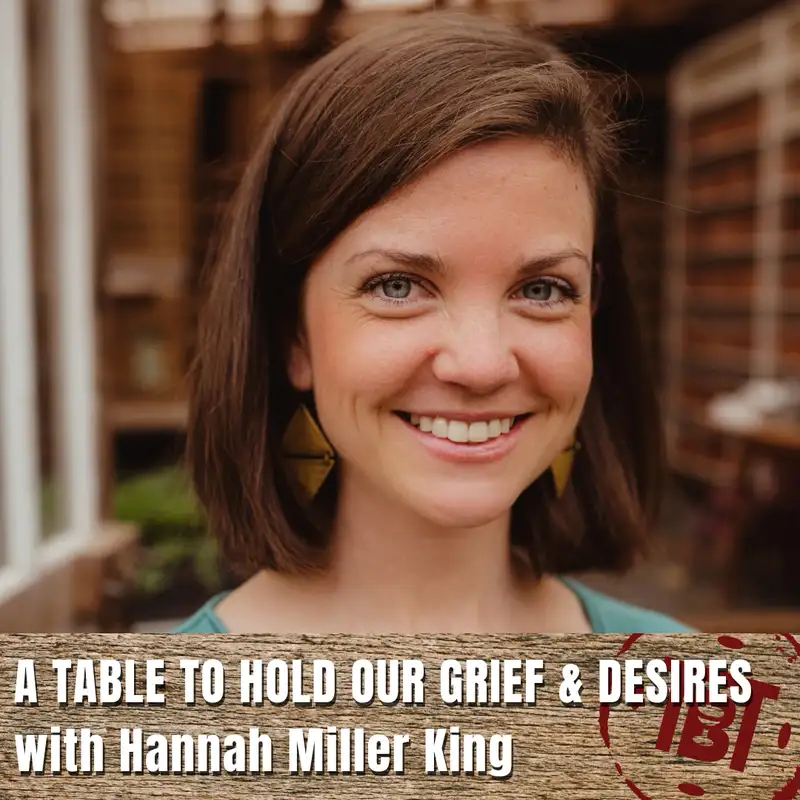
A Table to Hold Our Grief & Desires with Hannah Miller King
Episode 63 (Hannah Miller King)
===
Andrew Camp: [00:00:00] Hello, and welcome to another episode of The Biggest Table.
I am your host, Andrew Camp, and in this podcast we explore the table, food, eating, and hospitality as an arena for experiencing God's love and our love for one another.
And today I'm joined by Hannah Miller King.
Hannah is a priest and writer in the Anglican tradition. She has been a campus minister among conservatory musicians, an apartment minister in urban high rise, and a parish pastor in large and small churches. She currently serves as the associate rector at the Vine Anglican Church in Western North Carolina. She's a contributing writer for Christianity Today and Holy Post Media, and is the author of Feasting on Hope, how God Sets a Table in the Wilderness.
Hannah holds a Bachelor of Arts in Music from Westminster Choir College and a Master of Arts and Religion from Redeemer Seminary. She's currently being schooled in the minutiae of Star Wars and other galactic battles between good and evil by her three kids.
So thanks for joining me today, Hannah.
Uh, yeah, really enjoyed your book and excited. Always [00:01:00] love conversations that revolve around the Eucharist. So.
Hannah Miller King: Oh, me too. Thanks for inviting me.
Andrew Camp: Yeah. Um, no, and I appreciate you reaching out. 'cause I had heard your book and, uh, when you reached out and just really explained more of it, I was like, no, this feels like a great fit.
And, um, always wanna help enlarge in people's imaginations for what the Lord's table, the Eucharist, communion, whatever words we wanna use for it, can really form us into the people God would have us. So, uh, yeah.
Hannah Miller King: Yeah, well, likewise. When I saw a podcast called The Biggest Table, I was like, I have to know more.
So,
Andrew Camp: yeah. Yeah. Um, so here we are, and you write in early on in your book that we need a bigger frame for our grief. Um, and so your book really does unpack the Lord's table in the midst of the grief you've experienced and how that coming to this table has, you know, reframed your imagination. And so what.[00:02:00]
What do you mean by we need a bigger frame for our grief?
Hannah Miller King: Well, I grew up in an evangelical tradition that really emphasized God's ability to answer prayers and to perform miracles, and I still believe both of those things. But my father died of cancer when I was a young teenager, despite our fervent prayers.
And so I really needed, um. Just a more expansive theological framework, um, than just. Pray really hard and hope for the best. You know, because sometimes we don't get the answers to our prayers that we're expecting. Um, and I would say kind of into my teen years, I felt a little bit isolated from the community of faith because my story hadn't gone according to the sort of Christian formula.
And so finding that [00:03:00] sense of belonging again in the community of faith. Around the Lord's Supper was very healing for me because it helped me realize actually our experiences of unmet longing belong at the table. They are part of our faith. They're a feature, not a flaw. Mm-hmm. Because we believe in a story that isn't over yet.
We're still waiting for the renewal of all things, and so it's actually very important that we bring our grief with us to the table, so to speak.
Andrew Camp: I love that. Yeah. 'cause I've not heard many people talk about grief as, or I've not heard many people talk about the table as an avenue for bringing our grief.
Um, and so like, how, how did you arrive at the Eucharist? Is seeing it as a place that could hold your grief? Because, like me, you were raised evangelical where the Lord's table was. Maybe deemphasized or pushed, you know, if we made time for it, if the sermon didn't go long. Um,
Hannah Miller King: [00:04:00] right,
Andrew Camp: right. And so how, how did, how did the Eucharist then begin to take shape as a center for your grief versus an add-on?
Hannah Miller King: Well, it started when I began receiving communion every week at my church in seminary. And I was crying every week in church, and I didn't know why. Hmm. And so as I began to sit with that and reflect on it, I realized, you know, for me, uh, a lot of my grief centers around family and familial belonging. And so it was this experience of coming to a family table where I felt very vulnerable and.
Um, kind of exposed as a fatherless
Andrew Camp: mm-hmm.
Hannah Miller King: Person in my spirit, uh, coming to the table of the father. Um, it, it really kind of. Pushed on me where it hurt.
Andrew Camp: Hmm.
Hannah Miller King: You know, but it also, it was [00:05:00] welcoming. It was, you belong here and you are a daughter. So it, in a way, it was healing of my grief. And yet at the same time, in, in my tradition, the Anglican tradition, part of the Eucharistic liturgy is also, is also the celebrant says as we partake of these elements, um.
One day bring us with all of your saints to the fullness of your kingdom. And so there was this sense of longing even at the table, the sense that we're just getting a taste of the fellowship and the family that's coming. And so I, I realized my grief and all of our grief, I think can be both healed but also stoked at the Lord's table because there's a sense in which.
Jesus feeds us now in the gospel, but also, which he says and, and let this just whet your appetite because I'm coming [00:06:00] to, you know, this full feast.
Andrew Camp: Yeah. I love that, you know, you using the language of whet your, you know, your taste buds. I've always thought about the Lord's table as a, as an amuse bouche to the kingdom.
You know? Yes. As a professional chef, you know, the amuse bouche is something that enlivens the palette, you know, and gets you ready for the the full meal, um, you know, it's supposed to awaken, you know, your senses and get you ready. Uh,
Hannah Miller King: yes.
Andrew Camp: And so, yeah, when you say, you know, it's, it's that already not yet aspect that we long for, you know, and so that table helps us name our desires, you know, and helps us reshape what we long for hopefully, um, in ways that few other things may, may, can.
Hannah Miller King: Yes. Yeah, I love that. And CS Lewis and the Weight of Glory talks about, you know, the, I think he says like the scent of a flower we've not yet seen, or
Andrew Camp: mm-hmm.
Hannah Miller King: The tune of a song we've not yet heard. And there's this sense of longing for a [00:07:00] far off country. And I think, um, the Lord's Supper can be kind of a taste of the food from that far off country.
You know, we, we sense that it's real and we want it, but it's still to come.
Andrew Camp: Right. And so your book really helps us recenter the Eucharist. Um, and, and yet many of us are in traditions that don't have, you know, if we're not in an Anglican, Episcopal, Catholic, you know, um, Eastern Orthodox tradition, we may not have the Eucharist as a central element of our worship.
And so, what, what do many of us miss by not. Having the Lord's Supper as sort of the center or the climax of, of our weekly gathering?
Hannah Miller King: I mean, I think so. A lot of people who don't celebrate at weekly say, well, we don't wanna. Cheapen it or make it just feel rote. But I think what they miss out on [00:08:00] is the sense that it is kind of rote, you know, it's daily bread.
Andrew Camp: Yeah.
Hannah Miller King: Um, and it doesn't always have to be this big special thing, it's just a reminder that we're, we're literally fed by Christ when we come into his presence and nourished to be sent out then into the world on mission. But I would also say that even just pedagogically, I think. Sermons are great.
Obviously I believe in sermons. Um, but ritual and embodied practices c uh, communal embodied practices mm-hmm. Really help us to get the same information by means of a different avenue. Right. And I think that's really a large part of what happened for me is I was starting to learn the gospel. Through the practice, um, in a different way than I had through reading or listening or, you know, formal study.
So I think there's a lot to be said about just doing it.
Andrew Camp: There's a couple [00:09:00] things you touched on, one that something we do, um, we repeat that Eucharist is something we repeat on a weekly basis, whereas baptism's a one time thing. And so what is it like? And you point that out in your book and like, what is it about the Eucharist that needs to be repeated versus a baptism that is a one time event? Because it, like part of me thinks like, well, I, I need to be reminded of my death to Christ and being raised with Christ.
Hannah Miller King: Mm-hmm.
Andrew Camp: Yet my baptism is a once deal.
Hannah Miller King: Right.
Andrew Camp: Whereas the Eucharist were invited to the table.
Constantly.
Hannah Miller King: Yeah. Well, I think theologically, I mean, if we're thinking about the church as a family, you're born once.
Andrew Camp: Hmm.
Hannah Miller King: But then you come to the table, the family table, every day.
Andrew Camp: Right?
Hannah Miller King: So at the table, we're learning how to be brothers and sisters. Sons and daughters. Um, were being fed. Ongoingly. Mm-hmm. [00:10:00] I also think that, you know, the, talk about our appetites, you know, we're constantly looking for nourishment, satisfaction, fulfillment, and we're constantly looking in all the wrong places.
And so, you know, from a formation perspective, coming to the table again and again is that is a chance to remind ourselves, okay, Jesus is the bread of life. He alone can satisfy our great longing.
Andrew Camp: Mm-hmm.
Hannah Miller King: And I'm gonna direct my hunger towards him again and again.
Andrew Camp: I, I love that 'cause. Yeah. You touched on it earlier too, of this embodied practice that, you know, when Jesus asks us to remember him and remember the incarnation, it's not in the abstract, but we remember through chewing, through sipping, through swallowing, um, and you even write that the sacraments convey his love to our senses.
Um. You know, and so what it, like, how, [00:11:00] how, unpack that for us, I guess, or, you know, what, what is it about the sacraments that help us, you know, that we need to be reminded of our embodiedness
Hannah Miller King: mm-hmm.
Andrew Camp: Versus a sermon which may just appeal cognitively to who we are.
Hannah Miller King: Right. Which, again, I don't mean to diminish the cognitive, but if you think about.
You know, our pre-cognitive selves, like nonverbal infants, can still give and receive love through the senses. Yeah. You know, through eye contact, through touch. And even maybe in our old age, I mean, I remember being really struck by taking communion to. People in, um, skilled nursing facilities when I was training for ordination and how even after they really were verbal, you know, the person would come in with the clerical collar and they would just like open their mouths in their beds.
Like, you know, just like, give me the communion. And [00:12:00] it was like they still had a way of communing with God that, um. Yeah. Out outlived their ability to maybe form words. And that really struck me.
Andrew Camp: No. And um, when we were, when I was reading your book and preparing, I, I was thinking, I'm always drawn to Luke 24 in the road to Emmaus.
Mm. You know, in your book talking about grief and, you know, you talk about two disciples stricken with grief and Jesus meets him on these road. Um, you know, and he gives him the best sermon that could ever have been preached that we don't get access to. Um, but then they, they don't recognize Jesus until he, he breaks the bread.
Hannah Miller King: Yes.
Andrew Camp: Um, you know, and I'm curious, like a, as you've thought through that passage, like how has that informed your understanding of, of grief and also then meeting Jesus? Um, just 'cause I, I, obviously, it's one of my, it's my favorite passage and so it's formative for me. And I'm always curious how, how it might have formed your [00:13:00] imagination.
Uh,
Hannah Miller King: yeah, I really wanted to use that passage in my book, but it didn't, I don't know, it didn't present itself
Andrew Camp: right
Hannah Miller King: in any of the chapters that I worked on, but I mean, it's such a Eucharistic story and I love how Jesus accompanies them and he lets them talk first. You know? I think that's a good example of how God comes alongside us in our disillusionment and he.
Really, he doesn't just get to the punchline, but he, um, commits to being with us on the journey. And yeah, then he feeds us. Um, and you know, that moment then connects them back to their sense of longing. Didn't our hearts burn within us? You know, but we didn't quite understand until. He did, he did the moves.
You know, he broke the [00:14:00] bread and, and distributed it.
Andrew Camp: Right. And in that moment, you know, g you know, they thought they were gonna be the host and Jesus is the guest and everything's reversed. And you even point out in your book that in hospitality and in communion, we, you know, that the blurred lines of guest and hosts quickly
Hannah Miller King: mm-hmm.
Andrew Camp: Show up. And so like, how. A lot of us love to be the host, you know, 'cause it's a position of power or it's a position of comfort versus being a guest. And so like how, how can the Eucharist train ourselves to be good guests in a world that may not be always so hospitable?
Hannah Miller King: Hmm. Yeah. That's a really good question.
I do think we, like you said, we don't like to. Feel like we're not the person in the position of power.
Andrew Camp: Mm-hmm.
Hannah Miller King: And one of the things that really undid me when I [00:15:00] started receiving communion weekly was the whole empty hands bit. You know, you come forward and you don't have anything to contribute. Accept yourself.
Andrew Camp: Right.
Hannah Miller King: And so I think allowing ourselves to get in touch with that. And to feel the scariness of it, um, and to realize that we're kind of making ourselves vulnerable before God and saying, I'm hungry. Will you feed me? I'm, I'm empty. Will you accept me? And then marveling at how God then makes himself vulnerable in return by saying, this is my body given for you, I think can be.
A really healing and a really, um, just a reframing sort of way of even being in the world, you know, off learning how to offer ourselves as a [00:16:00] gift and receive the other as a gift as opposed to, um, showing up with our accomplishments or like you said, our sense of power.
Andrew Camp: Right. I, um, you made that phrase, you know, that Jesus shows up as the vulnerable.
Savior in the communion. And I, um, it's not a word I've heard and, you know, and it caught me, um, just, but I think it's so, so true, is, you know, obviously Jesus hanging on the cross is a very vulnerable act. But him to show up vulnerable to us, um, you know, to feed us, to meet us in these longings, um, certainly has the power to reshape our posture to the world.
Um.
Hannah Miller King: Yeah, because I mean, vulnerable just means wound able.
Andrew Camp: Hmm.
Hannah Miller King: Right. And he took on a body and became wounded for us, you know, in that kind of self offering and, and the sense that we can [00:17:00] reject him, you know, we can say thanks, but no thanks or
Andrew Camp: Right.
Hannah Miller King: I'll have this plus my other things that are really more important to me.
Andrew Camp: Yeah.
Hannah Miller King: And yet he continues to offer himself and to be generous, um, I think is really convicting.
Andrew Camp: Yeah. And so as we take communion, you know, we we're shaped by it. Our griefs are presented to Jesus, our desires. And so then how, how does that shape, you know, not only ourselves, but how does that shape us into community?
Because I think there is, you know. Paul's warnings to the Corinthians were all about, Hey, who you are as a community as you celebrate this. Um, and so often it's a me and Jesus moment, but where, where might the community come into play as we think about this table in a world wilderness?
Hannah Miller King: Yeah, so Peter Lightheart says, and I [00:18:00] quote him in the book.
We're often really interested in the zoom lens on communion. What's happening to the bread and the wine? Who gets to do it? Yeah. Uh, who gets to receive it? And we, those things are important, but we shouldn't also neglect the wide angle lens of communion, the theological aspect of the fact that at this meal, God is making a family and he's reordering society.
And you know, we see that really. Maybe more obviously in the early church when we think about slaves and free men and Jews and Gentiles and rich and poor, learning how to eat together and have this kind of equitable community in the ancient world, which was so revolutionary.
Andrew Camp: Mm-hmm.
Hannah Miller King: Uh, so what would it look like today for Republicans and Democrats to, you know, think of each other as brothers and sisters?
I mean, that's, that's can be a [00:19:00] hard pill to swallow depending on which Republicans or Democrats, you know? Right.
Andrew Camp: Yeah.
Hannah Miller King: Um, but to think, well, you know, they're in some sense my equal mm-hmm. And my brother and my sister, and. My love for Jesus is directly related to how I treat them in the body, in relationship.
Um, am I, am I neglecting those who are less well off than I am in the church or vice versa? Um, I think there's really, there's a lot to really think about in terms of how, how we do community based on the meal that Jesus is. Is hosting for all of us.
Andrew Camp: And so to make it personal, like how have you wrestled as somebody who offers communion weekly, um, to God's people, like, you know, these people, you see what [00:20:00] they maybe post on social media, um, like how, how do you wrestle in your own soul or how do you posture yourself so that you can freely offer still to people?
You may in your humanly aspect or, you know, fleshly aspect want to withhold? Sometimes
Hannah Miller King: I'll say two things. The first of which is, you know, I have not been deeply hurt by congregants
Andrew Camp: Okay.
Hannah Miller King: Per se. Um, I see congregants come who've hurt each other and it's really meaningful to see them coming and to.
Believe truly that I'm offering each of them, you know, God is offering each of them the grace that they need.
Andrew Camp: Yeah.
Hannah Miller King: To be sustained in the fellowship that they're desperately trying, they're grasping for, you know, our, our communion can feel so [00:21:00] flimsy in our human perspective, but God is on the other end of that line,
Andrew Camp: right.
Hannah Miller King: Um, holding us together. And so that's really meaningful. I have been deeply hurt by other clergy and other pastors, and so. For me, exploring communion through the lens of one Corinthians 11 and those who, um, eat and drink in an unworthy manner because of how they've treated other Christians, I think is actually really comforting to think that even our leaders who maybe are in that position of power and they're not repentant of their sentence towards the body, uh.
Jesus himself will hold them accountable in the meal that they're eating and drinking judgment on themselves. And so, you know, there's a, there's a sense of accountability kind of baked into this meal and that the leaders are not excluded from that.
Andrew Camp: Hmm. [00:22:00] It is interesting. Yeah. Because what does it mean to still just extend the fellowship and let Jesus, you know, I, I am called to.
Extend Jesus to people, even when I, I don't feel like it, or even if I feel hurt by them. And so to let Jesus deal with them, um, yeah, that's an interesting way to look at it. Um, that's challenging, but also comforting, like you said. Um,
Hannah Miller King: yeah, because I mean, historically the practice of reconciliation would've happened before communion.
Right. So we're supposed to be going to those people who've hurt us
Andrew Camp: Yeah.
Hannah Miller King: And working it out, you know, before we come to the table together. But a lot of times, uh, we try to do that and the other person's like, I didn't do anything wrong. You know?
Andrew Camp: Yeah.
Hannah Miller King: Um, that's all your problem. And so that reconciliation can't happen.
Even if maybe you've done everything in your power. And so at that point to [00:23:00] say, well, God is still involved in that situation, and I can extend peace and reconciliation as far as it depends on me,
Andrew Camp: right?
Hannah Miller King: And yet there's a sense in which, you know. Those who are un repentant, eat and drink judgment on themselves.
I don't know exactly what that means.
Andrew Camp: Yeah, right.
Hannah Miller King: Likewise. Yes. And it's, it's sobering. It's humbling, you know? Yeah. To think that could be me. And so that leads me to repentance. Mm-hmm. You know?
Andrew Camp: Yeah. Because it's not, you know, I remember being in youth group and, you know, hearing, well, you know, before you take communion, make sure you're right with God.
And it always felt like I had to clean up before coming to the table. Like, you know, you know, you think of the fifties dinner scenes of, you know, like it's, you know, like everybody's dressed in their best. And so I gotta come to, you know, Sunday table at church with my best clothes on. I can't come pour and wretched as I am.
Right? And yet, [00:24:00] like, what does that mean as you know how to be repentant and yet still come knowing I need forgiveness on a, on a daily, hourly basis.
Hannah Miller King: Right.
Andrew Camp: Has been challenging for me to think through. 'cause I'm like, wait, no, I don't need to clean up my act to come to the table, um, to receive Jesus anew, but I also can't come unrepentant.
And so there's a tension there. I think that needs to,
Hannah Miller King: right.
Andrew Camp: Yeah.
Hannah Miller King: Yes. Yeah. I think tension is a good word. Um, and that's, that's one I, I try to hold throughout the book.
Andrew Camp: Mm-hmm.
Hannah Miller King: Um, I do believe, you know, as a pastor that. The sacrament is a means of grace. And so absolutely. People who are struggling with sin, dysfunction, that's all of us.
Andrew Camp: Yeah.
Hannah Miller King: You know, we need to come begging for God's help, um, and, and expecting to receive it.
Andrew Camp: Mm-hmm.
Hannah Miller King: Um, but also we should come, um. With an open heart [00:25:00] to be convicted of the ways that maybe we're sinning against his body in the community and ready to make it right, or at least ready to say, Lord, help me get what I need to make it right.
You know, sometimes reconciliation takes years, but you know, we can come with that posture of saying, I, I want to be about this because you're about this, and so help me.
Andrew Camp: Yeah. 'cause and then it brings me to a point too of like, as we think about the table and we think about just even injustice in the world, like how, you know, 'cause you write that the economy of the kingdom is Eucharist, eucharistic, um, and so like how does coming to the table then inform how we view.
You know, society sends or you know, how we view, maybe for me it's food inequality. Like how might the Eucharist shape our imaginations for thinking about, [00:26:00] um, bigger picture, our bigger societal ills that, you know, many of us are feeling in this current moment.
Hannah Miller King: Moment. Yeah. I mean, I think it starts with this generous.
Miraculous abundance that God gives and you know that that goes all the way back to his Old Testament covenant with the people of Israel who left Egypt. You know, Egypt was the world's superpower and they controlled all the resources. Yeah. But God said, I don't need that to feed my people. And then he made bread for them in the desert, you know, and they still tried to hoard the bread, right?
Because they didn't believe that they would be there the next day. And, um, you know, as a teenager, I grew up with some food insecurity and I like hoarded [00:27:00] food under my bed because I was like, I want to save this for myself.
Andrew Camp: Yeah.
Hannah Miller King: Um, but I think, yeah, and trusting in God's abundance as a Christian. Can feel very like wishful thinking or like a convenience for rich people to say.
Andrew Camp: Mm-hmm.
Hannah Miller King: So what does it look like when you are actually food insecure or starving? Um, I think there's something prophetic about it because there is a sense in which there is still injustice in the world and there is scarcity, but. The world is also being made new. And so some of it I think is believing what's to come and, and hoping for that and trusting in that, even if we don't see it in the short term.
And also, you know, participating in that to the extent that God calls us to in terms of like relieving food, insecurity of others and not hoarding what [00:28:00] we have, but saying, I wanna participate in this. Other worldly economy. And I want to give more than I think I can give because I'm not afraid of needing to, you know, store up for my own rainy days.
But I'm gonna try to be more attentive to the Holy Spirit and participate in what he might be leading me to do, um, to, to bring about that, that eucharistic justice, you know. I'd love to hear your thoughts. That sounds like it's kind of more your wheelhouse.
Andrew Camp: Uh, yeah, I've thought about it. Or, you know, just, again, maybe not in depth or like practically what it means, but like how, if the Eucharist is this feast for the world, like it should engage our posture for helping us connect with.
Food insecurity or mm-hmm. Understand the world's [00:29:00] hunger in ways that, you know, propel us to act in ways that God is calling us to. Again, not everybody has the same passions and we're not all called to the same thing. Right. Um, and so, but at the same time, I think, you know, scriptures replete with images of God feeding people miraculously, you know, in satisfying hunger, and so I.
We minimize the Eucharist when we don't say that it should propel us to society's ills or that it's just a me and Jesus moment. Um
Hannah Miller King: Right.
Andrew Camp: But rather it's
Hannah Miller King: just a spiritual thing.
Andrew Camp: Yeah. It's just a spiritual thing. But that it should compel us to act in ways, um, you know, to feed the hungry. Um. So, yeah, I don't know.
Um, I didn't expect to the, the, the, you know,
Hannah Miller King: sorry.
Andrew Camp: No, it's good. It's good. And I need to, and I, I want to, and I, I, you know, it's more of the curiosity and thinking, you know, part of this [00:30:00] podcast has helped me think through and reframe issues and how to resort, you know, what I believe and how that might inform my being in the world.
And, um, it's easy to sit here and have the conversations. It's harder to actually go out and actually engage the world, um, in, in redeeming ways. Um, and so yeah, that's the continual wrestling.
Hannah Miller King: Mm-hmm.
Andrew Camp: For me, um,
Hannah Miller King: there's a great quote that I use in the book by, um, like a Pentecostal missionary. In Mozambique who was feeding hungry children every day, and more and more kept coming and they kind of got beyond their sense of, okay, this is how many we can accommodate, you know?
Mm-hmm. And she was praying one night and she had this vision of all these kids coming and she was saying, this is too much. And Jesus shows up and he says, you give them something to eat, and he breaks [00:31:00] off a piece of his side.
Andrew Camp: You
Hannah Miller King: know, it becomes bread. And then he says, give them something to drink. And he pours a cup of blood from his side and then he says, because I died, there will always be enough.
Hmm. And she's not a sacramental, liturgical, anglican Christian. Right. But it was Jesus body broken. That translated very practically for her and her ministry. Uh, feeding the poor.
Andrew Camp: Hmm.
Hannah Miller King: Um, that really animated her imagination. And I've, I've been in love with that story ever since I heard it in college
Andrew Camp: now.
Yeah. Now that you mention, I remember that story and yeah. It is that we operate so often from a point of scarcity that, you know, I need to accumulate all that I can accumulate in order to be safe versus, whereas the Eucharist imagination might call us. Towards the place of abundance that the community has, what it's needed to feed the people.
Um, you know, and [00:32:00] yeah, trusting that God will provide the resources for us to, to engage in ways that he's calling us to.
Hannah Miller King: Yeah. You know, lent is a little teeny, tiny version of practicing that.
Andrew Camp: Yeah.
Hannah Miller King: Every year where you fast and you say, I can't, can I learn to go without in a small way?
Andrew Camp: Mm-hmm.
Hannah Miller King: And you give alms, you know, can I practice giving more than I normally would want to?
Andrew Camp: Yeah.
Hannah Miller King: And I think it is kind of that, that training and trust for God's abundance for others, you know, not just for me. Through me, God's abundance to others.
Andrew Camp: Um, yeah. And so the Eucharist as a training ground to help us engage, but it also, I think I, you know, firmly believe that the Eucharist shapes how we relate our own home tables.
And so, like, for you, like how has, how has the Eucharist maybe transformed how you relate? You [00:33:00] know, your tables in your home or in others' homes or, um, and how do you help others think through that?
Hannah Miller King: Two things come to mind. The first of which is I want my children to grow up knowing that they, um, are persons who belong. They're not objects who. I meet my needs or do my bidding, although I do often treat them that way. Um, but at the table we learn how to be human, how to be known, and, um, fed in the context of covenant and relationship and safety and belonging.
Um, but I also think that the Eucharist really compels us to then open up our family tables. To our neighborhoods and to our communities so that it's not just about me and my nuclear family or me and my roommates, but it's about who [00:34:00] does Jesus want to bring to this table so that they too can experience that belonging and that inclusion and that nourishment.
And so for me, the Eucharist has really shaped my sense of mission, and I think that's in part because. That's what I experienced. You know, I was that child who felt kind of on the outside of belonging and community and at the, the Lord's table, at the table of church friends, I was kind of grafted in. And so I, I'm kind of like a firsthand beneficiary Yeah.
Of that mission. And I, I really believe that it can be world changing. Hmm.
Andrew Camp: You know, and I, I sometimes think too of like, um, Richard Beck has influenced my ideas, some of hospitality a lot, and he always, he talks about, you know, seeing Jesus in the other and like who, you know, um, who might be Jesus for me in that moment.
And so how to even have that posture [00:35:00] of, you know, yes, I want to be Jesus to others or show them love or can, you know, care and concern. Um, but how might they be Jesus to me in unexpected ways that they had no ideas. They were Hmm. Um, you know, and I, I wonder too, you know, as we celebrate the Eucharist, how might Jesus show up in the unexpected ways in the stranger, um, that, you know, in us trying to minister to others, how might, you know, people minister to us in, in the unexpected,
Hannah Miller King: right?
Yeah. That gets back to what you were saying about the hospitality blending. Blurring the lines between the host and the guest.
Andrew Camp: Yeah,
Hannah Miller King: yeah, yeah. A lot of times we think, oh, I'm gonna help that person, right, by including them at my table or doing this nice thing for them. And then often we're the ones who end up being blessed and being met by Christ, you know, through that other person.
I was just reading a [00:36:00] story in a book by Scott McKnight, who was talking about a woman in his church who was a nurse. She volunteered to wash the feet of a patient that came in that were like really moldy and just pussing, I mean like a really severe situation. And it started out as like, oh, I think my Christian obligation should be to do this.
Right? And as she was doing it, she started sobbing and looked up and into the person's eyes and he was looking at her and she said, and then I saw Jesus, you know, there he was. Mm-hmm. Um. And it turned into this really meaningful experience of her encountering God, you know?
Andrew Camp: Right. And I think that's where the Eucharist trains our imagination, where we can begin to see Jesus in the unexpected and the, maybe even in the mundane, um, you know, I.
I, I subscribed to Diana Butler Bass's, um, newsletter and she wrote, like, she coin this phrase, normalcy [00:37:00] as res resistance, where like, you know, that maybe in our normalcy we actually may resist the evil forces, um, around us, that maybe in our everyday eating, in our extending fellowship, we might be forming communities of resistance more than we imagined, than, you know, going out and protesting.
Um. I
Hannah Miller King: like that.
Andrew Camp: Yeah. It really resonated with me just 'cause of the fact of mundane eating and just this idea that, okay, what is my task? And I may not be able to, you know, lead a, a protest, but I, I can still, you know, sit down with my girls for dinner, um
Hannah Miller King: Right.
Andrew Camp: Sharing the laughter there, or, you know, meet with people extend mm-hmm.
You know, have people over, um, that need encouragement.
Hannah Miller King: Yeah.
Andrew Camp: Um, and so for those people listening that may think, okay, this is all nice and good, but I have been deeply hurt by the church and for [00:38:00] me mm-hmm. Just to go receive Jesus sounds too much.
Hannah Miller King: Hmm.
Andrew Camp: Um, what encouragement or. Past, you know, where, where should somebody start?
Who's, who's feeling that way thinking, Hey, this sounds nice. I'm glad the Eucharist is this beautiful thing for you, but
Hannah Miller King: mm-hmm
Andrew Camp: I can't receive right now. Um, where might people start?
Hannah Miller King: I think I would want them to start just with God's grief over that. Um, I remember reading the. One of the many reports about the Catholic, um, you know, sex abuse crisis and not to pick on any denomination. 'cause we all have,
Andrew Camp: right?
Hannah Miller King: We all have them.
Andrew Camp: Yep.
Hannah Miller King: But just being so grieved to think that for someone the cross of Christ could be their trigger, um, to their abuse was [00:39:00] just really devastating.
And I think that's only a, a small glimpse of how God feels about. You know how his name has been misused and, um, and wielded as a weapon against his children. So I think I wanna start just with permission to grieve, um, and to know that God grieves and is angry on your behalf.
Andrew Camp: Yeah.
Hannah Miller King: Um, also, I think I would say patience because.
God is with us. He's committed to us over the long haul of our stories, and a lot of things in our stories do not resolve quickly. Um, I do think, you know, some wounding happens in relationship and therefore can only be healed in relationship. And so at some point there is that challenge to take. The [00:40:00] risk.
Yeah. Again, um, I've known personally that sometimes it can help to, you know, maybe have a change of scenery. So a lot of times Christians have to switch traditions.
Andrew Camp: Mm-hmm.
Hannah Miller King: Um, you know, be in a, go to a church where the music is different and the decorations are different and the words are different. Um, but where you can still be with God's people and hear his word and come to his table.
And I think, um,
yeah, I would encourage, you know, I had a neighbor in my old town who was like, yep, I don't know that I'm gonna come back to church. And I was like, if you wanna come to my church, walk in late, wear sunglasses, sit in the back row and leave before it's over. Like, you are welcome, you know. I would say take the risk, uh, at the [00:41:00] level you can withstand the challenge, you know, and just know that God is with you in that.
Andrew Camp: Hmm. No, I appreciate that word. And I, uh, in the midst of a transition for me, I had to go to a different church, a, you know, a church that I wouldn't have normally gone to. Um, you know, that was much more progressive, but small. You know, um, and it was a healing moment and friends went with us, you know, friends said, Hey, if you wanna check it out, we'll go with you.
Um, and that was, I love
Hannah Miller King: that,
Andrew Camp: that was a gift. Um, they had been once before, they'd been a couple times before. And so, you know, finding somebody who might go with you and um, yeah. Um,
Hannah Miller King: dipping
Andrew Camp: with you that support. Yeah. You know, and hold you in that grief 'cause Yeah. Like you said, you know. We're wounded in relationship, but many times our healing comes through relationship too.
And so mm-hmm. Where, where are those relationships [00:42:00] that might provide the security you need? Um, or the safety Right. Um, to, to risk again.
Hannah Miller King: Yeah.
Andrew Camp: Um, and so a question I ask all of my guests as we wrap up, what's the story you want the church to tell?
Hannah Miller King: Wow, that's such a great question.
I think I want the church to tell a story of hope in the sense that, um, not come to Jesus and all your problems are gonna be resolved, but come to Jesus and he. Holds and sustains us mm-hmm. Until the day that he makes all things new. And also that he is trustworthy to hold us while we are broken and while we are still on the way, um, that we can come to him as we are, and [00:43:00] that we can trust that a bruised root, he will not break and a faintly burning wick he will not quench.
Andrew Camp: Mm-hmm. Yeah. Thank you for that word. It's always. Fun, interesting. Sacred to hear people's responses. Um, 'cause I think it in times it lines up with the nature of what we've been talking about, but also just expresses a heart, um, that, you know, a desire that is very deep in people. So, uh, uh, and then a few fun questions about food to, to wrap up.
Um, what's one food you refuse to eat?
Hannah Miller King: Oh, wow. This is gonna be hard for me. I love food.
I do not like brown avocados. I love green avocados. Yes. But if they get, you know, even a little bit of brown, I'm like, I can't do it.
Andrew Camp: That's fair.
Hannah Miller King: I can't scoop around it. [00:44:00]
Andrew Camp: Okay. Fair. Yes. Uh,
Hannah Miller King: I'm sure there's more, but
Andrew Camp: yeah,
Hannah Miller King: I do like most things. Yeah.
Andrew Camp: Then if you like most things, what's one of the best things you've ever eaten?
Hannah Miller King: I mean, cheese is gonna be too boring of an answer, but I do, I do love cheese.
Andrew Camp: Okay. Well, just
Hannah Miller King: passionately.
Andrew Camp: Okay. You know, my first job in the restaurant was as a fag, so you and I love, I, I I speak cheese. So like when you say cheese, I'm hoping you're not just meaning, you know. Um, you know, craft singles sliced
Hannah Miller King: right?
Oh,
Andrew Camp: are sliced, you know, Kroger cheddar, but there's a deep, you know, artisanal cheese in your, in your brain. And so like, you know, do you have a favorite cheese or style
Hannah Miller King: of
Andrew Camp: cheese?
Hannah Miller King: A deep artisanal cheese in my brain. Um, a favorite That would be hard. I mean, I really love cheddar. I really love brie goat cheese, blue cheese.
I mean, I like stinky cheese.
Andrew Camp: Oh yes.
Hannah Miller King: I [00:45:00] still remember the first time I had Brie. I grew up in the south and you know, it's, it was not exactly um, culinary fancy place, but I had some brie at a reception. And I was like, what is this?
Andrew Camp: Yeah.
Hannah Miller King: And an adult told me it's a soft French cheese and yeah. So I think, you know, the more fat and the more odor on it is the better.
Andrew Camp: No, I fully agree. Epoisses is one of my favorite French cheeses. Um, it's a stinky Okay. Stinky rind. Um, Brillat Savarin, one of the great food writers of the 19th century, I believe, said it was the King of Cheeses.
Hannah Miller King: Oh my. Yeah. I wonder if I've had that. I'm gonna have to look it up.
Andrew Camp: Yeah. Or I think our Jasper Hill Farms, um, they, they're in the US but they make this cheese and it's available at our Kroger, but it's like [00:46:00] Harbison.
It's a round, um, creamy cheese that's wrapped in spruce bark. Mm. That's really, that has a pungency. That is, is delightful. Um. Yeah.
Hannah Miller King: Awesome.
Andrew Camp: Yeah. Y yeah, cheese, a cheese and wine night is one of my wife and I's favorite. You know, like there's not much better than that.
Hannah Miller King: That's right.
Andrew Camp: Yeah.
Hannah Miller King: Wow. Yeah. It's can kind of, um, not be so great afterwards, but in the moment,
Andrew Camp: in the moment,
Hannah Miller King: it's worth it.
Andrew Camp: Yes. Yes. And sometimes your fridge smells like cheese afterwards.
Hannah Miller King: I can't eat cheese for dinner anymore. Yeah. But
Andrew Camp: yeah. Yes.
Hannah Miller King: Yeah,
Andrew Camp: no, I once wrote and, you know, as I was. Exposed to cheese. I wrote on the ferous nature of cheese and how like there's correlations, like we don't, like stinky cheeses and what does that mean for our spiritual lives And
Hannah Miller King: oh, I wanna read that.
Andrew Camp: Um, yeah, just 'cause I'm thinking, you know, it's like oftentimes we don't like the stink, but you know, in the stink there's goodness, you know, if we can get pat, you know, if we can move [00:47:00] towards something beautiful, you know, the complexity and the. Yeah. Anyway. See, now you got me going. Uh,
Hannah Miller King: that's great.
Andrew Camp: Yeah.
And finally, there's a conversation among chefs about last meals, as in, if you knew you only had one more meal left to enjoy, what would it be? So if Hannah had one last meal, what might be on her table?
Hannah Miller King: Oh wow.
Hmm. My last meal. Gosh, that's a tough one. I feel like I'm gonna cry. Um, maybe Thanksgiving dinner.
Andrew Camp: Yeah.
Hannah Miller King: Just like for sentimental reasons.
Andrew Camp: Yeah.
Hannah Miller King: Um, yeah, my, my grandfather's about to die, but, um, he fed us Thanksgiving dinner for so many years and when I was like a college student living a thousand miles away from home, I just remember.
Getting on a plane and thinking about pie, you know, at Thanksgiving [00:48:00] and just the comfort of those family recipes. And, um, yeah, all the calories, you know, the dessert. I think that might be it. Thanksgiving dinner.
Andrew Camp: All right. Is there a recipe of your grandpa's that sticks out from Thanksgiving? Like you said, pies, but, um.
Hannah Miller King: Um,
there's, they have a corn casserole. Um, the stuffing, you know, it's, it's not fancy. I remember asking for the recipe once and he was like, oh, yeah, it's one of those boxes, you know, just when you grow up eating something, you just think this is the best ever.
Andrew Camp: Right.
Hannah Miller King: Um, they have like a marinated carrot salad and they do a, mm-hmm.
Cranberry, orange relish. You know, he and my, my grandmother have all these family recipes from both sides of [00:49:00] their family. Right. And, and they're not gourmet, but they're just special.
Andrew Camp: Yeah.
Hannah Miller King: Yeah.
Andrew Camp: Nope. That's those special recipes Yeah. Are what stay with us. And the stories that, memories they harken back to, um, again, it, it's a foretaste Yeah.
Of something more beautiful, uh, to bring it back to the Eucharist. So I really enjoyed this conversation. Hannah. If people want to learn more about your work, um, where, where can they find you?
Hannah Miller King: My website is Hannah Miller king.com and there's a link there to my substack. I write a monthly reflection, um, also on my website, our links to other things I've written, uh, for other outlets.
Andrew Camp: Awesome. Yeah, and do pick up the book Feasting on Hope, how God sets a Table in the Wilderness. It's published by InterVarsity. It's available now wherever you get your books, but hopefully from smaller book. Retailers and not the big, bad evil, which we all buy from. [00:50:00] He
Hannah Miller King: who must not be named.
Andrew Camp: Yeah, he who must not be named.
So if you've enjoyed this episode, please consider subscribing, leaving a review or sharing it with others. Thanks for joining us on this episode of the Biggest Table where we explore what it means to be transformed by God's love around the table and through food. Until next time.